Are sodium-ion batteries suitable for start-stop vehicles? For a defined part of the fleet the answer is yes. As a general claim about the category it is no, and the reason has less to do with chemistry than with the vehicle. Sodium-ion chemistry handles the work a start-stop system creates better than its energy density figures suggest: shallow and frequent cycling at partial state of charge, repeated cranking, long stretches of accessory load with the engine off. What it does not do is slot into every vehicle that has a start-stop button, because the constraint that decides most conversions is not chemistry. It is whether the vehicle's charging system will keep a battery with a different charge-acceptance curve in a usable state of charge.
That distinction is expensive to learn late. An importer who reads a chemistry datasheet and concludes that it replaces AGM across a range places the order, ships the container, and then finds in the first winter that a subset of vehicles never gets above a partial charge on short-trip duty. The chemistry was adequate. The programme was never qualified.
The useful way to answer it is to split suitability into three questions a programme clears in order: can the chemistry do the work, does a product exist in the right physical and electrical format, and will this vehicle's electrical architecture accept it. A programme can pass the first two and fail the third, and most of the risk lives there.
_______________________________________________________________________
Three Questions Behind One Word
Capability, product and system acceptance get compressed into one word in most sales conversations. That is why the word causes trouble after delivery, when the three are tested separately and only two pass.
Chemistry capability. The work is cold cranking, charge acceptance at partial state of charge, tolerance of shallow high-rate cycling, and behaviour in engine-bay heat. Sodium-ion's structural strengths sit on the first and second. Desolvation of the sodium ion costs less energy than desolvation of lithium, which is part of why discharge power holds up as temperature falls, and using aluminium foil on both electrodes instead of copper on the anode gives the cell more tolerance of over-discharge and of long storage at low voltage. A sloped cell voltage curve from the hard carbon anode also gives the management system a usable voltage-to-state-of-charge relationship, unlike the flat plateau that makes lithium iron phosphate awkward to estimate. The structural weakness sits on charging near freezing, where the risk of plating sodium metal instead of storing it in the hard carbon forces the management system to cut charge current.
Product fit. A chemistry is not a part number. The question is whether something exists in the group size the tray expects, in the DIN, JIS or BCI envelope, with the terminal layout, hold-down pattern and case height the vehicle was built around, a management system that either talks to the vehicle or stays out of its way, and the documentation a distributor needs to sell and support it. A cell in a plastic box is not an automotive battery.
System acceptance. The vehicle has an opinion. Alternator regulation, recuperation voltage ceilings, temperature-compensated charging, an intelligent battery sensor whose state-of-charge model was written around lead-acid behaviour, a start-stop inhibit strategy, and on dual-battery vehicles a converter with its own setpoints. Any one of these can reject a battery that passed every bench test.
The third question carries most of the technical work in a conversion programme, and it is the one a supplier cannot answer from a datasheet, because the answer depends on the vehicle rather than the product.
_______________________________________________________________________
Where Sodium-Ion Fits, and Where It Does Not
The start-stop fleet sorts into segments with different binding constraints. Underneath the table the pattern is simple: fit tracks who controls the charging system. Where the channel controls the replacement and the charging source is fixed or separately managed, there is room. Where the manufacturer controls fitment and has calibrated the energy management to a specific original battery, the chemistry argument is not the deciding one.
Vehicle segment |
What actually limits the battery |
Sodium-ion position |
What decides it in practice |
Passenger car, single twelve-volt battery, temperate or hot market,out-of-warranty replacement |
Charge acceptance at partial state of charge; heat soak in the engine bay |
Good fit |
Charge-acceptance data at the vehicle's regulated voltage, plus a registration and relearn procedure |
Passenger car, cold-climate market, short-trip urban duty |
Cold cranking power;charge current allowed near freezing; winter energy deficit |
Good on discharge, conditional on charging |
A charge-current map against temperature, and a review of the charging strategy for short-trip duty |
Light commercial, delivery or service fleet |
Cycle depth, key-off drain, accessory load growth |
Strongest fit |
Pack-level cycling data at the fleet's real duty, and a key-off current budget |
Vehicle inside the manufacturer's warranty with AGM original fitment |
Warranty terms and energy-management calibration |
Not appropriate as a warranty replacement |
The manufacturer's own position; nothing the battery supplier can settle alone |
Dual-battery vehicle with a managed auxiliary circuit |
Converter setpoints and the auxiliary load profile |
Good fit |
Whether the auxiliary converter can be set inside the pack's charge window |
Specialist, high-vibration or type-approved applications |
Mechanical qualification and homologation |
Case by case |
Test evidence against the application's own standard |
Two rows carry most of the commercial volume. Row one and row three are where an importer can build a programme without asking a manufacturer for permission, because the replacement decision belongs to the channel. Row four is where most of the arguments happen and where the answer is usually no. Not because sodium-ion cannot do the work, but because a warranty replacement is a decision the manufacturer has already made inside the calibration, and no battery supplier can settle it from the outside.
Row two is the segment most often sold badly. Sodium-ion's cold-weather reputation is real, but it is a discharge reputation. A pack that cranks well at minus twenty and charges slowly at minus five will keep starting a car on short trips until one morning it does not, because across a winter of five-kilometre journeys the energy going out exceeds the energy going back in. That is a charging-strategy problem which presents at the counter as a battery failure.
_______________________________________________________________________
The Four Gates a Start-Stop Vehicle Applies
Whatever the segment, four tests decide acceptance. They are listed here in the order they should be checked rather than the order they are usually discovered, which is after the returns start arriving.
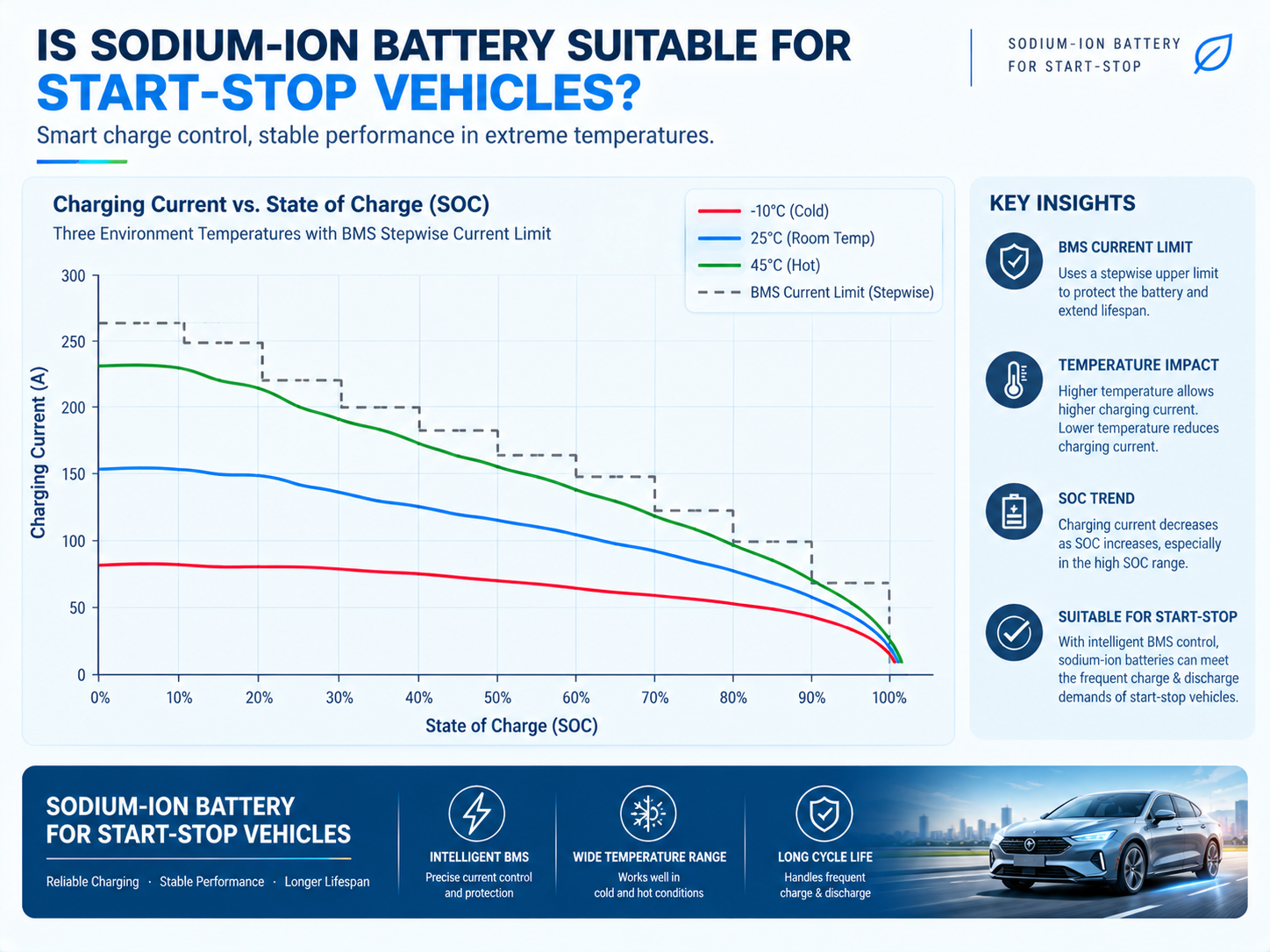
Charge acceptance against the charging strategy. A start-stop vehicle does not charge at a constant voltage. It raises voltage under deceleration to recover braking energy, drops it under acceleration to unload the alternator, and in some strategies holds the battery deliberately below full to leave recuperation headroom. The battery is asked to accept current anywhere in that window, at whatever state of charge the duty produced and whatever temperature the engine bay happens to be. The figure that predicts whether this works is not capacity. It is charge current accepted at stated voltage, state of charge and temperature. Two packs with identical capacity can differ by a large factor on that figure, and the difference decides whether the vehicle recovers its energy between stops or runs a deficit.
Cranking at the deployment temperature, through the vehicle's wiring. Cold cranking is a power event, not an energy event. What matters is terminal voltage during the crank staying above the level at which control modules drop out, at the coldest temperature the market actually delivers, with the vehicle's cable resistance and ground path in circuit. A cell-level result measured on a bench with short leads does not transfer to a pack in an engine bay. This is also where sodium-ion's discharge advantage has to be demonstrated rather than asserted.
The cycling duty, not a cycle count. Start-stop duty is shallow, frequent, partial-depth cycling with irregular charge pulses between events. A full-depth cycle life figure describes a different test, and a pack that performs well in one can underperform in the other, because degradation is driven by more than throughput: time spent hot, time spent near full, and the depth of each excursion all count. Ask for cycling data that resembles the duty, and for the end-of-test criterion that was applied.
The vehicle's electronics. An intelligent battery sensor measures current, voltage and temperature and runs a model that estimates state of charge and state of health. That model was written for the battery the factory fitted, so a different chemistry drifts its estimate until the sensor is reset and relearns, and in some vehicles the start-stop function stays inhibited until a defined drive cycle completes. Where the pack carries its own management system, that system may cut charge or discharge on a protection threshold the vehicle reads as an open circuit. The vehicle then reports a battery fault that is not a battery failure. Both are manageable. Neither is obvious at the counter.
_______________________________________________________________________
Three Verdicts, and What Puts a Programme in Each
A qualification exercise should end in one of three answers rather than a yes. Each verdict implies a different next action.
Fit. The chemistry does the work, a product exists in the right envelope, and the vehicle's charge strategy sits inside the pack's acceptance window without modification. Typical of fixed-voltage charging, auxiliary circuits with their own converter, and fleet duty where the operator writes the specification. Action: order, with incoming inspection on the charge-acceptance and cranking figures that were specified.
Fit with conditions. One gate is open but not settled. Cold-climate short-trip duty where the winter energy balance needs review; adaptive charging whose voltage behaviour has to be measured on the vehicle rather than assumed; vehicles whose battery sensor needs a defined reset and relearn. Action: a small vehicle trial in the target market, through the season that stresses the pack, before the volume order.
Not a fit. The manufacturer's calibration, warranty terms or type approval set the answer. Action: leave it. A programme that pushes into this category spends its margin on returns and its credibility with the channel.
Most real programmes belong in the second verdict on the first pass, and treating that as a failure is a mistake. A conditional verdict with a test behind it is a stronger position than an unconditional one without evidence: the importer can show the distributor what was checked and what remains open.
_______________________________________________________________________
The Condition That Decides Most Programmes
If one gate decides outcomes more often than the other three, it is charge acceptance, and specifically the interaction between two control systems that were never designed together.
The vehicle decides when to charge and at what voltage. In a start-stop car that schedule is written for fuel economy, and it is not negotiable from the battery side. The pack decides how much current it will accept at that voltage and in that state, and where its own protection will intervene.
The failure mode is quiet. A pack that accepts less current than the strategy assumes recovers slowly between stops, drifts down across a week of short trips, and eventually reaches a state of charge where either cranking margin or the inhibit threshold is crossed. Nothing has failed. The vehicle never put back what it took out.
Three questions separate a programme that works from one that does not. What is the vehicle's regulated voltage at operating temperature, and does it move with state of charge or driving phase? What is the lowest voltage the strategy will hold for long periods? What charge current will the pack accept at that voltage, at the temperatures the market delivers, at the states of charge the duty produces? Answer those and the verdict usually writes itself. Skip them and the first winter writes it instead.
_______________________________________________________________________
What to Verify Before Committing a Container
The sequence is ordered so the cheapest checks fail first.
1. Confirm the vehicle list and its charging behaviour. Model years, whether regulation is fixed, temperature-compensated or adaptive, and where recuperation raises the ceiling.
2. Ask for the pack-level charge-acceptance curve. Current against voltage, state of charge and temperature, with the management-system limits marked on the same chart.
3. Ask for the cranking figure with its test conditions attached. Temperature, duration, cut-off voltage, and whether it was measured at cell, module or pack terminals.
4. Ask for cycling data that resembles start-stop duty. Shallow depth, partial state of charge, and a stated end-of-test criterion.
5. Check the physical envelope against the actual tray. Group size, terminal layout and material, hold-down, case height, and any venting requirement.
6. Establish what the management system does at its boundaries. Low temperature, high temperature, over-voltage, over-discharge, and what the vehicle sees when it acts.
7. Get the registration and relearn procedure in writing. What the workshop has to do after fitting, in what order, and what the vehicle does if it is skipped.
8. Run a vehicle trial in the target market during the season that stresses the pack. Winter for a cold market, peak summer for a hot one, mixed duty rather than a motorway cruise.
9. Size the warranty reserve from the trial's return behaviour rather than from the datasheet's cycle count.
PITTAR supplies sodium-ion battery products to automotive battery importers, distributors, wholesalers, dealers, and OEM and ODM buyers, and the list above is the shape of the assessment that belongs before a first order rather than after a first claim.
_______________________________________________________________________
Reading a Supplier's Suitability Claim
Suitability claims are cheap to write and expensive to test, so the practical skill is recognising the ones that cannot be backed.
Suitable for all start-stop vehicles. No chemistry is. The claim skips the vehicle side of the question entirely.
Cell figures presented as pack figures. Energy density and cycle life quoted from a cell datasheet, with nothing said about what the pack delivers after the management system, the case, the thermal path and the interconnection resistance take their share.
A cranking figure with no temperature. Cold cranking without a stated temperature, duration and cut-off voltage is not a specification. It is a number.
No charge-current map. A pack sheet that states capacity and voltage but not the current it will accept at low temperature has left out the figure that decides winter performance.
Certification without scope. A standard number without the test report, the revision it was tested to, and whether it applies at cell or pack level is a logo rather than evidence.
No registration guidance. A supplier who has not considered what the workshop does after fitting has not supported a start-stop programme before.
None of these is dishonest on its own. Each is a missing piece that the buyer ends up supplying from their own margin, usually one returns cycle later.
_______________________________________________________________________
Frequently Asked Questions
Can I fit a sodium-ion battery to any start-stop car?
Physically, often. Electrically, not always. The binding constraint is whether the vehicle's charging strategy will keep the pack in a usable state of charge, and whether the battery sensor and start-stop logic accept it after a reset. Vehicles with fixed-voltage charging and a conventional replacement path are the straightforward cases. Vehicles with adaptive charging and an energy management calibration written around a specific original battery need the charge-acceptance question answered first.
Will a non-original battery affect my vehicle warranty?
The manufacturer sets those terms, and they vary by market. A battery that does not meet the vehicle's electrical specification gives a manufacturer a reason to question a related claim, and a battery failing because the charging strategy never filled it looks the same at the counter as a defective one. Read the terms for the specific market rather than assuming either answer.
Does anything need to be reset after fitting?
Usually. Many start-stop vehicles need the new battery registered so the energy management stops applying an ageing correction to a fresh pack, and the battery sensor may need a relearn period or a defined drive cycle before its state-of-charge estimate settles. Skip this and the vehicle behaves as though the old battery is still fitted, which gets reported as a faulty replacement.
Is sodium-ion better than AGM for start-stop duty?
There is no single answer, and the honest version depends on the duty. Sodium-ion's discharge behaviour at low temperature and its tolerance of partial-state-of charge operation are structural advantages in this duty. AGM has the advantage of a decade of vehicle-level validation and a service network that knows how to test it. Which matters more depends on the market, the vehicle and the channel's own support.
Why does the battery start the car in cold weather but charge slowly?
Because discharge and charge are limited by different things. Discharge power depends on how readily ions move and how little resistance the cell presents, which is where sodium-ion's electrolyte behaviour helps. Charging near freezing risks depositing sodium metal on the anode surface instead of storing it in the hard carbon, so the management system reduces or blocks charge current to protect the cell. The pack will still crank. It will not refill quickly until it warms, which is why short winter journeys are the hardest duty for any chemistry carrying that restriction.
 Hot News
2026-11-03
2026-10-30
2026-10-26
2026-10-22
2026-10-14
2026-10-07

Pittar Power is a professional manufacturer specializing inenergy storage solutions.
Room 302, Building 1, No. 10, Huangjin First Road, Nancheng District, Dongguan City, Guangdong Province, China
Copyright © Shenzhen Pittar Power Co., Ltd. All Rights Reserved Privacy Policy
 EN