The Core Reason: Start-Stop Changes What a Battery Has to Do
A traditional car battery is asked to do one thing well: deliver a short, high-current burst to crank the engine, then sit at near-full state of charge while the alternator refills it. The whole system is designed around that single event per trip. Start-stop vehicles turn that mental model on its head. Every time the car comes to a stop, the engine shuts off; every time the driver releases the brake or presses the clutch, the engine fires back up. Across an urban commute the battery may crank the engine dozens or even hundreds of times instead of once. It also has to keep every electrical system alive between those cranks and accept irregular charge pulses from the alternator and the regenerative braking system. The chemistry, plate design, charge acceptance and thermal tolerance of an ordinary starter battery were never built for that workload.
This is the single most important reason start-stop cars need a special battery. It is not a marketing claim. The duty cycle the system imposes on the battery is fundamentally different in three respects: how often it has to deliver cranking power, how often it is partially discharged between cranks, and how much electrical load it has to support while the engine is off. A regular flooded lead-acid battery can survive those conditions for a while, but it will sulfate, lose capacity and fail much earlier than it would in a non-start-stop vehicle.
The Hidden Workload a Standard Battery Was Not Designed For
From a battery's point of view, three workload changes happen the moment a manufacturer bolts a start-stop system into a vehicle. Each one on its own would shorten the life of a conventional battery; combined, they require a different battery design.
More frequent engine restarts
In dense urban traffic a start-stop vehicle may restart its engine several times per kilometre. Conventional batteries are rated for a single high-current event followed by a long recharge period. Repeated cranks in quick succession generate heat, accelerate plate corrosion and reduce the effective cranking capacity of the battery well before its calendar age suggests it should fail.
Sustained accessory load with the engine off
When the engine stops at a red light, the battery becomes the only power source for HVAC blower, infotainment, instrument cluster, lighting, sensors and any active safety systems. Depending on the vehicle, this engine-off draw can last anywhere from a few seconds to several minutes at a time, and adds up over a trip. A regular battery can support that draw briefly, but it was never designed to spend large portions of its day at partial state of charge while running accessories.
Irregular charging pulses from alternator and regenerative braking
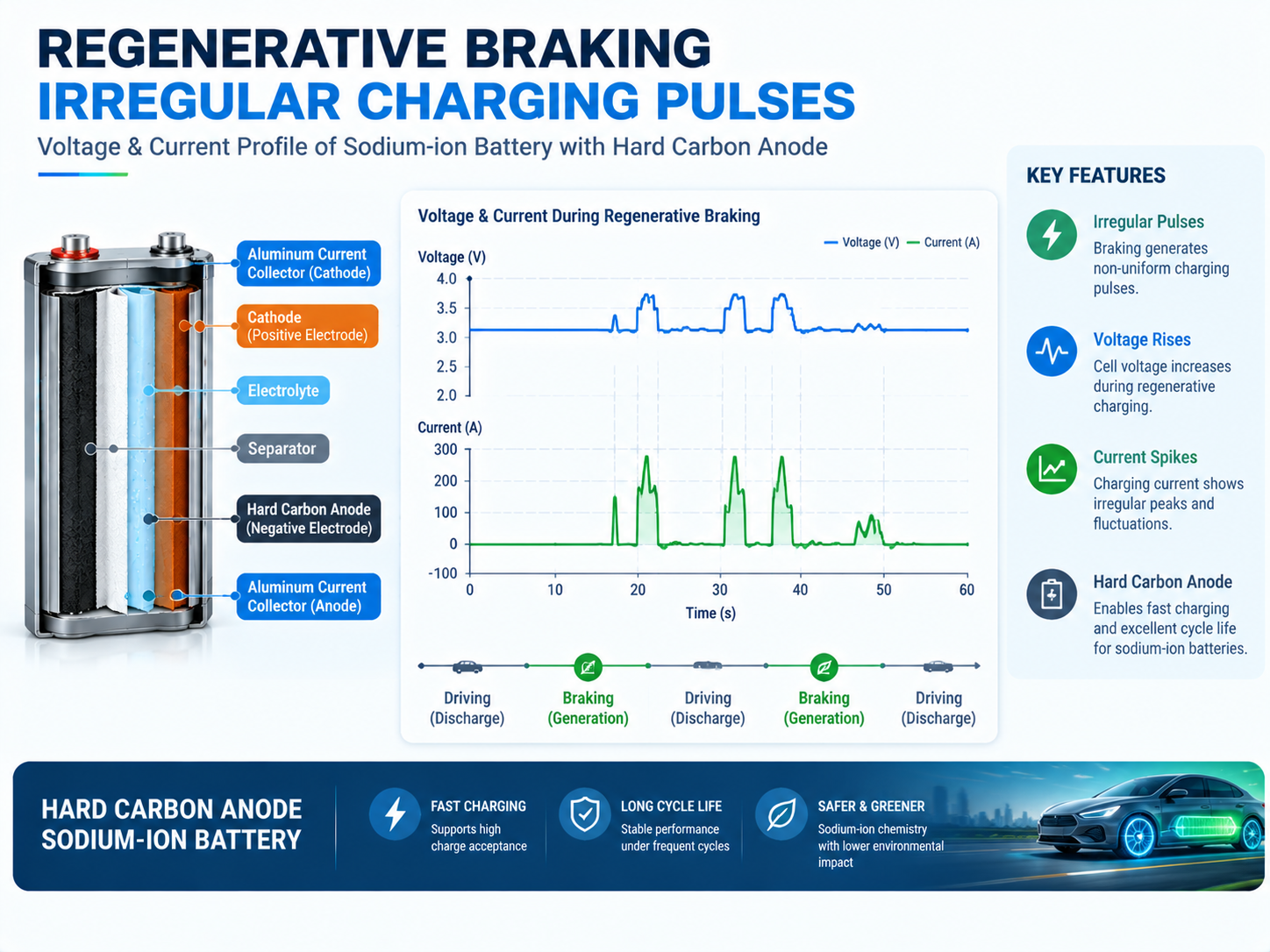
Start-stop vehicles often pair the start-stop function with regenerative braking. The alternator and the brake-energy recovery system push charge back into the battery in short, variable pulses rather than the long, steady top-up charge that conventional vehicles deliver at cruising speed. A flooded lead-acid battery absorbs those pulses inefficiently, builds up surface sulfate and loses usable capacity over time.
Why a Regular Flooded Lead-Acid Battery Falls Short
Flooded lead-acid remains the cheapest 12 V automotive battery chemistry on the market, which is why it is still the default reference point when buyers ask “why do start-stop cars need special batteries.” The honest answer is that the chemistry, not the brand, is the issue. Three structural characteristics of flooded lead-acid collide directly with start-stop duty:
• Limited cycle life at partial state of charge. Flooded lead-acid is designed to live near 100% state of charge. Repeated shallow discharge cycles without a full recharge cause progressive sulfation that is only partly reversible.
• Slower charge acceptance. The high internal resistance of flooded plates means the battery cannot absorb the short, high-voltage pulses from regenerative braking efficiently.
• Acid stratification and water loss in engine-bay heat. Repeated shallow cycling disturbs the electrolyte, and the higher average state of charge used in start-stop vehicles accelerates water loss in non-sealed cells.
The result is not a dramatic failure on day one. It is a slow shortening of service life, often combined with state-of-charge drift and eventually a no-start event. For a vehicle that may crank its engine thousands of times a year instead of a few hundred, the math no longer works for flooded lead-acid.
What “Special” Actually Means in Start-Stop Battery Design
Buyers and procurement teams often hear the word “special” without a clear definition. In practice, a start-stop battery has to deliver four engineering properties that a conventional starter battery only delivers in a limited way:
Higher cycle life at partial state of charge
Start-stop batteries are designed and tested for many more shallow cycles at partial state of charge than starter batteries. In engineering terms this shows up as cycle-life ratings measured at well below 100% depth of discharge, often specified against a reference duty profile such as the EN 50342-1 micro-hybrid sequence.
Stronger dynamic charge acceptance
Charge acceptance describes how much current a battery can absorb during a given charging window. Start-stop batteries need higher charge acceptance than conventional starter batteries so the short pulses from regenerative braking and the alternator are actually captured, instead of being turned into heat and gassing.
Robust operation across a wide state-of-charge window
Where a flooded battery is happiest above roughly 80% state of charge, a start-stop battery has to remain healthy while spending much of its life between roughly 60% and 90% state of charge. That requires tighter cell-to-cell consistency, more stable active materials and, in most chemistries, a battery management system that monitors voltage, current and temperature.
Improved thermal and vibration tolerance
Frequent restarts and engine-off accessory load generate additional heat inside the cells. The battery housing, plate anchoring and venting have to handle that extra thermal cycling, as well as the vibration of an engine that is restarting many times per trip.
The Three Battery Families Built for Start-Stop Duty
When buyers look at the aftermarket today, three battery families are marketed specifically for start-stop service. Each one addresses the duty cycle in a different way, which is why the answer to “why do start-stop cars need special batteries” is the same, while the right battery for a given vehicle depends on the system it has to support.
Enhanced Flooded Battery (EFB)
EFB is an evolution of flooded lead-acid. It uses a reinforced plate structure, a carbon additive in the negative active material and a polyester scrim that holds the active mass in place. The result is roughly twice the cycle life of a standard flooded battery at partial state of charge, with moderately improved charge acceptance. EFB is typically specified for entry-level start-stop vehicles without regenerative braking or with mild energy recovery.
Absorbent Glass Mat (AGM)
AGM is the incumbent premium choice for start-stop. The electrolyte is held in a glass-fibre mat, which gives the battery higher compression, lower internal resistance, faster recharge and significantly better cycle life at partial state of charge than flooded designs. AGM is the standard answer for vehicles with active regenerative braking, heavy accessory load and the higher electrical demands of modern driver-assistance systems.
Sodium-ion automotive batteries
Sodium-ion is a newer entrant that has begun to appear in the 12 V automotive auxiliary and start-stop space. The chemistry is structurally different from lead-acid: sodium ions shuttle between the cathode and a hard-carbon anode through a sodium-based electrolyte, with aluminum current collectors on both sides. Sodium-ion batteries designed for automotive auxiliary duty typically carry an embedded battery management system and are offered in 12 V modules that fit existing battery trays.
Sodium-ion is not a drop-in replacement for every start-stop vehicle in the field today, and a buyer should always verify that the battery matches the vehicle's electrical architecture and the original equipment specification. Where it is offered as a direct-fit start-stop battery, however, it is one of the credible answers to the question “why do start-stop cars need special batteries” for fleets and buyers looking beyond lead-acid.
Where Sodium-Ion Chemistry Fits Into the Picture
Sodium-ion is sometimes described as “just another start-stop battery.” The honest description is that it is a chemistry with a different set of structural advantages and constraints compared with AGM and EFB. Three properties matter most for buyers asking whether it addresses the start-stop duty cycle:
• Stable discharge behaviour in cold weather. Sodium-ion chemistry tolerates sub-zero temperatures for discharge without the steep capacity loss that some other chemistries show, which matters for cold-start cranking.
• Tolerance of irregular charge pulses. The cell chemistry absorbs the irregular, regenerative-braking-style charge profile that a start stop system delivers, which is one of the engineering gaps that flooded lead-acid cannot bridge.
• Resource and supply-chain profile. Sodium is widely available, the cell can use aluminum current collectors on both electrodes, and the supply chain is geographically more diversified than that of some other chemistries. For multi-year sourcing programmes, that profile is part of the “why a special battery” calculation.
Those structural properties do not turn a sodium-ion battery into the universal answer. Energy density at the cell level is lower than some lithium chemistries, and automotive sodium-ion manufacturing is at an earlier commercial maturity than AGM. For buyers and workshops, the practical question is not “sodium-ion or not” but “does the battery match the vehicle specification, the climate and the duty cycle?” That is the same question the auto industry has asked of every start-stop battery since the system first appeared.
What This Means for Buyers and Workshops
For procurement teams, distributors and workshops, the practical consequence of the answer to “why do start-stop cars need special batteries” is a short diligence list that has to be applied every time a replacement battery is specified:
• Match the chemistry to the original equipment spec. A vehicle designed for AGM should not silently be downgraded to EFB or flooded, and a battery qualified for a particular start-stop architecture should not be swapped for an arbitrary alternative without verifying compatibility.
• Check cycle life and charge acceptance data, not just CCA. Cold-cranking amps matter, but they are not the limiting factor in start-stop service. Ask the supplier for cycle data at partial state of charge and dynamic charge acceptance values.
• Confirm the battery management system. Modern start-stop batteries, including most sodium-ion designs, carry an embedded BMS that communicates with the vehicle. Compatibility with the vehicle's electrical architecture and charging profile should be confirmed before sourcing.
• Plan for warranty and second-source. Because start-stop batteries operate in a more demanding envelope, warranty terms and second-source arrangements matter more than for ordinary starter batteries.
Start-stop systems are now standard across most new petrol and diesel vehicles sold globally. The battery underneath that system is no longer an afterthought. It is the component that decides whether the start-stop function actually saves fuel for the full life of the vehicle, or whether it ends up disabled by the onboard system to protect a battery that is no longer up to the job. That is the underlying answer to the question buyers, workshops and fleet managers are really asking.
Frequently Asked Questions
Q. Can I put a regular car battery in a start-stop vehicle?
In an emergency you can crank the engine once with a regular flooded battery, but it is not a sustainable replacement. The battery will sulfate faster than in a conventional vehicle because of the partial state of charge and the irregular charging pulses, and most vehicles will disable the start-stop function to protect an under-specified battery.
Q. How do I know what kind of battery my start-stop car needs?
The original equipment specification from the vehicle manufacturer is the starting point. It will list the battery family (EFB, AGM or another qualified technology), the capacity, the CCA rating, the dimensions, the terminal layout and, in many modern vehicles, the BMS registration procedure. A reputable supplier or workshop will cross-check the spec before quoting.
Q. Are EFB and AGM batteries interchangeable?
In some vehicles yes, in others no. Some manufacturers explicitly approve AGM as an upgrade from EFB, others require AGM for vehicles with regenerative braking or heavy accessory load. Downgrading an AGM-specified vehicle to EFB can shorten battery life and may trigger warning messages from the vehicle's energy management system.
Q. Do start-stop batteries last as long as regular car batteries?
They are designed to last through many more shallow cycles than a regular starter battery, so in service they should meet or exceed the calendar life of a conventional battery in the same vehicle. The actual lifespan still depends on climate, driving pattern, charging system health and how often the vehicle spends long periods at very low state of charge.
Q. Why does the start-stop function sometimes stop working?
Most vehicles will automatically disable start-stop when the battery state of charge is too low, when the battery temperature is outside its operating window, when the engine or cabin is warming up, or when a heavy accessory load is active. If the function rarely engages, the battery is often the first component to inspect, before looking at sensors or control modules.
 Hot News
2026-10-30
2026-10-26
2026-10-22
2026-10-14
2026-10-07
2026-10-02

Pittar Power is a professional manufacturer specializing inenergy storage solutions.
Room 302, Building 1, No. 10, Huangjin First Road, Nancheng District, Dongguan City, Guangdong Province, China
Copyright © Shenzhen Pittar Power Co., Ltd. All Rights Reserved Privacy Policy
 EN