What Is a Sodium-Ion Battery? Complete Guide
A sodium-ion battery is a rechargeable battery that stores and releases energy through the movement of sodium ions between a positive electrode (cathode) and a negative electrode (anode). It belongs to the wider family of "alkali-ion" batteries and works on a similar principle to the lithium-ion batteries that dominate consumer electronics, electric vehicles, and stationary storage today, but it uses sodium instead of lithium as the charge carrier.
Sodium is one of the most abundant elements on earth. It is found in sea salt and in mineral deposits across many regions, and it does not require the same constrained supply chains as lithium, cobalt, or nickel. That single material reality is the main reason the technology is being discussed again across automotive programs, micro-EV platforms, two-wheeler fleets, low-speed electric vehicles, and certain stationary storage segments.
For B2B buyers — automotive battery importers, distributors, wholesalers, dealer networks, OEM and ODM procurement teams, and engineering companies evaluating next-generation platforms —understanding what a sodium-ion battery actually is, how it works, and where it realistically fits is becoming part of normal supplier qualification. This guide builds that foundation and connects naturally to the broader lithium battery topic cluster that already exists around lithium-ion and LiFePO4 chemistries.
_______________________________________________________________________
What Is a Sodium-Ion Battery?
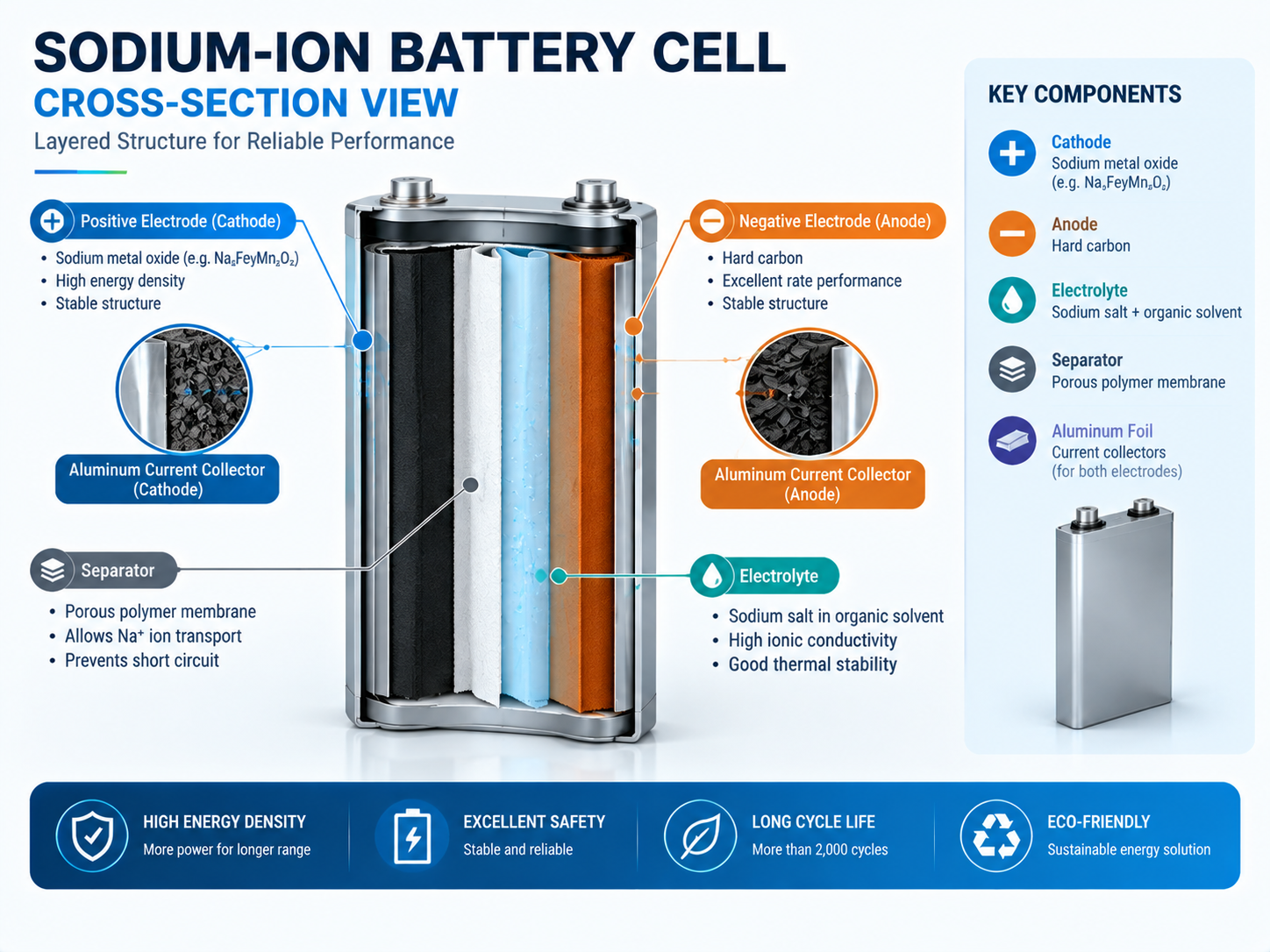
A sodium-ion battery is a rechargeable electrochemical device in which sodium ions shuttle back and forth between the cathode and the anode during charge and discharge. The cathode is typically a sodium-containing transition metal oxide or polyanion compound, the anode is often a hard carbon material, and the electrolyte is a sodium-ion conducting salt dissolved in a suitable solvent.
The term "sodium-ion battery" covers several different cathode and anode chemistries. Layered oxides, Prussian blue analogs, and polyanion-type cathodes are all being developed by different manufacturers. This matters for buyers because cell-level performance, cycle behavior,
low-temperature response, and cost trajectory vary depending on which chemistry and which cell format a supplier is using. A "sodium-ion battery" is not a single product — it is a category of chemistries built on a shared working principle.
The most common commercial interest today is in 12V automotive start-stop batteries, micro-EV powertrains, two- and three-wheeler batteries, low-speed electric vehicles, telecom backup modules, and some stationary storage and industrial applications. The exact fit depends on cell design, BMS quality, pack engineering, and certification readiness — not just on the underlying chemistry.
_______________________________________________________________________
How a Sodium-Ion Battery Works
The working principle is essentially the same shape as a lithium-ion battery, with sodium ions taking the place of lithium ions.
1. During discharge, sodium ions leave the anode and travel through the electrolyte toward the cathode. Electrons flow through the external circuit and power the connected load — in a car, this typically means the starter motor, the ECU, lighting, infotainment, and other 12V electrical consumers.
2. During charging, an external power source — the vehicle alternator in an automotive application — pushes sodium ions back from the cathode to the anode, restoring the cell to a charged state.
3. The movement of ions is enabled by the electrolyte, while a separator physically keeps the two electrodes apart to prevent internal short circuits.
4. The cell is managed by a battery management system (BMS) that monitors voltage, current, temperature, state of charge, and protection limits.
For a deeper look at the charge and discharge mechanism and the supporting components that enable it, see How Does a Sodium-Ion Battery Work?.
_______________________________________________________________________
Main Components of a Sodium-Ion Battery
A sodium-ion cell is the smallest functional unit, but a commercial sodium-ion battery is a pack made of multiple cells plus the electronics and mechanical structure that make those cells safe and usable in real vehicles.
The cathode side typically contains sodium plus a transition metal oxide, a polyanion compound, or a Prussian blue analog. Common cathode families include layered oxides (similar in structure to NMC-type lithium cathodes), sodium vanadium phosphate and other polyanion materials, and Prussian blue / Prussian white analogs. The anode is most commonly a hard carbon material, which offers reasonable capacity and stable cycling behavior without depending on graphite mining supply chains in the same way some lithium chemistries do.
The electrolyte is usually a sodium salt — such as NaPF6 or NaClO4 — dissolved in carbonate-based solvents, tuned for sodium-ion transport and stability. The separator keeps the electrodes physically isolated while allowing ions to pass, following the same engineering logic used in lithium-ion separators. A notable structural difference is on the current collector: sodium-ion cells can use aluminum on both the cathode and anode sides, because aluminum does not alloy with sodium at typical operating voltages. This removes the need for copper current collectors on the anode side, which is one of the contributing factors behind the projected cost advantage of sodium-ion over lithium-ion in some applications.
The BMS performs the same core functions as in a lithium-ion pack: voltage monitoring, current monitoring, temperature monitoring, cell balancing, state-of-charge estimation, and protection against overcharge, over-discharge, overcurrent, short circuit, and out-of-range temperatures. In automotive start-stop applications, the BMS also has to coordinate with the vehicle's charging system, react to alternator voltage, and handle the very high cranking current pulses demanded by the starter motor. Pack-level mechanical design — terminal layout, hold-down dimensions, venting, thermal behavior under the engine bay — is as important as cell chemistry for drop-in replacement of conventional automotive batteries.
_______________________________________________________________________
Sodium-Ion vs Lithium-Ion: Core Differences for Buyers
For buyers who already evaluate lithium-ion and LiFePO4 products, the most useful way to understand sodium-ion is by direct comparison.
Dimension |
Sodium-Ion Battery |
Lithium-Ion / LiFePO4 Battery |
Active ion |
Sodium (Na+) |
Lithium (Li+) |
Anode (typical) |
Hard carbon |
Graphite, sometimes silicon-enhanced |
Anode current collector |
Aluminum |
Copper |
Energy density (cell level) |
Generally lower than NMC Li-ion; close to or somewhat below LiFePO4 depending on chemistry |
Higher for NMC; LiFePO4 lower than NMC but commercially mature |
Cycle life potential |
Promising in lab and early commercial data; long-term field data still limited |
LiFePO4 well-documented; NMC also well-documented |
Low-temperature behavior |
Often highlighted as a strength; actual performance depends on cell design |
LiFePO4 performance drops at very low temperature without heating |
Raw material exposure |
Sodium is abundant; some chemistries avoid lithium, cobalt, nickel |
Lithium, cobalt, and nickel supply chains are more concentrated |
Commercial maturity |
Emerging; growing automotive pilot projects and limited mass-market models |
Mature across consumer electronics, EVs, and stationary storage |
Cost outlook |
Potentially lower cell cost in some chemistries, depending on scale and raw materials |
Mature cost curves; LiFePO4 already very competitive |
Energy density values reported by sodium-ion developers vary widely depending on cathode chemistry, cell format, and whether the number is at cell level or pack level. Specific Wh/kg figures should always be cross-checked against the supplier's test conditions and the chemistry in question — cell-level numbers do not translate directly to pack-level performance. For broader context on lithium battery technology, including LiFePO4 and NMC, see What Is a Lithium Battery?.
_______________________________________________________________________
Why Sodium-Ion Is Entering the Automotive Start-Stop Conversation
The automotive start-stop segment is where sodium-ion is attracting serious attention, because the use case matches several of the chemistry's natural strengths. Start-stop vehicles turn the engine off at traffic lights and restart it as soon as the driver releases the brake. A conventional starter battery is sized for a single cold start and is rarely deeply discharged, but a start-stop battery is asked to deliver thousands of engine restarts, accept charge from a variable-output alternator, and keep the 12V electrical system alive while the engine is off.
That duty cycle favors a battery chemistry that can handle high cycle counts, accept irregular charging patterns, and operate reliably across a wide temperature range — especially in cold winters. Sodium-ion is being positioned for this kind of mid-power, high-cycle, temperature-resilient application rather than for long-range electric vehicle traction packs, where energy density remains the priority. For a focused look at how sodium-ion fits the start-stop use case, see What Is a Sodium-Ion Automotive Start-Stop Battery?.
_______________________________________________________________________
What B2B Buyers Should Look for in a Sodium-Ion Battery
Sodium-ion is a real technology, but it is also a category with significant variation between suppliers. A serious B2B evaluation should cover the following points.
Cell chemistry disclosure. Ask the supplier which cathode family and which anode material the cell uses. Layered oxides, Prussian blue analogs, and polyanion materials do not behave the same way. Vague "sodium-ion battery" claims without chemistry disclosure are a yellow signal.
Cycle life evidence. Request cycle life data at realistic depth of discharge and at relevant temperatures. Lab cells and field packs can differ significantly. For start-stop use specifically, ask for cycle data under high-rate partial state-of-charge cycling, which is closer to real vehicle conditions than simple full-cycle lab tests.
Low-temperature data. Sodium-ion is often promoted on cold-weather performance, but actual cold-cranking performance depends on cell design, electrolyte formulation, internal resistance, and BMS behavior. Ask for cold-cranking amp (CCA) data, internal resistance at low temperature, and capacity retention at sub-zero conditions.
Pack-level engineering. Cell chemistry alone does not make a reliable automotive battery. Inspect terminal layout, dimensions, hold-down compatibility, venting, vibration resistance, and BMS protections. The pack must be designed for the engine bay environment, not just for the lab.
Certification and documentation. Confirm which standards the product has been tested against, what documentation is available, and what warranty terms the supplier is willing to commit to in writing.
Supplier track record. Sodium-ion is a newer category. Buyers should weigh the supplier's experience with battery manufacturing, quality systems, and customer references — not only their sodium-ion marketing claims.
_______________________________________________________________________
Frequently Asked Questions
Is a sodium-ion battery the same as a salt battery? Not exactly. The term "salt battery" is sometimes used informally to refer to sodium-ion batteries because sodium is the main element in table salt, but the actual chemistry in a sodium-ion battery is a carefully engineered system of cathode, anode, electrolyte, and separator — not salt in any simple sense.
Is a sodium-ion battery cheaper than a lithium-ion battery? In some chemistries and at sufficient scale, sodium-ion has a meaningful cost advantage because sodium is abundant and because aluminum can replace copper as the anode current collector. Actual battery pricing, however, depends on cell design, manufacturing scale, BMS cost, and pack integration.The cost picture is still evolving, and "cheaper" is not automatically true across every application.
Are sodium-ion batteries safe for cars? Sodium-ion cells do not face the same cobalt-driven thermal runaway risks as some high-energy lithium chemistries, and many sodium chemistries are considered thermally stable. Real-world automotive safety, however, depends on cell design, BMS quality, pack engineering, and certification. "Safe" should be evaluated product by product, not assumed from the chemistry name alone.
How does sodium-ion compare with LiFePO4 for start-stop vehicles? LiFePO4 remains a more mature commercial technology with a much larger field-data set. Sodium-ion is being introduced in start-stop pilots and select automotive programs, with chemistry advantages around raw material exposure and low-temperature behavior. The right choice depends on the specific vehicle, climate, duty cycle, and supply chain priorities of the buyer.
 Hot News
2026-10-30
2026-10-26
2026-10-22
2026-10-14
2026-10-07
2026-10-02

Pittar Power is a professional manufacturer specializing inenergy storage solutions.
Room 302, Building 1, No. 10, Huangjin First Road, Nancheng District, Dongguan City, Guangdong Province, China
Copyright © Shenzhen Pittar Power Co., Ltd. All Rights Reserved Privacy Policy
 EN