How Does a Sodium-Ion Battery Work?
A sodium-ion cell stores and releases energy through the controlled movement of sodium ions between two electrodes. The mechanism looks similar to a lithium-ion cell on a whiteboard, but the materials, the ion size, and a few practical consequences are different. For anyone evaluating sodium-ion batteries for automotive start-stop applications, understanding how the cell actually works inside the battery is the starting point for every specification, comparison, and procurement decision that follows.
_______________________________________________________________________
The Basic Structure Inside a Sodium-Ion Cell
A sodium-ion cell is built from the same essential parts as most other rechargeable chemistries: a positive electrode (cathode), a negative electrode (anode), a separator that keeps them physically apart, an electrolyte that carries ions between the two, and current collectors that connect each electrode to the external terminals.
The materials used in those components are what distinguish a sodium-ion cell from a lithium-ion cell. Sodium-ion cells typically use:
• A sodium-containing cathode, such as layered transition-metal oxides (for example, NaNi1/3Mn1/3Fe1/3O2 and similar compositions), Prussian blue analogues, or polyanion-type compounds. The exact chemistry varies by manufacturer and intended application.
• A hard carbon anode, which is the most widely used anode material for sodium-ion chemistry. Sodium ions are taken up into the disordered carbon structure during charging.
• A liquid electrolyte containing a sodium salt — most commonly NaPF6 or NaClO4 — dissolved in carbonate-based solvents. Some designs use gel or solid-state electrolytes, but these are less common in commercial automotive batteries today.
• Aluminum current collectors on both sides. This is a meaningful difference from lithium-ion cells, where copper must be used on the anode side because aluminum reacts with lithium at low voltages. Sodium does not alloy with aluminum at typical cell potentials, so both sides can use aluminum foil, which simplifies cell manufacturing and reduces material cost.
A porous separator — typically a polymer membrane — physically separates the cathode and anode while still allowing sodium ions to pass through. The separator is soaked in electrolyte and acts as the bridge between the two electrodes. The cell is then sealed inside a rigid housing (cylindrical, prismatic, or pouch format) with terminals that connect to the outside of the battery pack.
_______________________________________________________________________
What Happens During Discharge
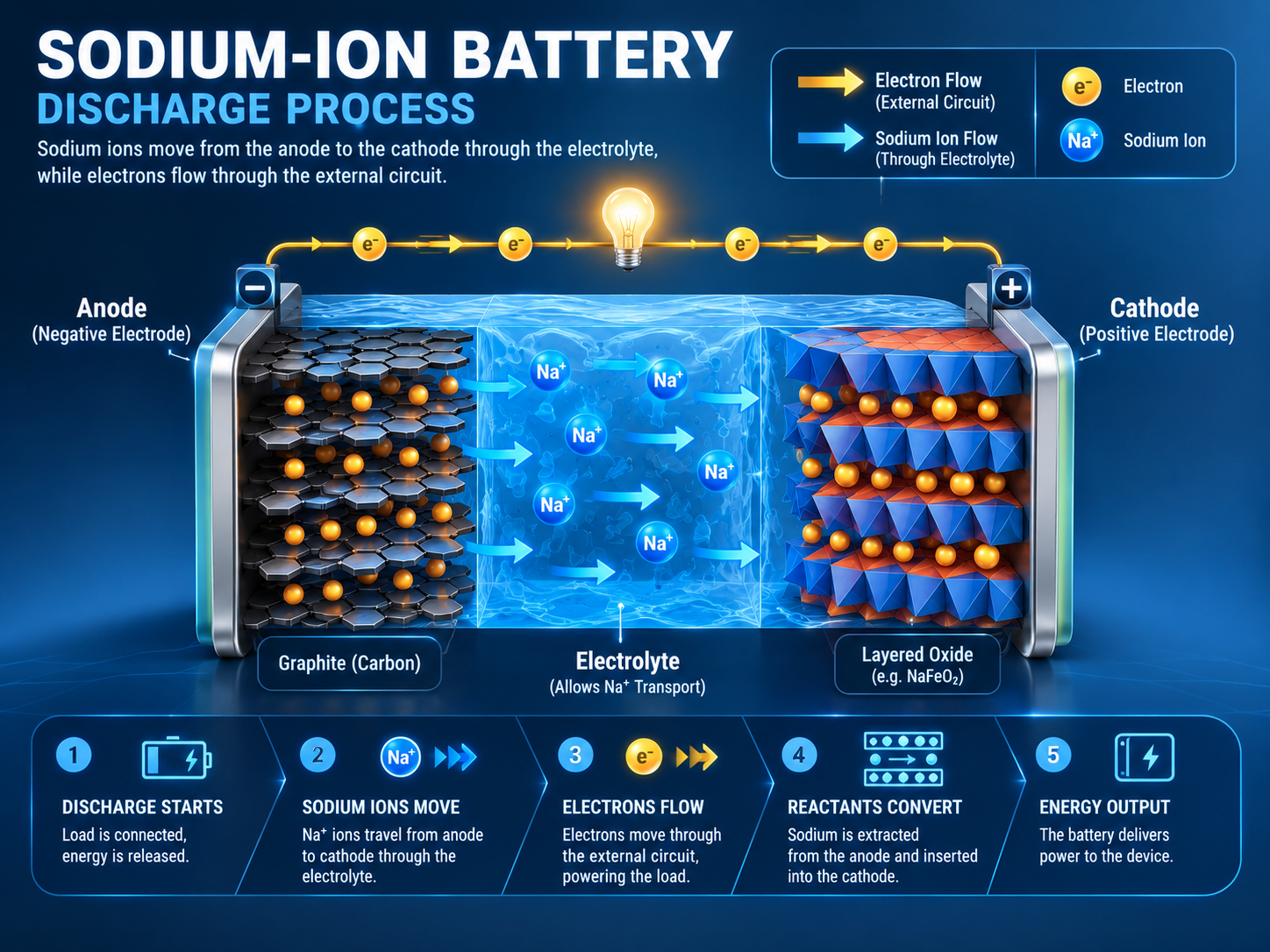
When the battery delivers power — for example, when a starter motor cranks an engine — sodium ions move from the anode to the cathode through the electrolyte. At the same time, electrons are released at the anode, travel through the external circuit, and re-enter at the cathode.
Sodium Ion Movement and Electron Flow
On the anode side, sodium leaves the hard carbon structure and enters the electrolyte as Na ions.
On the cathode side, those Na ions are inserted into the cathode material while electrons arriving through the external circuit reduce the cathode host. The two streams— ions through the electrolyte and electrons through the wire — must match in rate, which is why the external current the battery can deliver is fundamentally limited by how fast ions can move inside the cell.
In an automotive battery, this electron flow is what powers the starter motor, ignition, lights, infotainment, and all of the vehicle's onboard electronics. In a Start-Stop vehicle, the same discharge process is repeated many times per journey: every time the engine stops at a traffic light, the battery continues to supply electrical systems, and every time the engine restarts, the battery delivers a high current pulse for the starter. The cell has to survive this high-rate, frequent-cycling pattern, not just a single deep discharge.
_______________________________________________________________________
What Happens During Charging
Charging reverses the discharge reaction. Once an external voltage is applied across the cell — by the alternator in a running vehicle, or by an external charger in a workshop — sodium ions leave the cathode, travel back through the electrolyte, and re-insert into the hard carbon anode. Simultaneously, electrons are pulled out of the cathode, travel through the external circuit, and re-enter the cell at the anode. Energy is stored as sodium ions are pushed back into the anode structure, ready to be released again on the next discharge.
In a Start-Stop vehicle, the alternator does most of the recharging whenever the engine is running. The battery rarely reaches a full 100% state of charge in this kind of service — it normally operates in a partial state of charge between roughly 60% and 90%, with frequent short bursts of discharge and recharge. A battery chemistry that handles this pattern well, and that accepts charge efficiently at partial states of charge, is therefore more important in a Start-Stop application than one that simply offers the highest possible full-charge capacity.
_______________________________________________________________________
How Temperature Affects the Reaction
Temperature changes two things inside the cell:
• Ion mobility. At lower temperatures, the electrolyte becomes more viscous and ion movement slows down. This reduces the cell's ability to deliver or accept high current, which is one of the main reasons batteries lose cranking power in winter.
• Reaction kinetics. At higher temperatures, the electrode reactions proceed faster, but excessive heat can accelerate side reactions such as electrolyte decomposition, transition-metal dissolution from the cathode, and growth of the solid electrolyte interphase (SEI) layer on the anode. Over time, these side reactions reduce capacity and shorten cycle life.
Sodium-ion chemistry is often discussed as having better low-temperature ion transport than some lithium chemistries, because sodium's smaller desolvation energy and weaker solvation shell make it easier for the ion to shed its solvent molecules at the electrode interface. In practice, however, the cold-cranking performance of a real automotive product depends on cell design, electrolyte formulation, BMS limits, and pack engineering, not on chemistry alone. A test certificate or manufacturer datasheet is more reliable than any general claim.
_______________________________________________________________________
Why the BMS Is Part of How the Battery Works
A sodium-ion automotive battery is more than just cells. The battery management system (BMS) is what controls how the cells are used and protected during normal operation. In a Start-Stop battery, the BMS typically handles:
• Cell balancing during charging, so that individual cells in the pack stay at similar states of charge.
• Voltage, current, and temperature monitoring for every cell or group of cells.
• Protection against overcharge, over-discharge, short circuits, and excessive current.
• State-of-charge (SOC) and state-of-health (SOH) estimation, which the vehicle may use to decide when to disable Start-Stop, dim accessories, or alert the driver.
• Communication with the vehicle electrical system using protocols like LIN or CAN, depending on the application.
The chemistry may be different from lithium, but the role of the BMS is essentially the same. For B2B buyers, this means evaluating a sodium-ion battery for vehicles should not stop at cell chemistry. The BMS firmware, hardware quality, sensor accuracy, and compliance with the vehicle's electrical protocol all directly affect real-world performance, warranty cost, and customer satisfaction.
_______________________________________________________________________
How This Differs from a Lithium-Ion Cell
The working principle of a sodium-ion cell is similar to a lithium-ion cell: ions shuttle between two electrodes, electrons flow through the external circuit, and the reactions are reversible during cycling. The differences are mostly in materials and their practical consequences.
Key differences include:
• Ion size. Sodium ions are larger than lithium ions. This affects how easily they enter and leave the electrode structure and is one of the reasons sodium-ion cells typically have lower energy density than mainstream lithium-ion chemistries.
• Current collectors. Sodium-ion cells can use aluminum on both sides, while lithium-ion cells require copper on the anode. Aluminum is cheaper and lighter than copper, which simplifies cell design.
• Resource availability. Sodium is far more abundant and more geographically distributed than lithium. This affects long-term cost trajectories and supply security, especially for high-volume applications.
• Energy density. Current commercial sodium-ion cells generally have lower gravimetric and volumetric energy density than mainstream lithium-ion chemistries, although the gap varies by chemistry and generation.
For procurement teams, the practical question is not "which chemistry is theoretically better", but "which chemistry meets the requirements of the specific vehicle, climate, and duty cycle at the right cost". The fact that sodium and lithium work in similar ways makes them partly comparable, but it does not make them interchangeable. For a closer look at how a lithium-ion cell operates, see how a lithium battery works in the lithium battery cluster.
_______________________________________________________________________
What This Means for Automotive Start-Stop Use
For a sodium-ion battery to perform well in a Start-Stop vehicle, several things have to be true at the same time:
• Charge acceptance. The cell chemistry must support high charge acceptance, so the alternator can refill the battery quickly between restarts and after deep accessory loads.
• Cold-cranking amps (CCA). The CCA rating must be sufficient for the engine size and the climate the vehicle will see. A sodium-ion cell that delivers strong cranking at 25 °C may not deliver the same cranking at −20 °C.
• Cycle life under partial state of charge. The battery must match the high number of engine restarts expected in city driving — a Start-Stop battery in urban traffic may see many hundreds of engine restarts per week.
• BMS integration. The BMS must communicate properly with the vehicle and protect the pack over thousands of partial cycles. Without correct BMS integration, even a strong cell can be damaged by inappropriate charging or excessive depth-of-discharge.
A sodium-ion battery does not automatically fit every Start-Stop vehicle just because the chemistry exists. Vehicle specification, climate, charging profile, and the manufacturer's own validation work all matter. Procurement teams should always verify the product datasheet and ask the supplier for evidence of compatibility with the specific vehicle systems the battery is intended for, rather than relying on general statements about the chemistry. For a broader view of how lithium batteries are used in vehicles and other applications, see the lithium battery pillar guide.
_______________________________________________________________________
FAQ
Is a sodium-ion battery the same as a lithium-ion battery?
No. The general working principle — reversible ion movement between two electrodes — is the same. The materials are different. Sodium-ion cells use sodium-based cathodes, hard carbon anodes, and sodium-salt electrolytes, while lithium-ion cells use lithium-based cathodes and graphite anodes.
Do sodium-ion batteries need a BMS?
Yes. Automotive sodium-ion batteries require a battery management system to monitor cell voltage, balance cells, control charge and discharge, and protect the pack against unsafe conditions.
Can a sodium-ion battery be charged with a normal lead-acid charger?
Not as a general rule. Sodium-ion cells have different voltage windows and charge profiles than lead-acid batteries. Using an incompatible charger can damage the pack. Always follow the battery manufacturer's charging instructions and use a charger that is approved for the specific sodium-ion product.
Why do sodium-ion batteries often perform better than some lithium chemistries in cold weather?
Sodium's smaller desolvation energy makes it easier for the ion to shed its solvent molecules at the electrode interface at low temperatures, which can improve low-temperature ion transport. However, the actual cold-start performance of any specific product depends on cell design, electrolyte formulation, BMS limits, and pack engineering.
 Hot News
2026-10-30
2026-10-26
2026-10-22
2026-10-14
2026-10-07
2026-10-02

Pittar Power is a professional manufacturer specializing inenergy storage solutions.
Room 302, Building 1, No. 10, Huangjin First Road, Nancheng District, Dongguan City, Guangdong Province, China
Copyright © Shenzhen Pittar Power Co., Ltd. All Rights Reserved Privacy Policy
 EN