How Does an Automotive Start-Stop Battery Work?
A start-stop system adds a small but punishing layer on top of the older cranking-battery duty cycle. The 12-volt (or 24-volt) auxiliary battery under the hood is asked to shut the engine off at every traffic light, crank it back on when the brake is released, power cabin electronics during every engine-off window, and absorb irregular high-current pulses from the alternator and the regenerative braking system the rest of the time. None of these jobs existed in the older one-crank-per-trip duty cycle.
To understand how a start-stop battery works, it is more useful to look at the system around it than at the chemistry inside it. The chemistry matters — a flooded lead-acid battery cannot survive this duty cycle, an EFB or AGM battery is the incumbent answer, and sodium-ion is now being evaluated as a third option — but the chemistry only matters in relation to what the system is asking the battery to do.
This article walks through the actual duty cycle: what happens from the moment a vehicle stops at a light to the moment it accelerates away, where the battery is being drained, where it is being recharged, what the BMS is doing, and what each part of the cycle asks of the cells.
_______________________________________________________________________
What Happens During a Start-Stop Cycle?
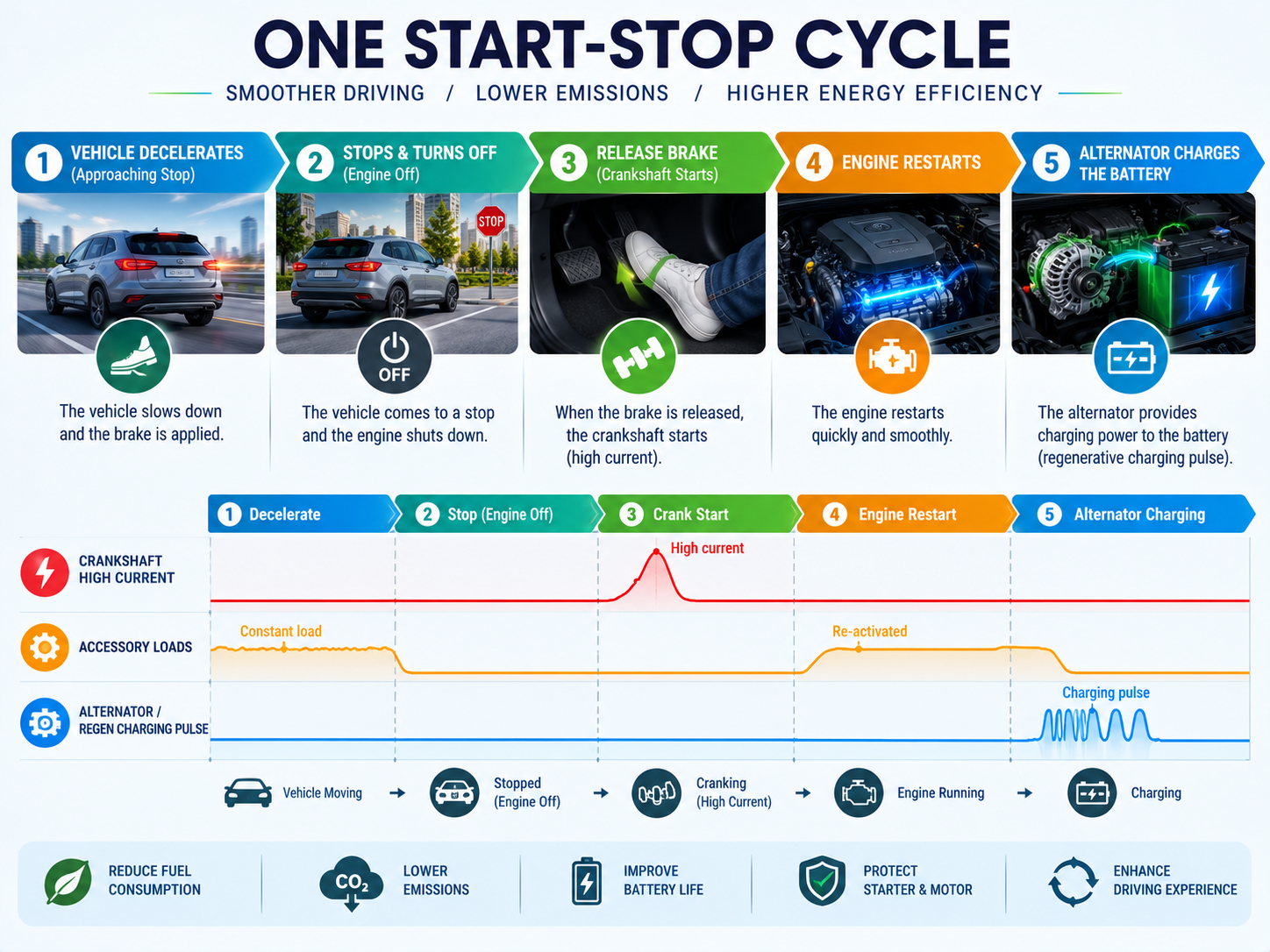
A complete start-stop cycle is short — usually under — but it exercises nearly every battery specification at once.
• Vehicle approaches a stop. The vehicle is decelerating. The alternator is often switched into regenerative mode, pushing charge current back into the battery. Voltage at the battery terminals typically rises during this phase.
• Engine shuts off at idle. When the vehicle comes to a complete stop and the brake pedal is held (or in some systems, when the vehicle is coasting), the engine management unit commands the engine to shut down. The starter motor and ring gear are now ready for the next crank. Battery current jumps from the alternator to the vehicle electrical system.
• Engine-off window. Headlights, climate control fan, infotainment, instrument cluster, parking sensors, body control modules, and a long list of smaller ECUs continue to draw current. This is the resting load or accessory load, and on a modern vehicle it can easily total several amps.
• Driver releases the brake (or presses the accelerator). The starter motor engages and cranks the engine. Current draw spikes to several hundred amps for a fraction of a second to a few seconds. Battery voltage drops during the burst.
• Engine restarts. Combustion resumes, the alternator comes back online, and charge current flows back into the battery. Voltage recovers, then the cycle repeats at the next stop.
These five events repeat dozens or hundreds of times per urban commute. They also vary in timing, current draw, temperature, and state of charge across the day and across seasons. That variability is the single most demanding part of the duty cycle.
_______________________________________________________________________
Why the Battery Is at the Center of the Start-Stop System
In a vehicle without start-stop, the battery is mostly a backup. The alternator powers the electrical system when the engine is running, and the battery exists to crank the engine at startup and to cover short electrical demands when the engine is off. State of charge sits close to full most of the time, and the battery is rarely asked to do anything other than deliver a short, high-current burst a few hundred times across its life.
Start-stop inverts that priority. The battery is now asked to be a working part of the system, not a backup. It runs the cabin while the engine is off, it accepts irregular charge from regenerative braking, and it cranks the engine back on dozens or hundreds of times per trip. The rest of the vehicle electrical architecture has been engineered around what the battery can do, not the other way around. That is why the battery selection for a start-stop program is more demanding than the battery selection for a non-start-stop program.
For a sodium-ion program specifically, the question is not whether sodium-ion chemistry can crank an engine (it can) but whether the chemistry can sustain the irregular charge acceptance, the partial state-of-charge operation, and the temperature exposure of an engine bay across many thousands of these cycles. The remainder of this article walks through those demands in detail.
_______________________________________________________________________
Three Jobs a Start-Stop Battery Must Do in a Single Cycle
A start-stop battery has to perform three jobs that overlap throughout a trip. Each job stresses the battery differently, and a chemistry that does one well may struggle with another.
• Deliver a high-current crank burst. When the engine restarts, the starter motor pulls several hundred amps for a fraction of a second to a few seconds. The battery voltage must stay above the threshold the starter motor needs throughout the burst, even at sub-zero temperatures. Internal resistance and cold-weather discharge behavior determine whether the battery can deliver that burst when it matters most.
• Power the electrical system while the engine is off. Modern vehicle accessory load — climate fan, infotainment, headlights, sensors, body control— can total several amps continuously. A start-stop battery must cover that load for every engine-off window, often without help from the alternator. Long engine-off windows in heavy traffic are the worst case for this job.
• Accept charge from the alternator and from regenerative braking. Charge acceptance is the most chemistry-sensitive part of the duty cycle. The alternator pushes high-current pulses back into the battery every time the engine restarts and during deceleration; regenerative braking adds irregular high-current pulses in many modern start-stop systems. The battery must absorb those pulses without gassing, without overheating, and without long-term damage to the cells.
These three jobs overlap in a single trip. The battery is asked to crank, sit at partial state of charge, accept charge, crank again, and accept more charge, often dozens of times before the vehicle is turned off. A chemistry that performs well on one job but degrades quickly under the others is not the right answer for this duty cycle.
_______________________________________________________________________
Cranking, Voltage Stability, and Cold-Weather Margins
Cranking performance is rated in cold cranking amps (CCA) and cranking amps (CA). Both numbers describe how much current the battery can deliver at a defined temperature for a defined duration while keeping voltage above a defined threshold. CCA, rated at −18 °C (or 0 °F), is the standard cold-weather number on most automotive battery labels.
For a start-stop vehicle, the relevant CCA is not just the startup CCA. It is the CCA that the battery can still deliver after thousands of partial cycles and after months of engine-bay temperature exposure. Internal resistance rises as a battery ages and as state of charge drops, so the cold-weather cranking margin a battery has on day one is not the margin it will have in year three of service. Sodium-ion chemistry has demonstrated useful low-temperature discharge behavior in published testing, which is one reason the chemistry is gaining attention in cold-climate automotive programs.
Voltage stability during the crank burst matters as much as peak current. The starter motor needs voltage to stay above its operating threshold throughout the burst; a chemistry whose voltage sags under load forces the starter motor to work harder, slows the crank, and risks a no-start. The flat voltage profile of most sodium-ion and lithium-ion cells during a high-current burst is a real engineering advantage over lead-acid chemistry, where voltage drops noticeably under cranking load.
_______________________________________________________________________
Charge Acceptance and Alternator Behavior
Charge acceptance is the part of the duty cycle where automotive battery programs are most likely to fail. The alternator and the regenerative braking system push current into the battery in irregular pulses, and the battery has to absorb those pulses without damage. A flooded lead-acid battery degrades quickly under this pattern: high-current pulses at partial state of charge accelerate grid corrosion, plate sulfation, and water loss. EFB and AGM batteries were specifically developed to handle this pattern, which is why automakers moved to those chemistries for start-stop service in the first place.
Sodium-ion chemistry handles high-current charge pulses differently. Sodium-ion cells can typically accept a high charge rate without the same kind of grid corrosion or plate sulfation issues that lead-acid batteries experience. That gives sodium-ion chemistry a structural fit with the regenerative braking and alternator charge pulses that characterize start-stop driving. Whether this advantage shows up in real-world service depends on the specific cell chemistry, the cathode family, the cell format, the BMS control strategy, and the vehicle integration — it is not automatic, and a buyer should look for validation data that speaks to the same charge pulse pattern the actual vehicle will produce.
Dynamic charge acceptance — how much current a battery can accept at partial state of charge, in the cold, and at the end of a long engine-off window — is the more demanding version of this same question. EFB batteries were designed to improve dynamic charge acceptance over flooded lead-acid; AGM improves it again. Sodium-ion chemistry has shown useful dynamic charge acceptance in published testing, but the actual numbers vary widely across cell designs and the duty cycle the cells see in service matters more than any bench-top number.
_______________________________________________________________________
Partial State of Charge, SOC, and SOH Monitoring
Start-stop batteries rarely sit at 100% state of charge. The alternator and regenerative braking top up the battery across a trip, but engine-off windows, accessory load, and crank bursts keep the battery closer to 70–80% state of charge for most of its service life. This is the worst operating zone for a flooded lead-acid battery: sulfation accelerates at partial state of charge, capacity fades faster, and cold-weather cranking margins shrink.
Modern start-stop systems monitor the battery through a battery management system (BMS)--sometimes called a battery sensor module or intelligent battery sensor in OEM documentation. The BMS tracks state of charge (SOC), state of health (SOH), temperature, and current flow. It uses that data to decide whether the engine should shut down at the next stop, whether the alternator should charge at higher or lower voltage, and when the driver should be warned that the battery needs replacement.
For a sodium-ion start-stop program, the BMS is not optional. Sodium-ion cells need cell balancing, voltage and current limits at high and low temperature, and protection against over-discharge during long engine-off windows. The BMS also needs to communicate with the vehicle electrical system so the alternator and the regenerative braking controller can shape charge pulses around the battery's actual state, not around a generic flooded lead-acid profile. Buyers evaluating sodium-ion for start-stop should pay close attention to how the BMS is integrated into the vehicle, not only to the cell chemistry.
_______________________________________________________________________
Temperature, Engine Bay, and Thermal Stress
Most automotive auxiliary batteries live in the engine bay or just outside it. They are exposed to a wide temperature range: cold winter nights at minus tens of degrees Celsius, summer engine-bay temperatures that can exceed 60 °C, and intermediate conditions that move quickly between the two. A start-stop battery has to perform across the entire range, and the demands at each extreme are different.
At low temperatures, the battery needs to crank the engine when internal resistance is highest. This is where sodium-ion chemistry's published low-temperature discharge behavior becomes a structural advantage. At high temperatures, the battery needs to accept charge pulses, sit at partial state of charge, and survive long engine-off windows without accelerated calendar aging. Calendar aging is the slow capacity loss that happens whether or not the battery is being used, and it accelerates at higher temperatures for most chemistries.
A buyer should look for sodium-ion cell data that addresses both ends of this range: cold-weather cranking validation at the deployment temperatures the vehicles will actually see, and high-temperature calendar aging data that supports the multi-year warranty the program wants to offer. Bench-top numbers at 25 °C are not a substitute for either of those.
_______________________________________________________________________
What This Demands from the Battery Chemistry
Pulling the duty cycle back together, a start-stop battery chemistry has to deliver five things in service, not just on a test bench.
• Reliable cold-weather cranking after thousands of partial cycles and across years of engine-bay exposure.
• High charge acceptance under the irregular alternator and regenerative braking pulse pattern, at partial state of charge, across a wide temperature range.
• Stable accessory-load delivery during long engine-off windows without driving the battery into a damaging depth of discharge.
• Long calendar life at engine-bay temperatures, not just at room temperature.
• BMS coordination so the vehicle electrical system can shape alternator and regenerative braking pulses around the battery's real state.
These five requirements are why flooded lead-acid batteries are no longer the right answer for most start-stop programs, why EFB and AGM have become the incumbent options, and why sodium-ion is now being evaluated seriously. Whether sodium-ion is the right answer for a specific program depends on how the chemistry is integrated into the vehicle, how the BMS is tuned, and how the duty cycle is validated — not on the chemistry label alone.
_______________________________________________________________________
Why Sodium-Ion Chemistry Maps Well to Start-Stop Service
Sodium-ion chemistry has a meaningful structural fit with the start-stop duty cycle for three reasons that map directly onto the five requirements above.
• Low-temperature discharge behavior. Published testing across multiple sodium-ion cathode families shows that sodium-ion chemistry holds useful capacity and lower internal resistance at sub-zero temperatures, which is exactly where cold-weather cranking matters most. This maps to the cold-weather cranking requirement.
• Charge pulse tolerance. Sodium-ion cells tolerate high charge rates without the same kind of grid corrosion or sulfation damage that lead-acid chemistry experiences. With a properly tuned BMS, this maps to the high charge acceptance requirement.
• Auxiliary-battery-appropriate maturity. The start-stop duty cycle does not need traction-pack energy density. Sodium-ion chemistry does not need to match NMC or LFP energy density to deliver useful 12-volt or 24-volt auxiliary battery performance, and the maturity curve for sodium-ion is well matched to this duty cycle. This maps to the calendar life and BMS coordination requirements, both of which a sodium-ion cell program can address at the chemistry-and-supply level.
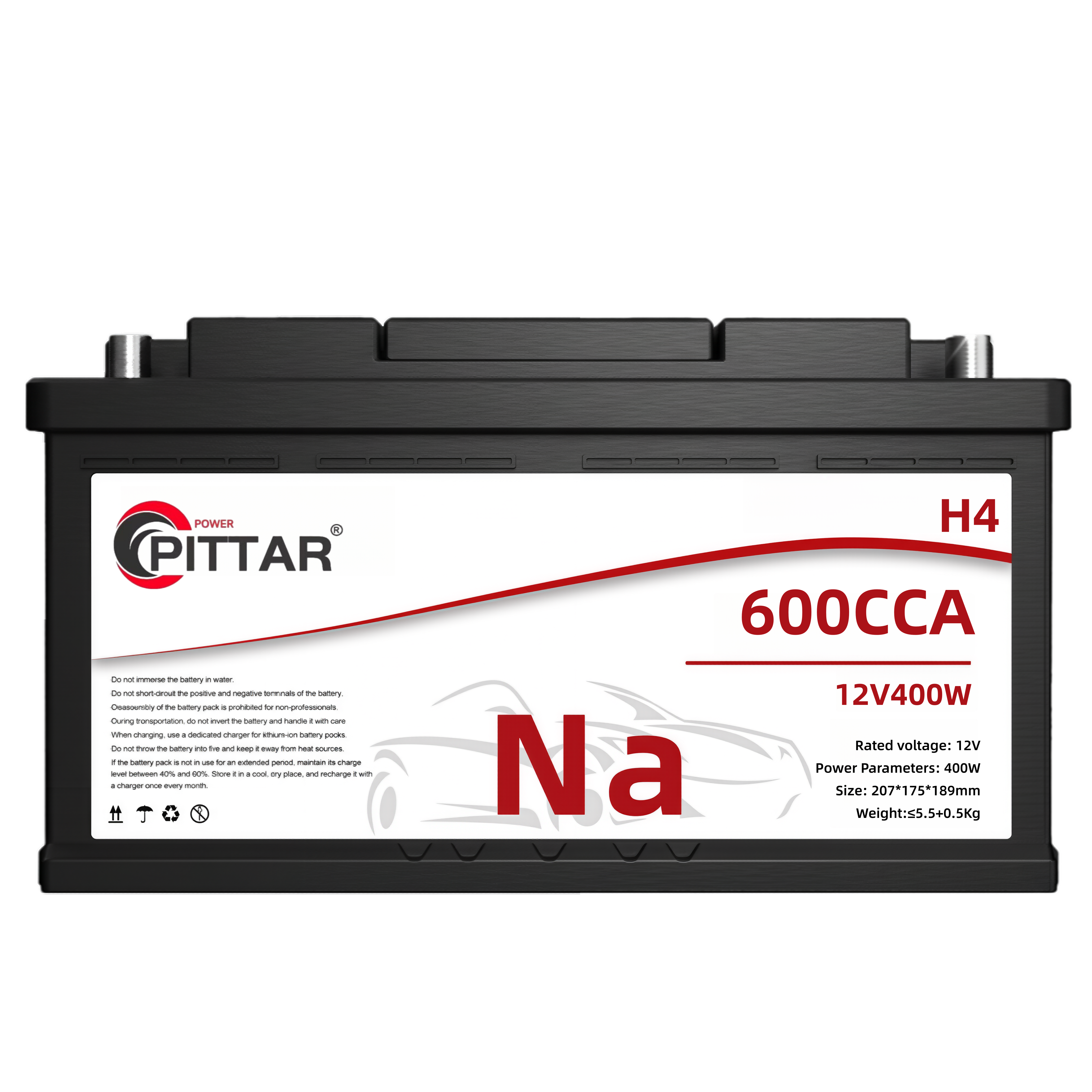
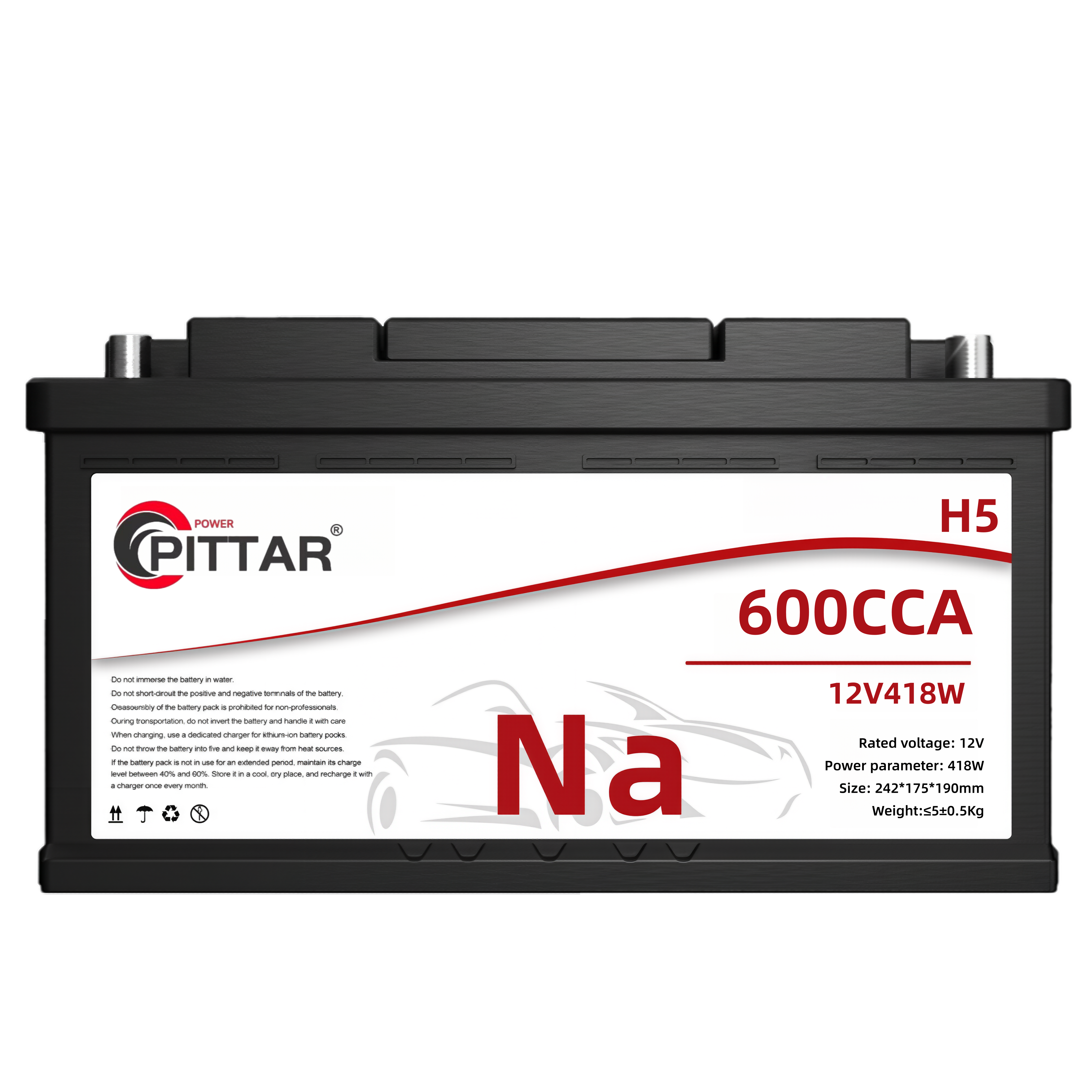
A buyer who walks into a sodium-ion start-stop program aware of these three structural advantages — and aware of the supplier diligence that the earlier-stage chemistry requires — is in a much stronger position than a buyer who walks in expecting sodium-ion to behave exactly like a mature AGM supply. As a battery and energy storage supplier serving automotive battery importers, distributors, wholesalers, dealers, and OEM and ODM buyers, PITTAR works with sodium-ion cell
programs that have been integrated with start-stop duty cycles in mind. Where the chemistry fits the program — cold-climate reliability, supply-chain diversification, multi-year volume commitments, and BMS-tuned integration with the vehicle electrical system — the conversation is worth having. Where the chemistry does not yet fit, the right move is to stay with the incumbent option until the fit changes.
_______________________________________________________________________
Frequently Asked Questions
How does a start-stop battery work?
A start-stop battery sits in a vehicle electrical system that automatically shuts the engine off at idle and restarts it when the driver is ready to move. During each cycle the battery delivers a high-current crank burst to restart the engine, powers cabin electronics and control modules during the engine-off window, and accepts charge from the alternator and regenerative braking system once the engine is running again. The BMS coordinates state of charge, temperature, and current limits so the battery can repeat that pattern thousands of times across its service life.
What makes a start-stop battery different from a regular car battery?
A regular car battery is built for a simple duty cycle: one crank per trip, slow top-up charge, and brief accessory load. A start-stop battery is built for thousands of cranks per trip, irregular high-current charge pulses from regenerative braking, long engine-off windows at partial state of charge, and engine-bay temperature exposure across many years. EFB, AGM, and sodium-ion are the chemistries designed for that harsher pattern; flooded lead-acid batteries are not.
How many times does a start-stop battery crank the engine in its life?
The number varies widely depending on driving cycles, climate, vehicle integration, and chemistry. Published OEM and third-party estimates for start-stop programs typically run from tens of thousands to hundreds of thousands of cranks across service life, but the exact number depends on the specific cell design, BMS tuning, and the actual duty cycle in service. Buyers should look for validation data that speaks to the same kind of duty cycle the vehicles will see, not to a generic bench-top number.
Does a start-stop battery need a special charger?
Sometimes. Sodium-ion, AGM, and EFB batteries have different charge voltage profiles than flooded lead-acid, and using the wrong charger profile can shorten service life or fail to recharge a deeply discharged battery. For a sodium-ion start-stop program, the vehicle electrical system should be tuned to the cell's charge voltage window and the BMS should coordinate with the alternator controller; an external bench charger used in a warehouse or service environment should match the same profile.
Why is sodium-ion being evaluated for start-stop service?
Sodium-ion chemistry has demonstrated useful low-temperature discharge behavior, tolerates irregular high-current charge pulses, and does not need traction-pack energy density to deliver 12-volt or 24-volt auxiliary battery performance. Those structural advantages map onto the cold-weather cranking, charge acceptance, and auxiliary-battery-appropriate maturity requirements that define the start-stop duty cycle, which is why sodium-ion is being evaluated seriously alongside EFB and AGM in automotive programs.
 Hot News
2026-10-30
2026-10-26
2026-10-22
2026-10-14
2026-10-07
2026-10-02

Pittar Power is a professional manufacturer specializing inenergy storage solutions.
Room 302, Building 1, No. 10, Huangjin First Road, Nancheng District, Dongguan City, Guangdong Province, China
Copyright © Shenzhen Pittar Power Co., Ltd. All Rights Reserved Privacy Policy
 EN