Introduction.
Lithium batteries can generally enter recycling processes, but what that means in practice depends on battery chemistry, condition, material composition, collection infrastructure, transportation logistics, available recyclers, and current market economics. A lithium battery that is technically recyclable may still be sent to long-term storage or disposal if collection or processing is unavailable in a region.
For B2B battery buyers, distributors, integrators, OEM customers, importers, RV/mobile power providers, and home and commercial storage users, the right question is not “Are lithium batteries recyclable?” but “What happens to our batteries at the end of useful service, and what should we look for in a supplier so the end-of-life pathway is responsible and predictable?” A buyer who treats recycling as part of the procurement decision makes a more sustainable and commercially sound choice than one who treats recycling as an afterthought.
__________________________________________________________________________________________________
Can Lithium Batteries Be Recycled?
Yes, lithium batteries can be recycled, but the meaning of that statement needs to be split into four separate categories:
Technically recyclable. The materials can be recovered through industrial processes. Different chemist ries use different processes and yield different products.
Economically recyclable. The recovered materials have enough value to cover collection, transport, and processing costs. Not every chemistry is equally profitable to recycle today.
Reusable. The battery or its cells can serve another application after testing. This is a separate pathway from recycling.
Properly disposed of. When reuse, repurposing, and recycling are not available, batteries still need controlled handling to keep them out of ordinary waste streams, landfills, and unsafe disposal pathways.
A lithium battery is not automatically all four. A LiFePO4 battery may be technically recyclable but less economically attractive than an NMC battery because LiFePO4 does not contain cobalt or nickel. A damaged lithium battery should not be reused even if it still holds charge. A battery in a region with no collection infrastructure may sit in storage rather than be recycled.
Lithium batteries are not a single chemistry. Cell chemistry affects material composition, recovery value, processing route, safety requirements, and recycling economics. Buying decisions that ignore chemistry-based recycling behavior can create downstream complications for both the buyer and the wider supply chain.
For a foundation on what lithium batteries are and why chemistry matters, see [What Is a Lithium Battery?] .
__________________________________________________________________________________________________
What Happens to a Lithium Battery at the End of Its Life?
A lithium battery reaching the end of its useful service life does not have one single destination. End-of-life pathways include continued use, reuse, repurposing, recycling, and controlled disposal of non-recoverable residues.
Continued use. A battery is not “end of life” simply because it no longer fits the original specification. A battery that has lost capacity for an EV may still serve many years in stationary storage, low-power applications, or seasonal use.
Reuse. Reuse generally means the same battery continues in the same application but with a different owner. This can include second-hand sales, rental fieet rotation, or transfer between company vehicles.
Repurposing. Repurposing assigns the battery to a different application after testing. A traction battery that no longer meets vehicle range requirements can sometimes serve in stationary energy storage, off-grid solar, lighting, or other lower-power
applications. Repurposing requires health-state assessment, safety testing, and often reconfiguration of the BMS settings or external protection.
Recycling. Recycling breaks down the battery into materials that re-enter the manufacturing chain. This is distinct from reusing the battery as a whole.
Final disposal. When reuse, repurposing, and recycling are not feasible, residual materials still need controlled handling. They should not be mixed with ordinary waste, burned, or buried.
The appropriate pathway is determined by battery condition, chemistry, application requirements, local infrastructure, and applicable regulation. A responsible supplier should be able to explain which of these pathways their batteries are designed to enter and why.
Pathway |
When It May Be Appropriate |
Main Consideration |
Continued use |
Battery still meets application requirements |
Health state, age, warranty status |
Reuse |
Battery fits a different owner’ s needs without modification |
Compatibility, remaining capacity, safety |
Repurposing |
Battery qualifies for a lower-power second-life application |
Testing, reconfiguration, BMS review |
Recycling |
Battery is no longer suitable for any application |
Collection, transport, processing availability |
|
Final disposal |
No recycling or reuse option is available |
Controlled handling, hazardous waste rules |
This table is a planning reference, not a substitute for local regulation or qualified recyclers.
__________________________________________________________________________________________________
How Are Lithium Batteries Recycled?
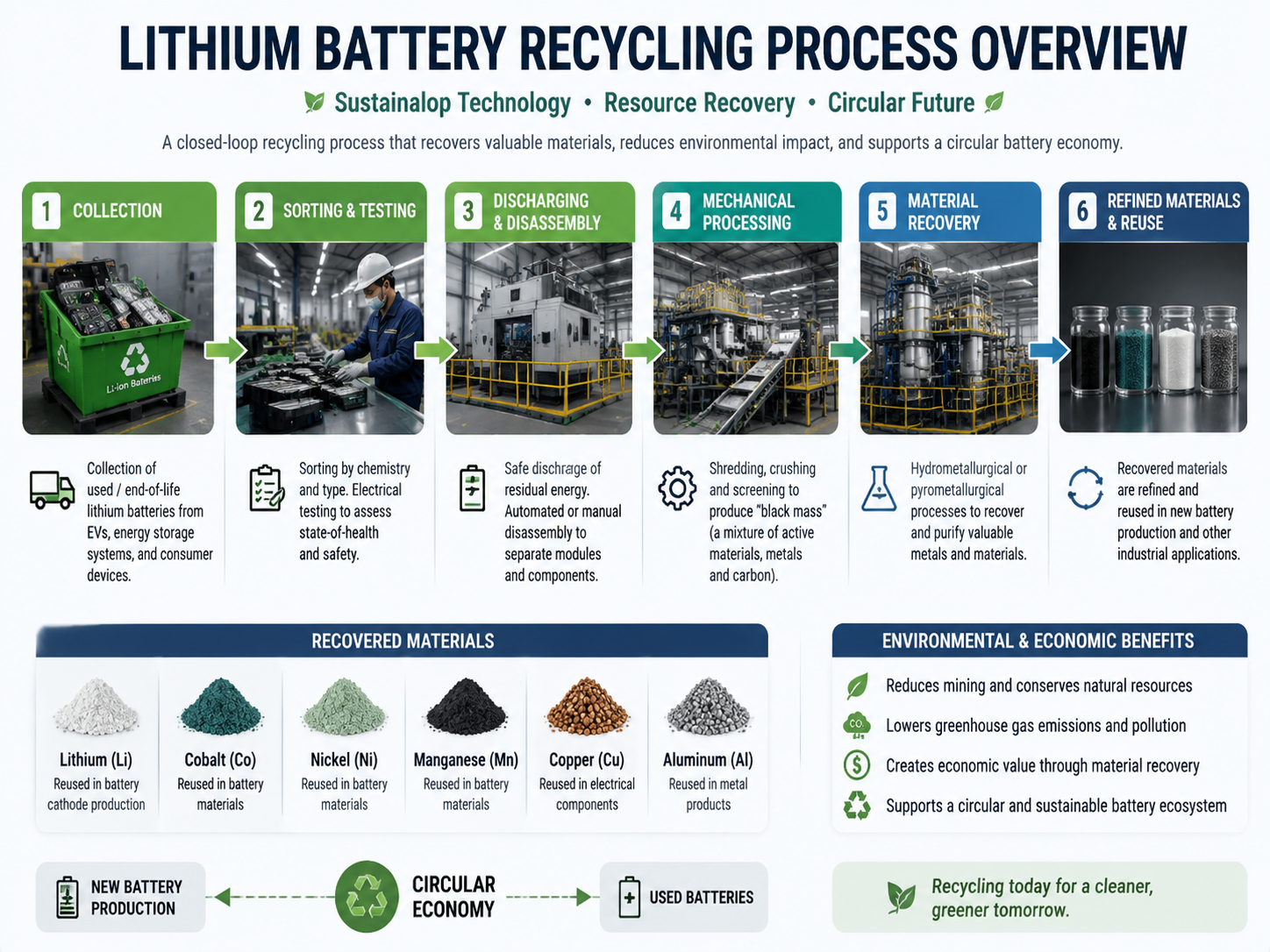
Industrial recycling processes vary by recycler, region, and chemistry. They generally follow a similar sequence:
1. Collection. Used batteries are gathered from users, dealers, service networks, or manufacturer take-back programs.
2. Transport. Batteries are transported under hazardous-material rules, often in protective packaging, to a sorting or processing facility.
3. Sorting. Batteries are sorted by chemistry, format, and condition. Sorting is critical because different chemist ries and cell formats need different processing routes.
4. Safe preparation. Batteries may be discharged to a defined state of charge, stabilized, or in some cases discharged into a controlled system. Damaged or unstable cells require specialized handling.
5. Mechanical processing. Cells may be shredded or dismantled to expose the internal materials. Modern facilities often operate under inert atmosphere or with fire suppression to manage safety risk during this stage.
6. Separation. Mechanical and sometimes density-based methods separate black mass, copper, aluminum, plastics, and steel casings.
7. Material recovery. Black mass is treated to recover lithium, nickel, cobalt, manganese, copper, aluminum, graphite, or other materials depending on chemistry. Industrial methods include pyrometallurgical (heat-based) and hydrometallurgical (liquid-based) routes. Mechanical or direct recycling approaches are also under development.
8. Refining and reuse. Recovered materials are processed into battery-grade or industrial-grade inputs that return to the supply chain.
Different recyclers use different combinations of these steps. A buyer should not assume that every recycler can process every chemistry, and some processes are more commercially mature for certain chemist ries than others.
__________________________________________________________________________________________________
What Materials Can Be Recovered from Lithium Batteries?
The recoverable materials depend on the battery’ s chemistry and construction. A typical lithium-ion cell contains:
Cathode active material (lithium combined with nickel, cobalt, manganese, iron phosphate, or other elements).
Anode material (usually graphite, sometimes with silicon or other additives).
Aluminum current collector (cathode side).
Copper current collector (anode side).
Electrolyte (organic solvents and lithium salt).
Separator (porous polymer film).
Cell housing, tabs, and external casing (steel or aluminum).
The relative economic value of these materials depends strongly on chemistry. NMC and NCA chemist ries contain cobalt and nickel, which have well-established recycling markets. LiFePO4 contains iron and phosphate instead, which are abundant and have less recycling market value.
A buyer who wants to understand recyclability should ask the supplier or a recycler what materials are targeted by the dominant local process. Material value, not technical recyclability, is the variable that most affects whether recycling is commercially attractive.
Chemistry |
Key Cathode Elements |
Recycled Material Value Trend |
LiFePO4 / LFP |
Iron, phosphate, lithium |
Lower, lithium is the main driver |
NMC |
Lithium, nickel, manganese, cobalt |
Higher because of nickel and cobalt |
NCA |
Lithium, nickel, cobalt, aluminum |
Higher because of nickel and cobalt |
LTO |
Lithium, titanium |
Specialized process, lower volume |
The exact materials, recovery rates, and process maturity depend on the specific recyclers and the local market. Numbers should always come from authoritative sources, not from a battery supplier’ s marketing claim.
__________________________________________________________________________________________________
Are LiFePO4 Batteries Recyclable?
LiFePO4 batteries are technically recyclable. Industrial processes can recover lithium compounds, iron, phosphate, copper, aluminum, and other cell constituents. The technical recycling pathway exists, and LiFePO4 is increasingly processed by recyclers that focus on lithium recovery.
However, LiFePO4 faces a commercial reality. Because the cathode does not contain cobalt, nickel, or manganese, the per- battery material value is generally lower than for NMC or NCA chemistries. Collection, transport, and processing costs may exceed the recoverable material value unless the recycler focuses on lithium, uses low-cost processing, or operates at scale. This means LiFePO4 recycling is more dependent on regional infrastructure, regulation, and lithium-market pricing than on technical possibility alone.
For LiFePO4 users, the practical implications are:
Collection and take-back programs are the most practical pathway.
Repurposing can be more attractive than recycling for some LiFePO4 packs because the cells are often larger, more robust, and easier to test and reconfigure.
Future regulatory changes and lithium-market shifts may improve LiFePO4 recycling economics.
LiFePO4 is not “easy” or “difficult” to recycle in absolute terms. It is recyclable, but the economics depend on the same collection, infrastructure, and material-market factors that affect every chemistry. For LiFePO4 chemistry background, see [What Is LiFePO4 Battery?] .
__________________________________________________________________________________________________
Reuse vs Recycling: Which Comes First?
Reuse and recycling are not interchangeable. The choice depends on the battery’ s condition, application fit, safety testing, and the willingness of the user or supplier to perform verification.
A battery may be suitable for reuse or repurposing when:
It still has adequate capacity and internal resistance for the intended application.
The BMS, enclosure, and connectors remain in good condition.
The battery has not experienced abuse, swelling, leakage, or thermal events.
Health-state data or testing is available to confirm its condition.
The intended second-life application has lower power or energy demands than the first.
A battery should be sent toward recycling when:
Capacity has dropped below a useful threshold for any practical application.
Internal resistance is too high for the planned use.
The pack has visible damage, swelling, or leakage.
Documentation or traceability is missing.
No qualified party is willing to test and repurpose it.
Reuse and recycling both have value. Reuse keeps a working battery in service longer, which can be the most resource-efficient outcome. Recycling recovers materials even when reuse is impossible. A responsible end-of-life strategy considers both pathways.
__________________________________________________________________________________________________
How Should End-of-Life Lithium Batteries Be Handled?
A practical end-of-life handling checklist:
Follow local collection requirements. Many jurisdictions have specific rules for battery disposal. Check whether the local authority accepts lithium batteries in ordinary trash; most do not.
Use qualified battery collection or recycling channels. Manufacturer take-back, distributor collection, electronic-waste programs, and approved recyclers are typical options.
Follow the manufacturer’s instructions. Some suppliers provide specific instructions for shipping, discharging, or packaging a battery for return.
Do not place batteries in ordinary household trash. Even small lithium batteries should go to hazardous-battery collection when the local system supports it.
Do not burn batteries. Lithium battery cells can rupture, vent, or ignite if exposed to fire.
Do not crush or puncture batteries. Physical damage can cause internal short circuits, thermal runaway, or fire.
Do not dismantle battery packs. Dismantling without training, tools, and protective equipment is dangerous and is not appropriate for ordinary users.
Protect damaged batteries from further physical damage. Place the battery in a non-conductive, ventilated, and fire- resistant container while awaiting qualified collection.
For damaged, swollen, leaking, smoking, or overheating batteries, stop using the battery, isolate it in a safe area, and contact the manufacturer, qualified service provider, or appropriate local hazardous-battery collection facility. Improvised repair or DIY dismantling is unsafe and should not be attempted. For general guidance on avoiding cell damage in the first place, see [What Damages a Lithium Battery?] .
__________________________________________________________________________________________________
What Should Buyers Consider When Choosing a Lithium Battery?
End-of-life handling should be part of the procurement decision, not an afterthought. The following questions help a buyer compare suppliers and products:
1.Battery chemistry. Different chemist ries have different recycling economics and end-of-life pathways. The choice between LiFePO4 and NMC affects both first-life use and end-of life options.
2.Product quality and traceability. A battery with documented cell source, batch records, and BMS firmware version is easier to manage at end of life than one without traceability.
3.Warranty and service life. Warranty terms and expected service life affect when the battery will reach end of life and what the buyer’ s replacement plan should be.
4.Technical documentation. Datasheets, BMS specifications, installation manuals, and safety instructions help a buyer operate and eventually retire the battery responsibly.
5.Maintenance requirements. A battery that is well-maintained is more likely to be eligible for reuse or repurposing when the original application no longer fits.
6.End-of-life handling. Does the supplier offer take-back, collection, or recycling guidance? Are local recyclers able to process the chemistry and format?
7.Applicable local regulation. Required certifications, transport rules, and hazardous-waste handling depend on the destination market and application. Requirements change; the buyer should confirm current rules before purchase.
A responsible lithium battery purchase is more than a price comparison. The supplier that can answer chemistry, traceability, warranty, and end-of-life questions clearly is also typically the supplier whose batteries are easier to manage responsibly through the entire service life and beyond.
__________________________________________________________________________________________________
Lithium Battery Recycling FAQ
Can lithium batteries be recycled? Yes. Industrial recycling pathways exist for the major lithium battery chemist ries, but the materials recovered, the value of those materials, and the availability of recycling services depend on chemistry, region, and market conditions.
Are LiFePO4 batteries recyclable? Yes. LiFePO4 cells can be processed by recyclers that target lithium, iron, phosphate, copper, and aluminum. The economic attractiveness of LiFePO4 recycling depends on regional infrastructure and current lithium pricing rather than on technical feasibility.
Can lithium batteries go in the trash? Generally no. Local rules vary, but most jurisdictions treat lithium batteries as hazardous waste and require separate collection. Check the local authority or recycler before disposal.
What happens to lithium batteries after recycling? Recycled materials, depending on the process, may include lithium compounds, nickel, cobalt, manganese, copper, aluminum, graphite, and steel. These materials can re-enter battery manufacturing, metallurgy, or other industrial supply chains.
Can old lithium batteries be reused? Possibly, but only after qualified testing. A battery that has been abused, damaged, swollen, or operated outside its specifications should not be reused. Reuse requires health-state assessment and a suitable lower-power application.
Are lithium batteries environmentally friendly? They are not automatically environmentally friendly simply because they are rechargeable. Their lifecycle impact depends on chemistry, manufacturing source, usage pattern, and the end-of-life pathway that is actually taken.
Is lithium battery recycling economically viable? It depends on chemistry, material value, collection logistics, processing technology, and local infrastructure. Some chemist ries are commercially profitable today; others depend on regulation, subsidies, or lithium-market pricing. A buyer should ask the recycler or supplier for current local conditions rather than rely on general statements.
 Hot News
2026-10-30
2026-10-26
2026-10-22
2026-10-14
2026-10-07
2026-10-02

Pittar Power is a professional manufacturer specializing inenergy storage solutions.
Room 302, Building 1, No. 10, Huangjin First Road, Nancheng District, Dongguan City, Guangdong Province, China
Copyright © Shenzhen Pittar Power Co., Ltd. All Rights Reserved Privacy Policy
 EN