Introduction.
Lithium batteries can be used safely when their cells, pack design, Battery Management System (BMS), charging equipment, installation, and operating conditions are appropriate. No rechargeable battery chemistry is entirely risk-free under every condition, and lithium batteries are no exception. The relevant question is not “Are lithium batteries safe in all cases?”but “What makes a lithium battery safe in the way I plan to use it, and what should I check before I buy?”
For B2B battery buyers, distributors, integrators, RV and mobile-power providers, OEM customers, importers, and commercial energy storage buyers, the practical answer involves the entire system: cell chemistry, cell quality, BMS design, charger behavior, thermal management, mechanical protection, installation, manufacturer traceability, and documentation. Treating safety as a system property, not a marketing label, is the difference between an informed purchase decision and an exposure to avoidable risk.
For a foundation on lithium battery technology used in this article, see [What Is a Lithium Battery?] .
__________________________________________________________________________________________________
Are Lithium Batteries Safe?
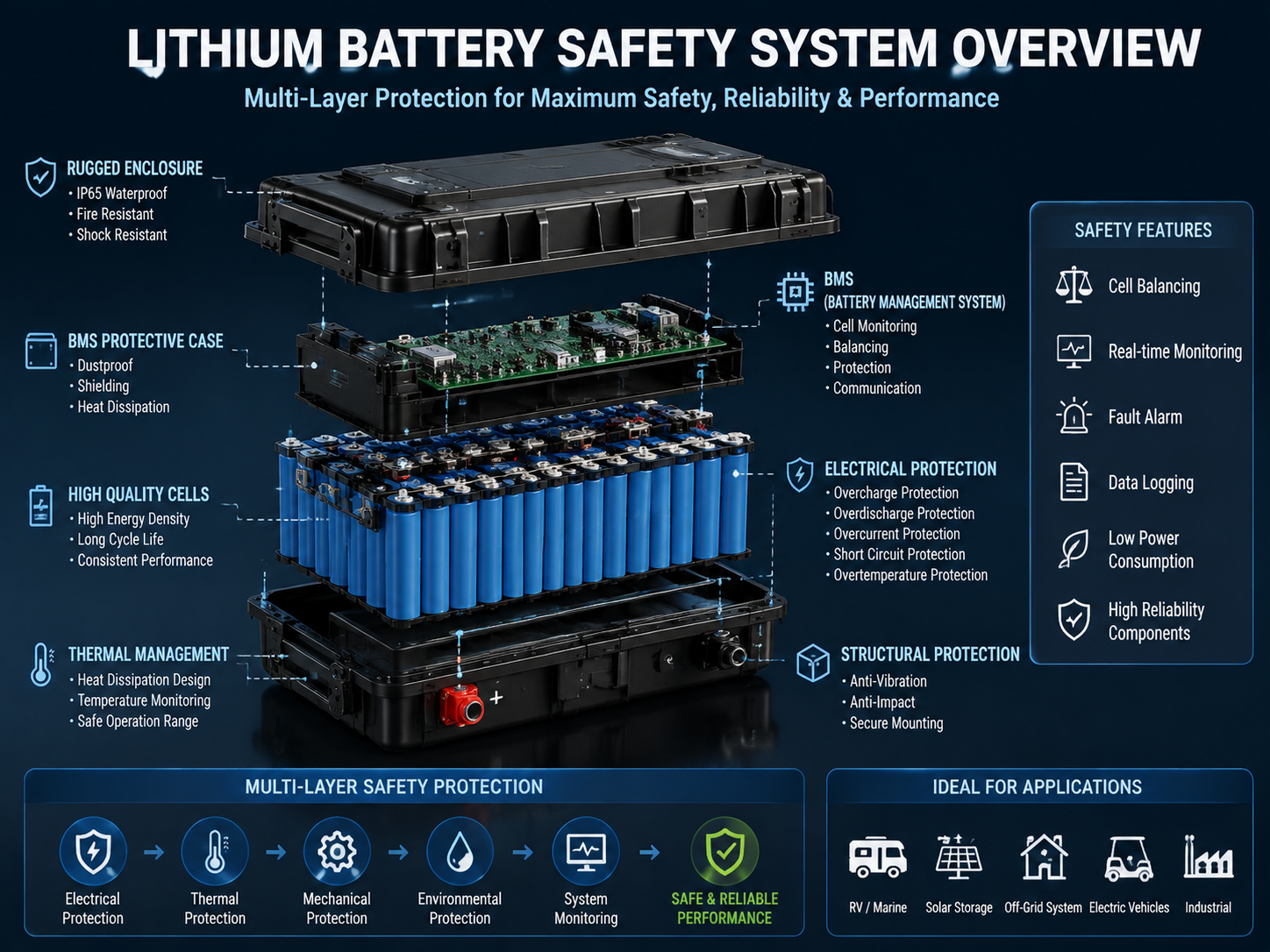
Lithium batteries are safe when designed, manufactured, installed, charged, and used correctly. Safety is not a property of the chemistry alone. It emerges from the interaction of cell quality, BMS protection, charging system, enclosure, thermal environment, installation quality, and operating behavior.
A buyer should treat the following as the main pillars of lithium battery safety:
1.Cell quality and chemistry selection.
2.Battery Management System protection and calibration.
3.Charger and charge profile compatibility.
4.Thermal management at the installation site.
5.Mechanical protection against impact, vibration, water, and dust.
6.Correct wiring, fusing, and grounding.
7.Manufacturer traceability, testing, and documentation.
8.Operating discipline, including temperature limits and state-of-charge management.
If any of these pillars is weak, the system becomes less predictable. If multiple pillars are weak, the system can fail under conditions it should otherwise tolerate. A safe lithium battery is therefore the product of a complete supply chain, a complete pack design, and a complete operating plan.
__________________________________________________________________________________________________
What Can Cause a Lithium Battery to Become Unsafe?
Lithium battery safety incidents are usually the result of a small number of recurring root causes. Each cause has a typical mechanism and a typical prevention approach.
Overcharging. Applying voltage above the chemistry’ s approved limit can drive unwanted chemical reactions inside the cell. The result can be cell heating, gas generation, permanent capacity loss, and in severe cases internal shorting.
Over-discharge. Allowing a cell to drop below its approved lower voltage can damage the electrode structure. A severely over- discharged cell may not recover, may develop internal shorts when recharged, or may simply fail.
External short circuit. A short across the battery terminals can produce extremely high current, heating, arcing, and possible fi re. Even a low resistance connection at high current creates heat quickly.
Internal short circuit. Mechanical damage, manufacturing defects, lithium dendrite growth, or separator failure can create shorts inside a cell. An internal short turns stored energy into heat within the cell itself.
Excessive current. Continuous or peak current beyond the battery’ s rated limit can overheat cells, damage welds, and stress the BMS. Heat accumulation is the common pathway to thermal runaway.
High temperature. Elevated ambient temperature, blocked ventilation, sun exposure, or heat from a parallel equipment can push a cell into a less stable chemical regime. Heat also accelerates nearly every other aging mechanism.
Low-temperature charging. Charging lithium cells below the chemistry’ s approved temperature can cause lithium plating on the anode. Plating is not only a capacity problem; it is a safety problem because plated lithium can create internal shorts.
Mechanical damage. Drop, puncture, severe vibration, or compression can deform the cell and break internal separators. A damaged cell may still appear to work but can fail without warning under stress.
Poor manufacturing quality. Inconsistent electrode coating, contaminated electrolyte, weak welds, or poor sealing can introduce latent defects that surface only after months of use.
Incorrect installation. Undersized wiring, missing fusing, incorrect grounding, blocked ventilation, or unstable mounting all increase risk. Even a high-quality battery can become unsafe if installed poorly.
Lack of documentation or traceability. A buyer who cannot trace cell origin, BMS firmware version, batch records, or test certificates is taking on additional supply-chain risk.
These root causes are the reason safety must be evaluated as a system rather than as a single feature claim.
__________________________________________________________________________________________________
What Is Thermal Runaway and Can Lithium Batteries Catch Fire?
Thermal runaway describes a state inside a cell in which heat generation exceeds the cell’ s ability to dissipate heat. Once a cell crosses that threshold, internal temperature rises rapidly. The chemistry accelerates its own decomposition, releasing more heat and, in some chemist ries, fiammable gas. The result can be venting, fire, or explosion depending on the cell state, enclosure, and surrounding environment.
Thermal runaway is not a normal operating condition. It is a failure state that requires an initiating event, such as severe overcharge, internal short, mechanical damage, or external fire. Most well-designed lithium batteries never enter this state across years of normal use because protection systems prevent the initiating events.
A lithium battery can catch fire under certain failure conditions, but this is different from saying that lithium batteries are inherently unsafe in normal use. The objective of safety design is to keep the cells out of the conditions that lead to thermal runaway, not to claim that runaway is impossible under any abuse. Protection is layered: cell selection, BMS, enclosure, installation, and operating practice each reduce the probability of entering a failure state.
__________________________________________________________________________________________________
How Does a BMS Improve Lithium Battery Safety?
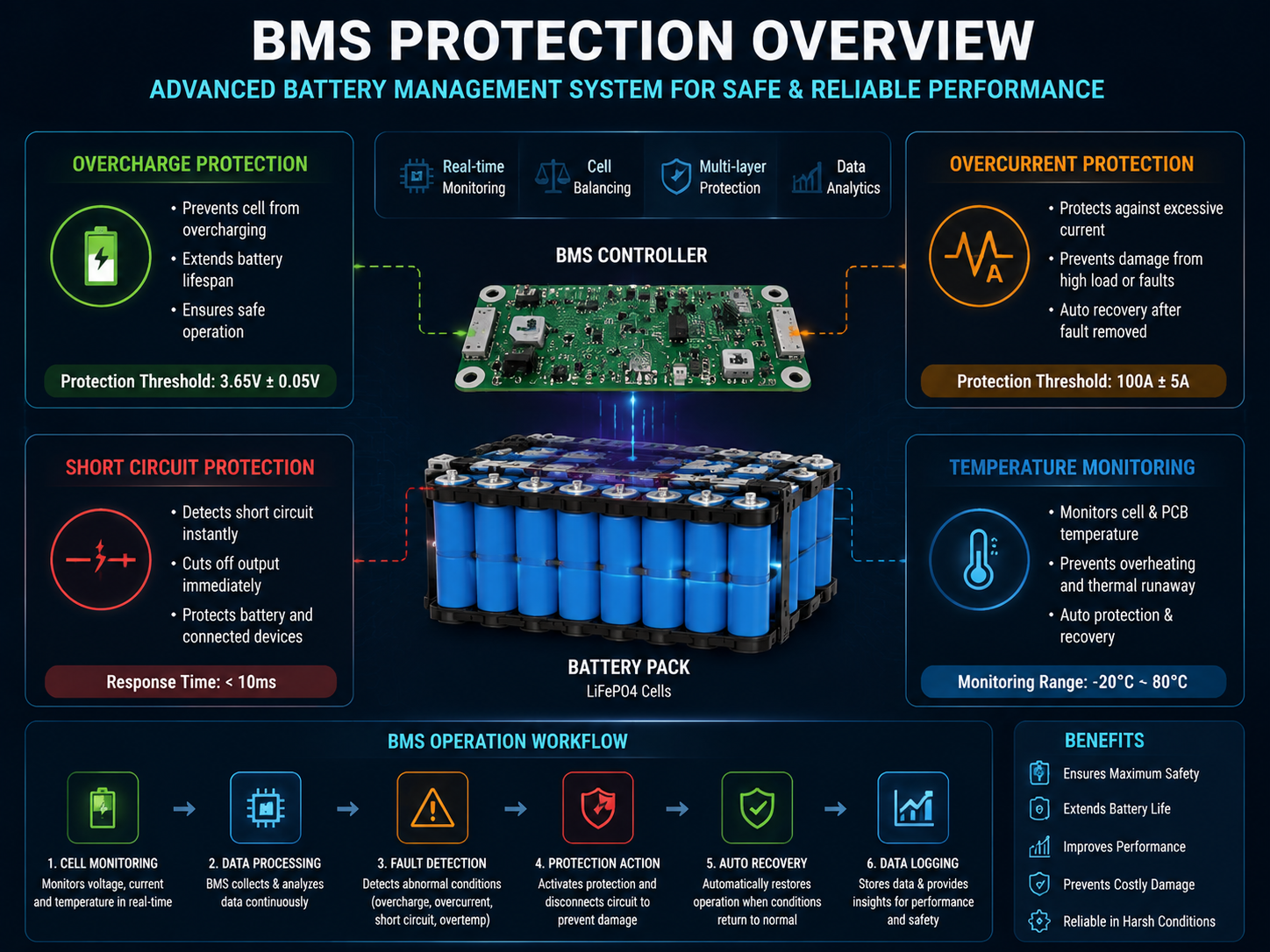
The Battery Management System (BMS) is the electronic control layer inside a lithium battery. It monitors cell voltages, current, temperature, and sometimes state of charge. When a reading exceeds an approved limit, the BMS disconnects or limits the battery’ s operation.
Common BMS functions include:
Overcharge protection: stops charging when a cell voltage exceeds the upper limit.
Over-discharge protection: stops discharging when a cell voltage drops below the lower limit.
Over-current protection: limits or disconnects current during abnormal demand.
Short-circuit protection: detects very high current and disconnects the battery quickly.
Temperature monitoring: suspends operation when temperature is outside the approved range.
Cell balancing: equalizes cell voltages so that weaker cells do not push the pack beyond limits.
Communication and alarms: reports state of charge, alarms, and faults to the inverter, display, or monitoring system.
A BMS reduces risk, but it does not eliminate all risk. A BMS has its own current limits, response time, and reliability
characteristics. A poorly designed BMS can fail to act, can fail to reset, or can introduce its own failure modes. The presence of a BMS is therefore a necessary but not sufficient condition for safety. It must be paired with correct wiring, correct charger settings, correct installation, and a battery pack built from quality cells.
__________________________________________________________________________________________________
Are LiFePO4 Batteries Safer Than Other Lithium-Ion Batteries?
LiFePO4, or lithium iron phosphate, is widely considered a comparatively stable lithium-ion chemistry for stationary and mobile energy storage. Its cathode chemistry is more thermally stable than the layered oxide chemist ries often used in higher- energy consumer electronics. In abuse testing, LiFePO4 cells are less likely to enter thermal runaway at the same trigger energy as some other chemist ries.
LiFePO4 is therefore common in applications where thermal stability and long cycle life matter more than compact energy density. Residential storage, off-grid solar, RV and marine house banks, and many commercial energy storage systems use LiFePO4 precisely because it tolerates fault conditions with less risk of catastrophic thermal runaway.
However, LiFePO4 is not immune to safety risks. Under severe abuse it can still vent, smoke, or contribute to fi re. Chemistry is one part of a safety system, not a substitute for one. Cell quality, BMS design, charger behavior, enclosure, installation, and operating practice remain essential. Selecting LiFePO4 because it is “safer” is reasonable; assuming that LiFePO4 removes the need for the rest of the safety system is not.
For a deeper treatment of LiFePO4 chemistry, see [ What Is LiFePO4 Battery?] .
__________________________________________________________________________________________________
How Can You Make Lithium Battery Use Safer?
A practical set of habits reduces most of the avoidable risk in lithium battery use.
Use a compatible charger. Match the charger to the battery chemistry, voltage, and approved charge profile. A lead-acid charger on a lithium battery, or a mismatched voltage setting, can cause repeated overcharge stress or undercharge symptoms.
Follow voltage and current specifications. Respect the battery's continuous discharge rating, peak current rating, and maximum charge current. Pushing beyond these ratings may not fail immediately but can shorten life and increase stress.
Stay within approved temperature limits. Avoid charging at temperatures below the chemistry’ s low-temperature limit. Avoid operating or charging in extreme heat. Where conditions regularly cross limits, add heating, cooling, or insulation.
Avoid damaged batteries. Drop, puncture, swelling, leakage, or unusual odor are signs that a battery is unsafe. Stop using it and follow the manufacturer's safety instructions. Improvised repair of a damaged lithium battery is dangerous and should not be attempted.
Use correct wiring and protection. Match cable size to current, use fuses or breakers rated for the system, and follow the battery manual’ s installation rules. Loose connections and undersized wires cause heating before they cause functional failure.
Do not bypass the BMS. A BMS exists because individual cells and packs can fail. Removing or bypassing it can expose the battery to conditions it was never designed to survive. If a BMS trips repeatedly, the right action is to investigate the system, not disable the protection.
Respect charge mode and storage SOC. Some lithium chemist ries tolerate storage at full charge; others prefer partial charge. Follow the battery manual, particularly for seasonal storage, and store in a cool, dry place.
For conditions that damage the battery and can create safety risk over time, see [What Damages a Lithium Battery?] .
__________________________________________________________________________________________________
Lithium Battery Safety Risk and Protection Measures
The table below pairs the most common safety risks with the typical mechanism and the typical protection or prevention. Use it as a quick reference, not as a substitute for the manufacturer manual.
Risk |
What Can Happen |
Typical Protection or Prevention |
Overcharge |
Cell stress, gas generation, internal shorting |
BMS overvoltage cutoff, approved charger, charge profile setting |
Over-discharge |
Permanent electrode damage, recovery risk on recharge |
BMS undervoltage cutoff, reserve SOC setting, correct sizing |
External short circuit |
Very high current, heating, possible fi re |
Fuses, breakers, correct cable sizing, BMS short- circuit detection |
Internal short circuit |
Local heating inside cell, thermal runaway risk |
Cell quality, manufacturing traceability, mechanical protection |
Excessive current |
Connector heating, BMS stress, accelerated aging |
Current rating, correct inverter sizing, BMS overcurrent protection |
|
High temperature |
Faster aging, reduced safety margin, possible thermal runaway |
Ventilation, shading, thermal management, temperature monitoring |
Low-temperature charging |
Lithium plating, capacity loss, latent short risk |
Low-temperature charge protection, heating, insulated placement |
Mechanical damage |
Separator failure, internal short, delayed failure |
Physical protection, stable mounting, drop avoidance, inspection after impact |
|
Incorrect charging |
Repeated overcharge or over-discharge stress |
Approved charger, correct settings, periodic verification |
Poor installation |
Voltage drop, heating, system instability |
Correct wiring, fusing, grounding, manufacturer installation rules |
Tampering or bypass |
Removal of safety controls |
No field modification of BMS, no bypassed fuses, qualified service |
A safety-conscious buyer should be able to point to a documented protection for each row above before approving a lithium battery system.
__________________________________________________________________________________________________
What Should Buyers Check Before Purchasing a Lithium Battery?
A safety-minded procurement review checks the battery, the system, and the supplier. The following list is a practical starting point.
Battery side.
1.Chemistry selection. Confi rm the chemistry matches the application’ s priorities. LiFePO4 is common for stationary and mobile energy storage, but other chemist ries may be appropriate in specific cases.
2.Cell quality and traceability. Ask whether cells are sourced from identifiable manufacturers with documented batch records.
3.BMS specifications. Review the overvoltage, undervoltage, overcurrent, short-circuit, and temperature limits. Confi rm BMS communication and reset behavior.
4.Continuous and peak current. Match the battery’ s continuous and peak ratings to the inverter and the largest expected load.
5.Operating temperature range. Confi rm charge and discharge temperature limits against the planned installation site.
6.Low-temperature charging protection. Verify that charging is blocked or limited at temperatures below the chemistry’ s approved threshold.
7.Enclosure and mechanical protection. Review the case, mounting points, vibration tolerance, and any ingress protection rating relevant to the application.
Supplier side.
1.Manufacturer traceability. Confi rm the supplier can identify the cell source, pack assembly site, and fi rmware version.
2.Documentation. Ask for datasheets, BMS specifications, installation manuals, safety instructions, and shipping documentation.
3.Testing and quality control. Ask what factory testing is performed on fi nished packs: capacity verification, BMS function checks, insulation testing, and end-of-line inspection.
4.Warranty terms. Review cycle or throughput conditions, temperature exclusions, and required installation rules.
5.Required certifications. Confi rm what certifications are appropriate for the destination market, transport mode, and product category. Required certifications depend on local regulations and product type, not on a universal standard.
A buyer who can document answers to these items has a much stronger safety basis than one who only has a brochure.
__________________________________________________________________________________________________
Lithium Battery Safety FAQ
Can lithium batteries catch fire? Under certain abuse conditions a lithium battery can enter thermal runaway, venting, or fi re. In normal, well-managed use this is unusual. Protection systems, quality construction, and correct charging are designed to prevent it.
Are LiFePO4 batteries safe for home energy storage? LiFePO4 is widely used for residential storage because of its thermal stability, cycle life, and lower abuse sensitivity. Final safety depends on the full system: cell quality, BMS, charger, installation, and operating behavior.
Can I charge a lithium battery overnight? Many lithium batteries are designed for unattended overnight charging with a compatible charger, in approved temperature conditions, on a non-combustible surface, and with smoke detection present. Always follow the manual for the specific product.
What happens if a lithium battery is overcharged? Sustained overcharge drives the cell beyond its approved voltage, causing heating, gas generation, electrode damage, and possible internal shorting. A BMS that disconnects charging at the upper limit is the primary protection.
Is a BMS necessary for a lithium battery? A BMS is required for safe lithium battery operation. It protects against overcharge, over-discharge, overcurrent, short circuit, and unsafe temperature. A lithium battery without a working BMS is not considered safe for normal use.
Are lithium batteries safe for RVs and camping? They can be, when the battery matches the RV or camping loads, the charger profile is correct, the installation is mechanically secure, and temperature limits are respected. Match the battery to the load, charger, and installation rather than the other way around.
What should I do if a lithium battery is physically damaged? Stop using it. Isolate the battery if it can be done safely. Do not attempt repair. Follow the manufacturer’ s safety instructions or contact qualified service. Do not charge or discharge a damaged, swollen, leaking, smoking, or overheating battery.
 Hot News
2026-08-20
2026-08-16
2026-08-12
2026-08-03
2026-07-30
2026-07-26

Pittar Power is a professional manufacturer specializing inenergy storage solutions.
Room 302, Building 1, No. 10, Huangjin First Road, Nancheng District, Dongguan City, Guangdong Province, China
Copyright © Shenzhen Pittar Power Co., Ltd. All Rights Reserved Privacy Policy
 EN
EN