What Is a Start-Stop Battery and How Is It Different from a Regular Car Battery?
A start-stop battery and a regular car battery look almost identical from the outside. Both are 12-volt lead-acid-sized boxes that bolt under the hood and connect to the same two cables. But the work the two batteries do in a vehicle is not the same, and confusing the two is one of the most common reasons a start-stop vehicle ends up with the wrong battery, premature failure, and avoidable warranty claims.
A regular car battery is built for a simple job: deliver a short, high-current crank at startup, then sit at near-full charge for the rest of the trip while the alternator powers everything else. A start-stop battery is built for a much harder job: crank the engine back on dozens or hundreds of times per trip, sit at partial state of charge for long stretches, absorb irregular charge pulses from the alternator and regenerative braking, and survive engine-bay temperatures for years. This article walks through what a start-stop battery is, what a regular car battery is, where the two diverge in engineering terms, how those differences play out in real vehicles, where sodium-ion chemistry now sits in the picture, and what buyers should verify before substituting one battery for the other.
_______________________________________________________________________
What Is a Start-Stop Battery?
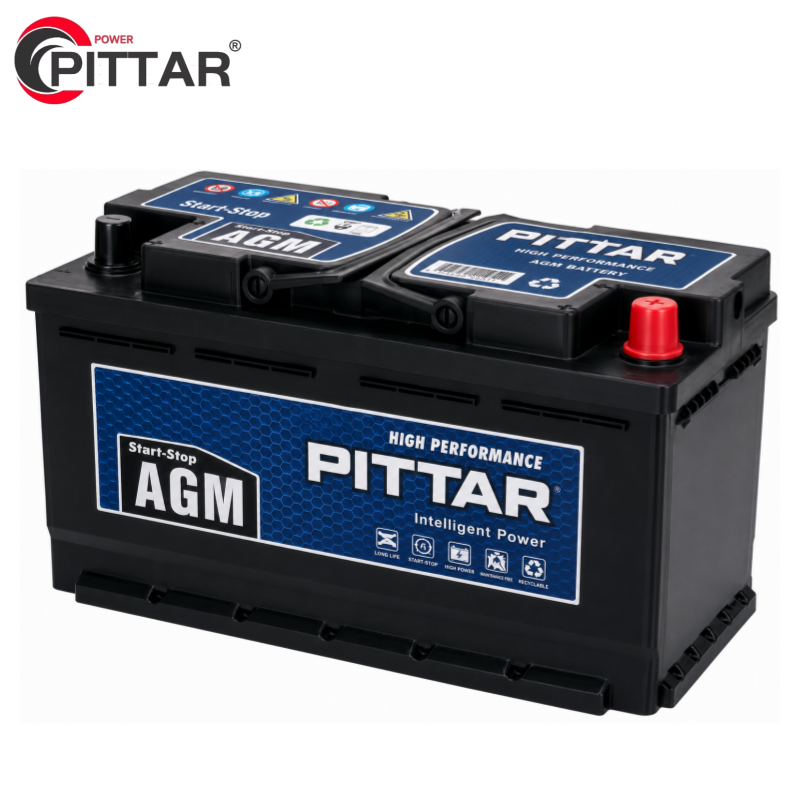
A start-stop battery is the auxiliary battery designed to support a vehicle equipped with an automatic engine shut-down and restart system. In a start-stop vehicle, the engine turns off when the vehicle comes to a stop (at a traffic light, in stop-and-go traffic, sometimes during deceleration), and the engine restarts when the driver is ready to move again. The battery is asked to do the cranking, run cabin electronics during each engine-off window, and absorb the charge pulses from the alternator and regenerative braking system the rest of the time.
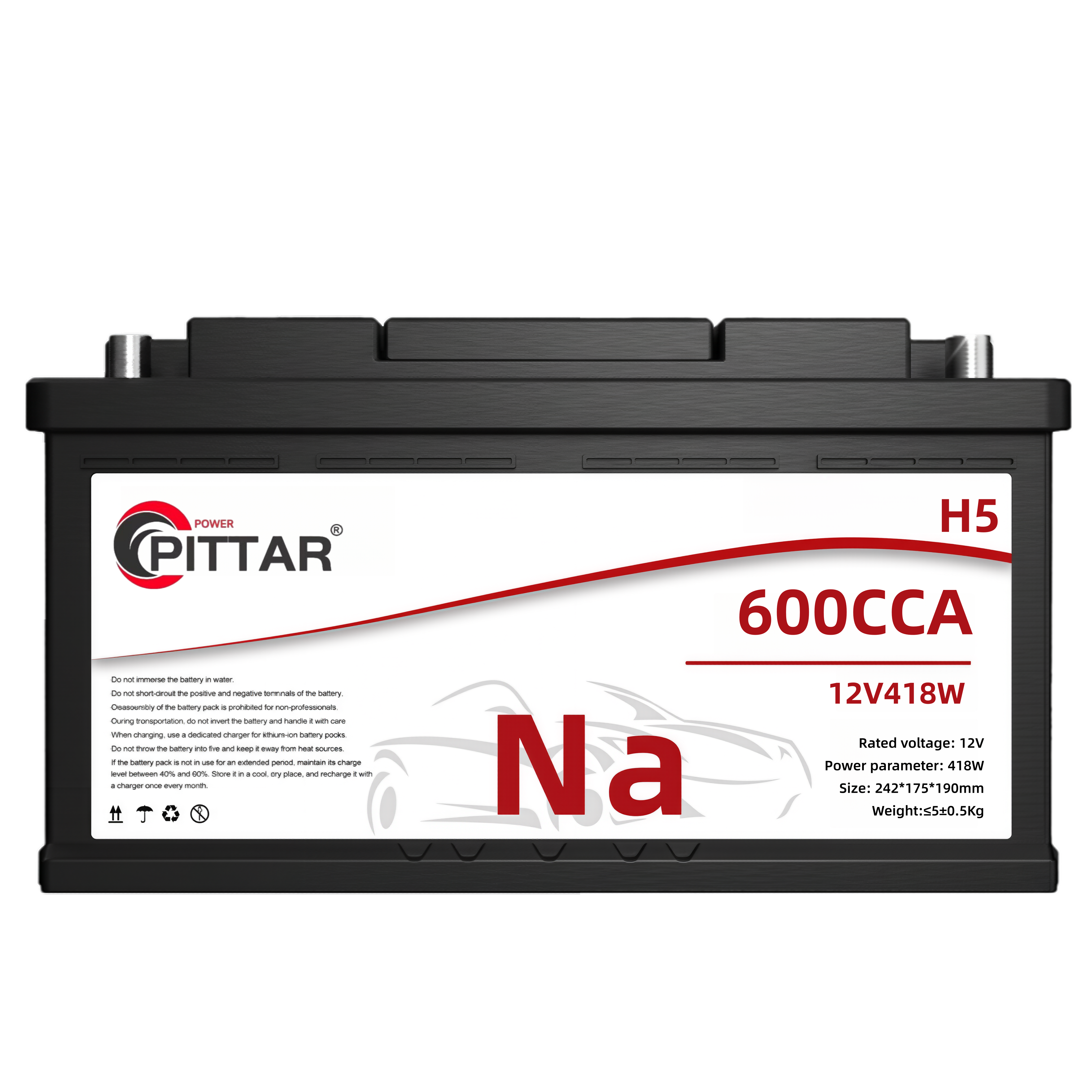
Start-stop batteries are not a single chemistry. The three families commonly in use today are enhanced flooded batteries (EFB), absorbent glass mat batteries (AGM), and — in newer programs — sodium-ion chemistries adapted to the 12-volt or 24-volt auxiliary role. What unifies the three is the engineering envelope: each is built to deliver the deeper cycle life, higher charge acceptance, and stronger partial-state-of-charge tolerance that the duty cycle demands. In OEM documentation a start-stop battery is sometimes labeled simply as an auxiliary battery, an advanced battery, or a battery with idle stop-start capability, and the vehicle's BMS is typically tuned to the specific battery it ships with.
_______________________________________________________________________
What a Regular Car Battery Is Designed to Do
A regular car battery is the flooded lead-acid battery that has lived under the hood of conventional vehicles for decades. It is built around three simple expectations: deliver a brief high-current burst to crank the engine at startup, accept a slow top-up charge from the alternator across the rest of the trip, and cover short accessory demands when the engine is off. State of charge sits close to full most of the time, and the battery is rarely cycled more than a handful of times per trip.
That simpler duty cycle is the reason a regular flooded lead-acid battery is inexpensive, widely available, and easy to ship, and also the reason that same battery fails when it is dropped into a start-stop vehicle. The flooded chemistry was not designed for the deeper discharge, the irregular charge pulses, or the partial-state-of -charge operation that a start-stop system imposes. In a start-stop vehicle, the flooded battery loses capacity faster, sulfates more quickly at partial state of charge, and fails earlier than the same battery would in a non-start-stop vehicle. A regular car battery is the right answer for vehicles that do not have start-stop, and the mismatch shows up when the duty cycle changes.
_______________________________________________________________________
Why the Two Batteries Exist at All — The Duty Cycle Difference
The reason two different battery types exist for what looks like the same job comes down to how often the battery is asked to crank, how deeply it is discharged between cranks, how the alternator recharges it, and how much electrical load it has to cover while the engine is off.
• Cranking frequency. A regular car battery cranks the engine once per trip. A start-stop battery cranks the engine dozens or hundreds of times per trip, sometimes more in heavy urban traffic.
• Depth of discharge. A regular car battery typically discharges less than 5% per crank and recovers quickly. A start-stop battery discharges more deeply and more often, especially when the engine-off windows are long.
• Charge pattern. A regular car battery receives a slow, steady top-up from the alternator. A start-stop battery receives irregular high-current charge pulses from the alternator and from regenerative braking.
• Electrical load during engine-off. A regular car battery covers accessory load for short stops. A start-stop battery covers accessory load for every engine-off window, which can be long in heavy traffic.
• Operating state of charge. A regular car battery sits at 80–100% state of charge most of its life. A start-stop battery sits closer to 70–80% state of charge most of its life.
• Thermal exposure. Both batteries sit in the engine bay and see the same temperature range, but the start-stop battery has to deliver cold-weather cranking performance after thousands of partial cycles and many months of that thermal exposure.
These differences are all driven by the same underlying fact: the start-stop system turned the battery from a backup into a working component of the vehicle electrical architecture, and that shift is the engineering reason the battery specification changed.
_______________________________________________________________________
Five Engineering Differences Between the Two
Each duty-cycle difference above translates into a concrete engineering difference in the battery itself. Each one is a set of design choices in the cell, plate chemistry, separator, BMS, and cell format — not a single number on a label.
Cranking frequency and cranking reserve. A start-stop battery has to deliver a high-current crank burst over and over, even when state of charge has dropped. EFB and AGM batteries are built with stronger plate structures and thicker grids to survive that pattern; sodium-ion cells, which do not use lead-acid grids at all, tolerate the repeated high-current bursts differently but still have to be sized and balanced for the duty cycle. The relevant cold cranking amp (CCA) figure for a start-stop battery is not the day-one CCA but the CCA the battery can still deliver after thousands of partial cycles and after months of engine-bay thermal exposure, because that is when the battery actually has to perform. A buyer comparing two start-stop batteries should compare the validated CCA at the deployment temperature, after the kind of cycle count the vehicle will see in service, not the nameplate number at 25 °C.
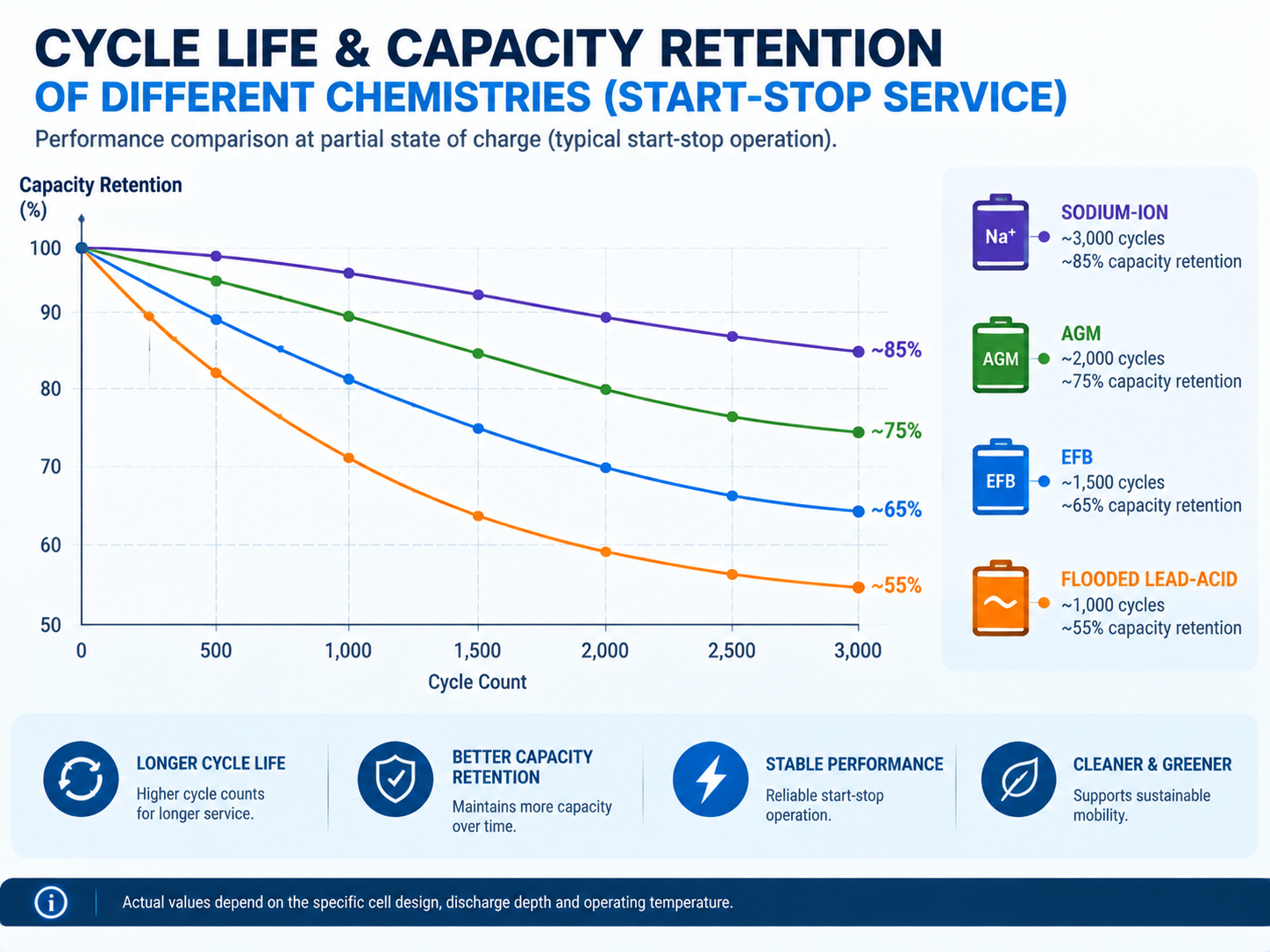
Cycle life and depth-of-discharge tolerance. Cycle life — how many times the battery can be discharged and recharged before capacity drops below a usable threshold — is the single most important difference between the two. A regular flooded car battery is rated for a small number of full cycles and survives longer when it rarely cycles at all. A start-stop battery has to survive thousands of partial cycles across its service life, often at deeper depths of discharge than a flooded battery was designed to handle. AGM batteries deliver a step-change in cycle life over flooded lead-acid; EFB delivers a smaller but still meaningful step. Sodium-ion chemistry has demonstrated useful cycle behavior where deployed for this duty cycle, with the actual count depending heavily on cathode family, depth of discharge, operating temperature, and BMS control strategy. Actual performance depends on chemistry, cell design, manufacturer, and operating conditions, so any cycle-life number attached to a specific product has to come from the supplier's own validation data, not from a generic chemistry label.
Charge acceptance and alternator pulse recovery. Charge acceptance is the part of the duty cycle where a flooded battery fails fastest in a start-stop vehicle. The alternator and the regenerative braking system push current back into the battery in irregular high-current pulses, often at partial state of charge, and flooded lead-acid chemistry absorbs those pulses poorly: high-current pulses at partial state of charge accelerate grid corrosion, plate sulfation, and water loss. EFB and AGM batteries were developed specifically to handle this pulse pattern, which is why automakers moved to those chemistries for start-stop service. Sodium-ion chemistry has a different mechanism, but with a properly tuned BMS it can tolerate high charge rates without the same kind of sulfation or grid corrosion. Actual performance depends on cell chemistry, BMS control strategy, and the specific charge-pulse pattern the vehicle produces.
Electrical load handling during engine-off windows. During every engine-off window, the start-stop battery is the only source of power for the cabin. Modern accessory draw — climate fan, infotainment, headlights, sensors, body control modules — can total several amps continuously, and in heavy traffic with long engine-off windows stacked back to back that load adds up. A regular flooded battery has to be sized generously to cover the worst-case engine-off window without driving itself into a damaging depth of discharge; in practice, that often means a flooded battery is not the right answer at all. A start-stop battery, sized correctly for the vehicle, covers that load comfortably across the engine-off windows the system actually produces, with the BMS coordinating when to keep the engine running because the battery cannot safely cover the next predicted stop. That BMS-coordinated behavior is part of why the battery specification changed.
Thermal and vibration tolerance. Both batteries live in the engine bay and see the same temperature range and the same vibration environment, but the start-stop battery has to deliver useful capacity and cranking performance across more of that range. Cold-weather cranking at sub-zero temperatures after thousands of partial cycles is the hardest case for any chemistry, and it is where the difference between a flooded battery and an EFB, AGM, or sodium-ion start-stop battery becomes most visible. High-temperature calendar aging — the slow capacity loss that happens whether or not the battery is being used — also accelerates faster for a flooded battery at partial state of charge than for an AGM or sodium-ion battery with a properly tuned BMS. Vibration tolerance is worth checking too: a start-stop battery in a vehicle that ships with a hold-down bracket, a thermal shield, or a BMS-coupled temperature sensor needs the same hardware when it is replaced, and substituting a battery with a slightly different footprint can leave the hold-down loose and shorten service life.
_______________________________________________________________________
How These Differences Play Out in Real-World Driving
In a city commuter vehicle with frequent stops, long engine-off windows in traffic, and short-trip driving, the engineering differences above turn into measurable service-life differences. A flooded battery in that vehicle typically fails within a year or two. An EFB battery extends that service life meaningfully; an AGM battery extends it further. A sodium-ion start-stop battery, integrated with a properly tuned BMS, has demonstrated comparable auxiliary-battery service life in published testing, with the actual result depending on the cell design, the duty cycle, and the validation data the supplier can produce.
In a highway-driven vehicle with few stops, longer trips, and warmer ambient temperatures, the gap between flooded and start-stop batteries narrows, because the start-stop system rarely activates. That is the case where substituting a regular flooded battery might appear to work, until the vehicle is driven in winter, in heavy traffic, or on a long trip with frequent deceleration events, at which point the flooded battery's limits become visible again. For an importer, distributor, or wholesaler, the practical implication is that start-stop vehicle owners tend to replace batteries more often than non-start-stop vehicle owners, and the battery they need depends on the duty cycle the vehicle actually sees.
_______________________________________________________________________
Where Sodium-Ion Chemistry Fits Into the Comparison
Sodium-ion chemistry is now being evaluated for start-stop auxiliary service alongside EFB and AGM. It is not a drop-in replacement for either, but it has three structural advantages that map onto the engineering differences above.
• Low-temperature discharge behavior. Sodium-ion chemistry holds useful capacity and lower internal resistance at sub-zero temperatures, which is exactly where cold-weather cranking matters most. For a start-stop vehicle in a cold climate, that is a meaningful structural advantage over a flooded battery.
• Charge pulse tolerance. Sodium-ion cells tolerate irregular high-current charge pulses without the grid corrosion or plate sulfation that lead-acid chemistry experiences. With a properly tuned BMS, this maps directly onto the alternator and regenerative braking pulse pattern that defines the duty cycle.
• Auxiliary-battery-appropriate maturity. The duty cycle does not need traction-pack energy density. Sodium-ion chemistry does not have to match NMC or LFP energy density to deliver useful 12-volt or 24-volt auxiliary performance, and the maturity curve for the chemistry is well matched to this duty cycle, giving sodium-ion a credible engineering fit for start-stop service today.
A sodium-ion start-stop program still has to clear the same diligence as any other start-stop battery: cold-weather cranking validation at the deployment temperatures the vehicles will see, dynamic charge acceptance data at partial state of charge, calendar aging data at engine-bay temperatures, BMS integration with the vehicle electrical system, and a credible second-source path for the cell. The chemistry label is not a substitute for any of that, but it does point in the right direction for a duty cycle where low-temperature discharge, charge pulse tolerance, and auxiliary-battery-appropriate maturity are the three engineering advantages that matter most. EFB and AGM remain the incumbent options for most start-stop vehicles today; sodium-ion is being evaluated as a credible third option.
_______________________________________________________________________
How to Tell Which Battery Your Vehicle Actually Needs
For a vehicle owner, the answer usually lives in the owner's manual or on the existing battery label. The vehicle manufacturer specifies the battery group size, CCA range, Ah, terminal layout, and chemistry (or chemistry family) for the vehicle as it left the factory.
Replacing the battery with a different chemistry is only acceptable if the new battery meets or exceeds every specification the OEM listed, including the BMS-compatibility requirement where the vehicle has an intelligent battery sensor.
For a buyer evaluating the battery for a fleet,a regional distribution program, or a wholesale channel, the right battery depends on the duty cycle the vehicle will actually see, the climate the vehicle will operate in, the BMS integration requirement, the warranty the program wants to offer, and the second-source path for the cell. A flooded lead-acid battery is the right answer for a non-start-stop fleet on a tight budget; an EFB or AGM battery is the right answer for most start-stop fleets today; a sodium-ion battery is worth evaluating for cold-climate fleets, long-warranty programs, and supply-chain diversification strategies where reducing lead exposure is a sourcing goal. In all cases, the substitution rule is the same: the replacement battery has to meet every OEM specification the original battery met, including physical dimensions, terminal layout, CCA at the deployment temperature, Ah capacity, and any BMS-compatibility requirement. A battery that meets only some of them is a candidate for premature failure and warranty disputes.
_______________________________________________________________________
What Buyers Should Verify Before Substituting One for the Other
For an importer, distributor, or wholesaler, the diligence list before stocking a start-stop battery as a replacement for a regular flooded battery should cover at least these points.
• Chemistry and cell format. Confirm the cell chemistry (flooded, EFB, AGM, or sodium-ion), the cell format (cylindrical, prismatic, or pouch), and that the cell format is supported by the OEM for the target vehicle.
• Cranking performance at deployment temperature. Ask for validated cold cranking amps (CCA) at the temperature the vehicles will actually see, not just the 25 °C nameplate number. Cold-weather performance is where flooded batteries most often fail in a start-stop vehicle.
• Cycle life under the actual duty cycle. Ask for cycle-life data at the depth of discharge and the temperature the program expects, not generic cycle-life data at room temperature.
• Charge acceptance at partial state of charge. Ask for dynamic charge acceptance data, ideally at the partial state of charge and the temperature the vehicle will produce. This is the most chemistry-sensitive part of the duty cycle.
• BMS compatibility and integration. Confirm the replacement battery supports the BMS protocol the vehicle expects. For a sodium-ion battery in particular, BMS integration is part of the product specification, not an option.
• Warranty, certification, and second-source path. Ask for the warranty the supplier is willing to back, the automotive certifications (or pending certifications) the program requires, and the second-source path the supplier can offer.
A buyer who runs through this list with every sodium-ion, AGM, EFB, or flooded replacement battery is in a much stronger position than a buyer who buys on price alone. The price gap between a flooded battery and a start-stop battery often looks larger than it really is once premature failures, warranty claims, and customer dissatisfaction are priced in. The right battery for a start-stop vehicle is the one validated against the duty cycle that vehicle will actually see, not the cheapest battery that fits the battery tray.
_______________________________________________________________________
Frequently Asked Questions
What is a start-stop battery?
A start-stop battery is the auxiliary battery in a vehicle equipped with an automatic engine shut-down and restart system. It has to crank the engine back on dozens or hundreds of times per trip, sit at partial state of charge during engine-off windows, power cabin electronics during those windows, and absorb irregular high-current charge pulses from the alternator and regenerative braking system. EFB, AGM, and (in newer programs) sodium-ion are the chemistries designed for that duty cycle.
What is the difference between a start-stop battery and a regular car battery?
A regular car battery is built for a simple duty cycle: one crank per trip, slow top-up charge, brief accessory load, and near-full state of charge for most of its life. A start-stop battery is built for thousands of cranks per trip, irregular charge pulses, long engine-off windows at partial state of charge, and engine-bay temperature exposure across many years. The flooded lead-acid chemistry that works fine in a regular car battery typically fails within a year or two in a start-stop vehicle.
Can I replace a start-stop battery with a regular car battery?
Not safely. A regular flooded battery in a start-stop vehicle will degrade faster than in a non-start-stop vehicle, and the BMS may not be calibrated for the flooded chemistry, which can cause additional issues. If the budget absolutely requires a flooded battery, the vehicle's BMS may need to be reset or re-tuned, and the warranty expectations have to be lowered. The right answer is an EFB, AGM, or sodium-ion battery that meets the OEM specification.
How long does a start-stop battery last compared to a regular car battery?
A regular flooded car battery in a non-start-stop vehicle typically lasts several years; in a start-stop vehicle it often fails within a year or two. An EFB or AGM battery in the same start-stop vehicle typically lasts several years, with the exact figure depending on climate, driving cycle, and BMS tuning. A sodium-ion start-stop battery is being evaluated against that AGM benchmark, with actual service life depending on the cell design and the validation data the supplier can produce.
Is a sodium-ion battery the same as a start-stop battery?
No. Sodium-ion chemistry is one option among several for start-stop service. EFB and AGM are the incumbent options; sodium-ion is a credible third option for cold-climate fleets, supply-chain diversification, and programs that want to reduce lead exposure. The right battery for a specific vehicle depends on the OEM specification, the climate, the duty cycle, and the validation data the supplier can produce, not on the chemistry label alone.
 Hot News
2026-10-30
2026-10-26
2026-10-22
2026-10-14
2026-10-07
2026-10-02

Pittar Power is a professional manufacturer specializing inenergy storage solutions.
Room 302, Building 1, No. 10, Huangjin First Road, Nancheng District, Dongguan City, Guangdong Province, China
Copyright © Shenzhen Pittar Power Co., Ltd. All Rights Reserved Privacy Policy
 EN