What Are the Limitations of Sodium-Ion Batteries?
Sodium-ion batteries have a real structural case behind them — abundant raw materials, more flexible supply chains, and useful cold-weather behavior. But every battery technology has trade-offs, and sodium-ion is no exception. A serious buyer does not evaluate a chemistry on its advantages alone; the limitations determine where the technology is actually ready, and where it is not yet ready, for a given application.
This article is the limitations counterpart to our article on the advantages of sodium-ion batteries. The aim is not to talk the buyer out of sodium-ion chemistry. The aim is to give importers, distributors, wholesalers, OEM and ODM procurement teams, and engineering companies an honest map of where sodium-ion batteries are still constrained — and where those constraints matter for automotive Start-Stop applications in particular.
Every limitation below is stated qualitatively on purpose. Where a specific number would mislead (because the chosen cathode family, cell format, or manufacturer changes the picture), the article stays qualitative. Actual performance depends on chemistry, cell design, manufacturer, and operating conditions.
_______________________________________________________________________
Lower Energy Density Than Lithium-Ion
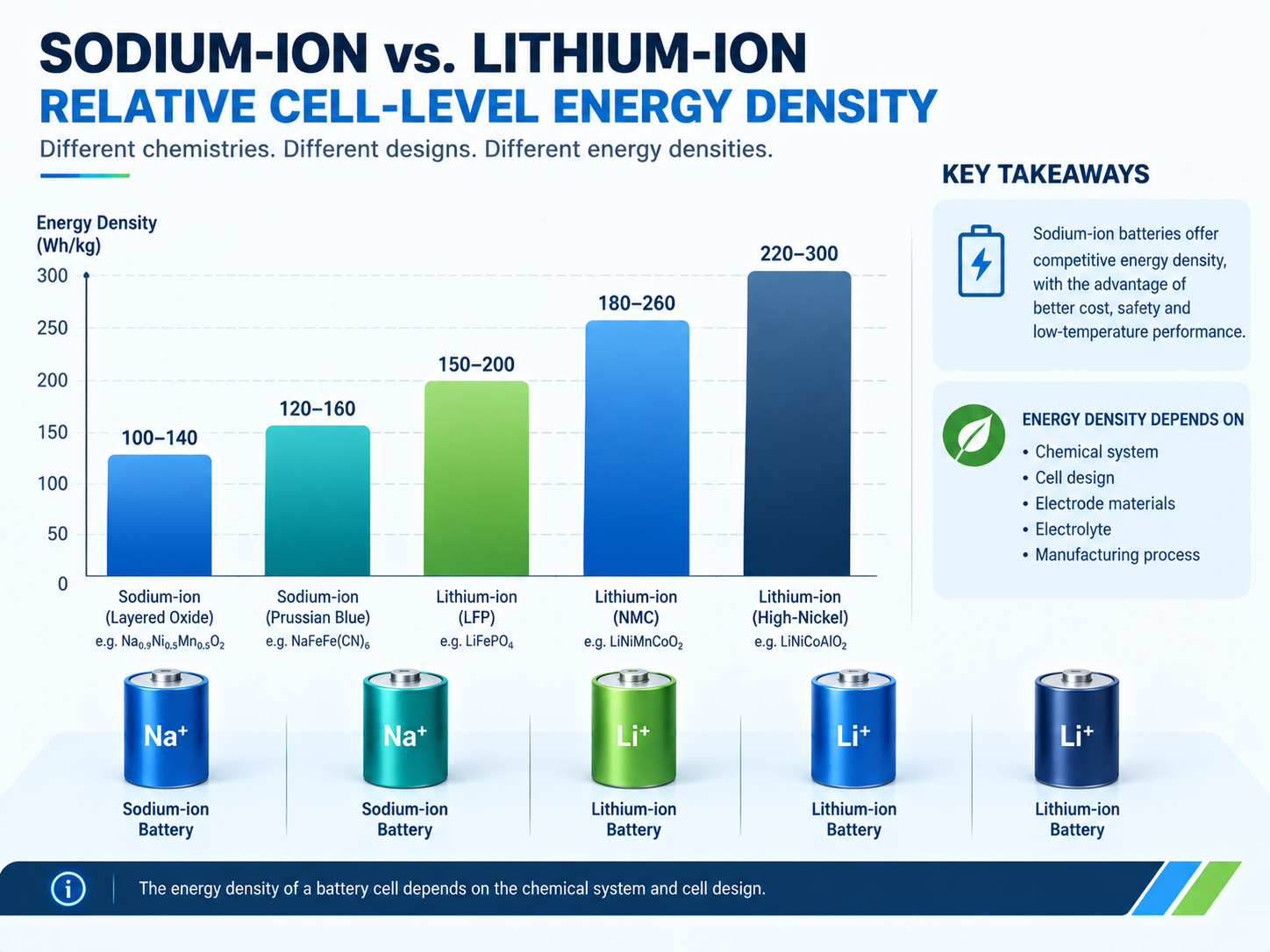
The single most cited limitation of sodium-ion batteries is energy density. Sodium-ion is heavier than lithium at the atomic level, and the cell-level energy densities reported by sodium-ion programs sit below the energy densities of mainstream lithium-ion chemistries. Volumetric energy density — watt-hours per liter of cell — is also typically lower than high-nickel or cobalt-rich lithium-ion cells.
For an automotive application, this gap matters in proportion to how much energy the battery is expected to store. A pure-electric traction pack,where every kilogram and every liter of pack volume is being squeezed to extend driving range, is the segment where the energy density gap hurts the most. Sodium-ion chemistry is not currently the right answer for that segment when competing against high-energy lithium-ion cells.
For an automotive Start-Stop battery, the energy density gap is much less painful. A Start-Stop battery does not need to store the energy of a traction pack. It needs to deliver cranking current, accept regen current, and survive thousands of shallow cycles. Sodium-ion's energy density disadvantage is real, but it is rarely the binding constraint in this duty cycle. Buyers should still ask the manufacturer for cell-level and pack-level energy density values — just not expect sodium-ion numbers to match high-energy lithium-ion numbers, and not disqualify the technology on that basis alone.
It is also worth noting that energy density is moving. Sodium-ion cathode families are at different points on the energy density curve, and pack-level engineering (cell-to-pack designs, more efficient module layouts, lower-overhead enclosures) continues to improve. The energy density gap to lithium-ion is narrowing in some chemistries and widening in others, depending on which cathode family and which manufacturer is being compared. Treat any single quoted number as a snapshot, not a permanent ceiling.
_______________________________________________________________________
Earlier Stage of Commercial Maturity
Sodium-ion batteries are not new as chemistry — they have been studied for decades — but they are new as a commercially deployed automotive product. Compared with lead-acid, AGM,EFB, and lithium-ion automotive batteries, the sodium-ion automotive battery market is at an earlier stage of commercial maturity. The number of qualified Tier-1 and Tier-2 cell suppliers is smaller. The number of validated automotive-grade pack designs is smaller. The number of vehicle programs that have used sodium-ion batteries through a full model lifecycle is smaller.
For a procurement team, this maturity gap translates into three practical things to verify. First, supplier longevity: is the sodium-ion cell manufacturer a stable company with a multi-year roadmap, or is it an early-stage venture whose continuity is uncertain? Second, validation evidence: has the specific cell and pack design been deployed in vehicles for long enough that field data exists, or is it still on its first few thousand units? Third, support infrastructure: does the supplier have an established warranty process, technical support team, and document trail for automotive customers?
This is not a reason to avoid sodium-ion. It is a reason to do the supplier diligence that an earlier-stage technology always demands. A buyer who treats sodium-ion sourcing the same way they treat sourcing for a fully mature technology — short list, lowest price, ship — will end up with a weaker supplier portfolio than the technology deserves. A buyer who does the diligence gets the upside without the maturity risk.
_______________________________________________________________________
Limited Cell Format Standardisation
Lithium-ion automotive batteries benefit from several decades of cell format evolution. Cylindrical cells (18650, 21700, 4680), prismatic cells, and various large-format pouch cells are all available with mature supply chains and standardized footprints. A lithium-ion automotive pack design can often source cells from multiple manufacturers and slot them into a common module.
Sodium-ion automotive cells are at a much earlier point on the format standardisation curve. Most sodium-ion cells currently available for automotive evaluation are prismatic or large-format pouch designs from a relatively small number of suppliers. Cylindrical sodium-ion cells exist but are less common. Standardized cross-supplier formats — the equivalent of what 21700 represents for cylindrical lithium-ion — are still forming.
For a buyer, this matters in two ways. First, it limits the ability to second-source cells quickly: a sodium-ion pack designed around one manufacturer's cell may not accept a competitor's cell without mechanical or BMS changes. Second, it makes long-term format continuity a real question: if the chosen manufacturer changes its cell format, the buyer's pack design may need to follow. Neither of these is a deal-breaker — it is simply the shape of the supply market today, and it improves as more manufacturers bring sodium-ion capacity online.
_______________________________________________________________________
Real-World Cycle Life Variability
Sodium-ion chemistry can deliver strong cycle life under controlled conditions — that is one of the technology's structural advantages. But the published cycle life numbers vary meaningfully across cathode families, cell formats, depth-of-discharge limits set by the BMS, operating temperatures, and the manufacturer's test methodology. A buyer looking at cycle life numbers from different suppliers will see different values, and a buyer looking at the same supplier's marketing versus test report will sometimes see different values as well.
The practical implication is that cycle life cannot be cited as a single number for the chemistry. It has to be qualified by: which cathode family, what depth of discharge in the test, what temperature the test ran at, what charge and discharge rates were used, and what end-of-life criterion the manufacturer is measuring to. Two cycle life numbers that look like they say the same thing may actually be measuring very different things.
For automotive Start-Stop applications specifically, cycle life matters a lot. The battery will be asked to deliver thousands of engine restarts over its service life, often at partial state of charge, often in a hot engine bay, and sometimes in cold weather. The buyer should ask suppliers for cycle data taken at a depth of discharge and temperature that matches the target vehicle use case, and should ask whether the cycle data comes from a single cell, a module, or a full pack. Pack-level cycle data is more meaningful than cell-level cycle data for a buyer deciding on an end product.
It is also worth distinguishing cycle life from calendar life. A battery that lasts many cycles but degrades quickly on the shelf is a different value proposition than a battery that lasts fewer cycles but ages slowly. Sodium-ion chemistry does not have a unique advantage or disadvantage on calendar life compared to lithium-ion; the comparison depends on the specific chemistry and the storage conditions.
_______________________________________________________________________
Cold-Weather Charging Behavior
One of sodium-ion's strongest advantages is cold-weather discharge — the ability to deliver cranking current at sub-zero temperatures. That advantage is real and worth pricing into a procurement decision. But cold-weather discharge and cold-weather charging are not the same thing, and sodium-ion's cold-weather charging behavior is more nuanced than its cold-weather discharge behavior.
Charging a sodium-ion cell at very low temperatures — below roughly −0 to −20 °C, depending on the cell — can be limited by the electrolyte's reduced ionic conductivity, by sodium plating behavior at the anode, and by the BMS limits placed on charge current at low temperatures. Some sodium-ion cell programs allow limited charging down to fairly cold conditions; others restrict charging to above freezing and rely on the vehicle's waste heat or a battery heater to warm the pack before charging.
For an automotive Start-Stop battery, the discharge side of cold-weather performance is the more important of the two — the battery has to start the engine when the temperature is low. The charging side matters less because the engine is running and the alternator is providing charge current to a battery that is warming up. But for buyers evaluating sodium-ion batteries for other applications (solar storage, portable power, anything that may need to charge in a cold environment), the cold-weather charging behavior is worth probing specifically. Ask for charge-acceptance curves at the temperatures relevant to the deployment, not just discharge curves.
_______________________________________________________________________
Automotive Certification and Homologation Gaps
Automotive batteries are not generic batteries. They have to meet vehicle-OEM specifications, regional homologation standards (such as ECE R100 for electric road vehicles in many markets), UN 38.3 transport testing, and often customer-specific validation programs. Some automotive programs also demand IATF 16949 quality management certification from the cell and pack supplier.
Sodium-ion automotive batteries are at an earlier stage of this certification journey than lithium-ion. Many sodium-ion cell and pack suppliers have completed UN 38.3 transport testing. Some have completed ECE R100 or equivalent regional standards for specific products. The number of suppliers holding full IATF 16949 certification specifically for sodium-ion production is smaller than for lithium-ion. And the number of vehicle programs that have completed multi-year field validation with sodium-ion batteries is still limited.
This is not a permanent limitation — certification coverage expands as the technology matures — but it is a real constraint in the short term. A buyer evaluating sodium-ion batteries for an automotive Start-Stop program needs to map which certifications the specific product holds, which certifications the supplier holds, and what the path is to fill any gaps before the program launches. In markets where specific homologation is mandatory, the certification status of the chosen sodium-ion product is not optional.
_______________________________________________________________________
Manufacturing Scale and Sourcing Volume
Sodium-ion battery production capacity is growing quickly, but it is still much smaller than lithium-ion production capacity. The number of GWh of sodium-ion cells produced annually worldwide is a small fraction of the number of GWh of lithium-ion cells produced annually worldwide. That gap matters in several practical ways.
For a buyer, a smaller production base means smaller order volumes in many cases — some sodium-ion cell suppliers have minimum order quantities that are different from what a buyer used to lithium-ion supply is used to. It means longer lead times in tight market conditions, because the buffer inventory across the supply chain is thinner. It means fewer second-source candidates with comparable capacity. It means that any single supplier's production problem — a quality issue, a force majeure event, a financial disruption — has a larger relative impact on the buyer's supply continuity.
Multi-year contracts with growing volume commitments are one common response: they give the manufacturer the volume signal it needs to expand capacity, and they give the buyer the supply security it needs to commit to downstream programs. Buyers should expect to have more active conversations with sodium-ion suppliers about capacity reservation, capacity expansion, and supply continuity than they would with a fully mature lithium-ion supplier — and should treat those conversations as part of normal sourcing, not as a red flag.
_______________________________________________________________________
Recycling and End-of-Life Infrastructure Still Maturing
Sodium-ion batteries have a structural advantage on recycling — they do not contain cobalt in most chemistries, the aluminum current collectors are already a mature recycling stream, and the cathode metals are typically earth-abundant. But end-of-life infrastructure that specifically targets sodium-ion is still at an early stage. Most recycling facilities are optimized for lithium-ion chemistries. Sodium-ion-specific collection networks, disassembly procedures, and hydrometallurgical or pyrometallurgical recovery processes are still being established.
For a buyer evaluating sodium-ion batteries today, this is mostly a future-state consideration rather than a present-day constraint — a Start-Stop battery bought today will reach end of life several years from now, and recycling infrastructure will have expanded by then. But for buyers planning extended producer responsibility (EPR) commitments, take back programs, or compliance with emerging battery recycling regulations (such as the EU Battery Regulation), it is worth asking the supplier what recycling pathways exist for the specific chemistry and what end-of-life documentation they can provide.
It is also worth noting that some current sodium-ion recycling routes borrow from existing lithium-ion recycling infrastructure — particularly pyrometallurgical processes that recover metal value regardless of which lithium or sodium cathode chemistry was used. The recycling infrastructure is less chemistry-specific than it might appear. But optimized hydrometallurgical recovery of sodium-ion cathode materials is still a developing field.
_______________________________________________________________________
What These Limitations Mean for Automotive Start-Stop Buyers
Translating the limitations above into Start-Stop buying decisions, five points stand out.
• Energy density is not the binding constraint here. A Start-Stop battery does not need traction-pack energy density. Sodium-ion's energy density gap to lithium-ion is real but rarely disqualifying in this duty cycle. Focus the supplier evaluation on cranking performance, cycle life at the target depth of discharge, and cold-weather discharge behavior instead.
• Maturity demands active supplier diligence. Sodium-ion is earlier-stage than lithium-ion. Treat supplier selection as a structured diligence process — financial stability, validation evidence, warranty process, technical support, and documentation — not a price comparison.
• Format standardisation limits quick second-sourcing. Sodium-ion cell formats are less standardised across suppliers than lithium-ion formats. Locking in a cell-source strategy with an intentional second-source path is more important than it is for mature chemistries.
• Cold-weather discharge is strong; cold-weather charging needs verification. For Start-Stop service, discharge at sub-zero temperatures is the priority and sodium-ion chemistry has a real edge. For buyers evaluating sodium-ion for cold-weather charging applications, ask for charge-acceptance data specifically.
• Certification and capacity are short-term constraints. Map which homologation and certifications the chosen product holds, and which the supplier holds, before committing to a launch. Build multi-year volume commitments into supply agreements to support capacity expansion.
These limitations do not disqualify sodium-ion chemistry from automotive Start-Stop service. They define what the buyer should verify. A buyer who walks into sodium-ion sourcing aware of these constraints — and who structures the supplier relationship to address them — is in a much stronger position than a buyer who walks in expecting sodium-ion to behave like a fully mature automotive battery chemistry. Sodium-ion is a credible candidate for Start-Stop service today; it is just not yet a mature commodity. Treat it accordingly.
_______________________________________________________________________
Frequently Asked Questions
What is the biggest limitation of sodium-ion batteries?
Energy density is the most cited limitation. Sodium-ion cell-level energy density is lower than mainstream lithium-ion chemistries, particularly high-nickel or cobalt-rich lithium-ion cells. For traction-pack applications where weight and volume are critical, this is a real disadvantage. For Start-Stop and other auxiliary battery uses, it is rarely the binding constraint. Other important limitations include technology maturity, cell format standardisation, automotive certification coverage, and current production scale.
Why is sodium-ion energy density lower than lithium-ion?
Sodium is heavier than lithium at the atomic level, which reduces gravimetric energy density. Sodium also tends to intercalate into host materials with larger volume changes and fewer available high-energy cathode frameworks, which limits volumetric energy density. The cathode family, the electrolyte salt concentration, the cell format, and the pack-level engineering all affect how large the gap is in practice.
Are sodium-ion batteries mature enough for cars?
Sodium-ion chemistry is mature enough to be evaluated seriously for automotive Start-Stop and certain auxiliary applications. It is less mature than lithium-ion as a deployed automotive chemistry, and the number of suppliers, validated products, and certification records is smaller. Buyers should treat sodium-ion as a credible but earlier-stage technology and do the supplier diligence that an earlier-stage technology demands.
Do sodium-ion batteries have cold-weather problems?
Sodium-ion chemistry generally performs well in cold-weather discharge, often better than mainstream lithium-ion chemistries at sub-zero temperatures. Cold-weather charging is more nuanced —some chemistries restrict charging at low temperatures to avoid sodium plating and rely on a battery heater for cold environments. For Start-Stop service, cold-weather discharge is the priority and sodium-ion has a real edge there.
Will sodium-ion batteries replace lithium-ion batteries?
Not as a blanket statement. In some segments — Start-Stop, certain auxiliary loads, low-speed electric vehicles, and stationary storage in cost-sensitive or cold-climate contexts — sodium-ion chemistry can replace or complement lithium-ion batteries. In segments where energy density is the binding constraint, lithium-ion chemistries still lead. The right framing for a buyer is application fit, not blanket replacement.
Internal Link Recommendations
• What Is a Sodium-Ion Battery? Complete Guide — sodium-ion cluster pillar (Article 01). Place inside the introduction to give readers a quick path back to the foundational definition before reading the limitations.
• What Are the Advantages of Sodium-Ion Batteries? — sodium-ion advantages article (Article 04). Place inside the introduction or the closing synthesis section so readers can move directly between the limitations article and its advantages counterpart.
• How Does a Lithium Battery Work? — lithium cluster mechanism article. Place inside the energy density section to give readers a direct comparison point on the lithium side.
 Hot News
2026-10-30
2026-10-26
2026-10-22
2026-10-14
2026-10-07
2026-10-02

Pittar Power is a professional manufacturer specializing inenergy storage solutions.
Room 302, Building 1, No. 10, Huangjin First Road, Nancheng District, Dongguan City, Guangdong Province, China
Copyright © Shenzhen Pittar Power Co., Ltd. All Rights Reserved Privacy Policy
 EN