What Are the Advantages of Sodium-Ion Batteries?
Sodium-ion batteries keep surfacing in industry roadmaps for one simple reason: the working ion is sodium, and sodium is not scarce, expensive, or concentrated in a small number of producing regions. That single fact reshapes a lot of downstream decisions — raw-material cost trajectories, supply-chain flexibility, cold-weather behavior, and how confidently a manufacturer can plan multi-year production.
But resource abundance alone does not make a battery technology suitable for vehicles. The advantages worth paying attention to are the ones that translate into a better battery under the hood of an automotive Start-Stop car. This article walks through the practical advantages of sodium-ion batteries as they actually apply to importers, distributors, wholesalers, OEM and ODM procurement teams, and engineering companies evaluating sodium-ion products for automotive use.
Every advantage below is real — but every advantage also depends on the chosen cathode family, cell format, pack design, and the manufacturer’s engineering execution. Where a specific value cannot be given without picking a chemistry or a supplier, the article stays qualitative on purpose.
_______________________________________________________________________
Sodium Availability and Resource Security
Sodium is the sixth most abundant element in the Earth’s crust. It is widely available in rock salt, sea salt, and soda ash deposits, and it is not a critical mineral under most supply chain classifications. Lithium, by contrast, is far less abundant in the Earth’s crust, is concentrated in a small number of producing countries, and is treated as a critical raw material by several major economies.
For a procurement team weighing ten-year supply security, this difference matters. A technology whose active ion comes from a globally distributed, low-cost raw material is easier to source, hedge, and substitute than a technology whose active ion comes from a handful of concentrated suppliers. That does not mean sodium-ion batteries are immune to supply risk — the cathode still uses transition metals, the electrolyte uses salts and solvents, and the hard carbon anode has its own supply chain. It does mean that the working-ion side of the cell is unlikely to be the bottleneck.
For B2B buyers, the practical implication is simpler planning. Sodium raw-material pricing has historically been far less volatile than lithium pricing, which translates into more predictable input costs for the manufacturer and, potentially, more stable pricing for the buyer over multi-year contracts. Actual realized cost depends on cell design, cathode family, and where in the cost-down curve the manufacturer sits — not just on raw sodium.
_______________________________________________________________________
Cost Potential from Raw Materials and Cell Design
Sodium-ion’s cost story is more nuanced than “cheaper than lithium,η but it does have a defensible structural basis. The structural drivers worth naming are the working ion itself, the cathode metals, and the current collectors used inside the cell.
On the cathode side, sodium-ion chemistries can be built around earth-abundant transition metals. Layered oxides often use nickel-manganese-iron combinations without scarce metals, polyanion cathodes can lean on phosphate and vanadium or entirely on iron-based frameworks, and Prussian-blue-analogue cathodes can be made without nickel or cobalt at all. Cobalt, which has been one of the most ethically and economically challenging inputs in some lithium-ion chemistries, is not a required material in mainstream sodium-ion cathode formulations.
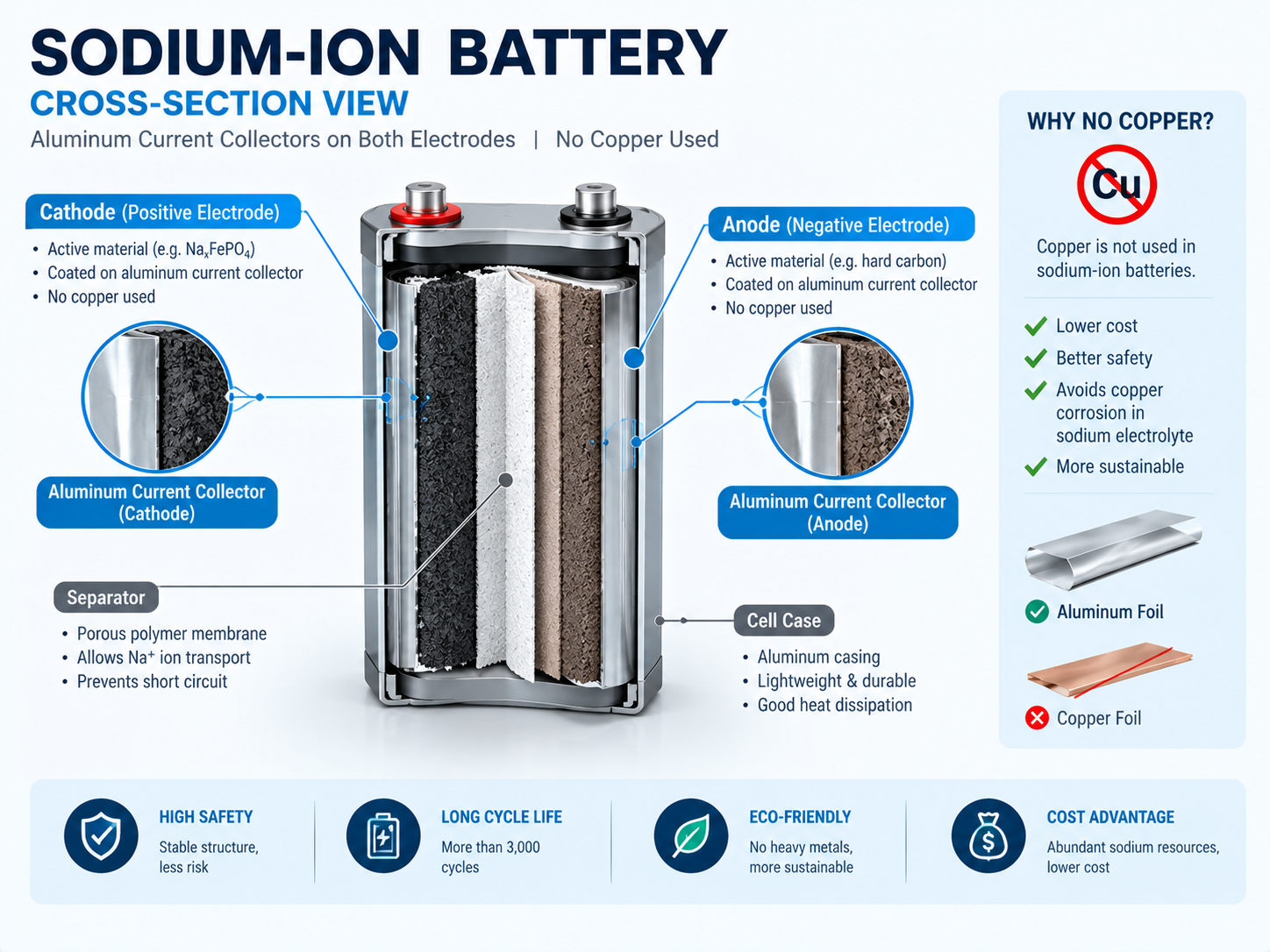
On the current-collector side, sodium-ion cells can use aluminum foil on both the cathode and the anode. Sodium does not alloy with aluminum at typical cell voltages, so the copper foil that lithium-ion cells require on the anode side is not needed. Aluminum is lighter and cheaper than copper, and using it on both sides is one of the structural cost-down levers the technology is built around.
None of this means a sodium-ion battery automatically costs less than a comparable lithium-ion battery today. ln many product categories the two are at parity or sodium-ion is even slightly more expensive, because the technology is earlier in its manufacturing learning curve. The cost trajectory, however, is structurally favorable — and for a buyer planning a multi-year sourcing strategy, trajectory matters as much as the current price tag.
_______________________________________________________________________
Cold-Weather Performance as a Practical Advantage
One of the most consistently cited advantages of sodium-ion chemistry is its ability to retain capacity, power, and reasonable charge acceptance at low temperatures. Several published sodium-ion cell programs have demonstrated usable discharge and charge behavior below 0 °C, and in many cases down to _20 °C and beyond. That is meaningful for any battery that lives outside in winter — which includes most automotive batteries.
The reasons are partly chemical and partly structural. Sodium-ion electrolytes can be formulated with solvents and additives that keep ionic conductivity reasonable at sub-zero temperatures. Hard carbon anodes tend to retain their sodium insertion capability at low temperatures better than graphite anodes do for lithium. And the absence of copper on the anode side removes one of the failure modes that lithium-ion cells face in extreme cold.
For an automotive Start-Stop battery, the practical implication is straightforward. A driver in a _15 °C morning expects the engine to restart cleanly. A battery that can deliver high cranking current at that temperature, then accept regen current from the alternator as the vehicle warms up, is a battery that does not strand its user. Sodium-ion chemistry has a structural advantage here, though again — actual cold performance depends on the specific electrolyte formulation, the cell design, the BMS cold-current limits, and the manufacturer’s validation. A poorly engineered sodium-ion cell will still perform poorly in the cold. A well-engineered one has a real edge.
_______________________________________________________________________
Thermal Stability and Safety Behavior
Safety in a battery is never just about chemistry. It is a combination of cell chemistry, cell format, separator quality, electrolyte stability, BMS behavior, thermal management, and pack engineering. Sodium-ion batteries do, however, start from a chemistry base that is generally more thermally stable than some mainstream lithium-ion chemistries — particularly those that rely on cobalt or high-nickel layered cathodes.
Several sodium-ion cathode families, especially the polyanion and Prussian-blue-analogue families, have intrinsically more stable crystal structures than layered lithium-ion cathodes. They are less prone to oxygen release at elevated temperatures, which is one of the main triggers for thermal runaway in lithium-ion cells. Sodium-ion electrolytes, while still carbonate-based and flammable, do not have the same cobalt-oxide-related failure modes some lithium-ion cells exhibit.
That said, “more thermally stable” is not the same as “safe by default.” A sodium-ion cell that is overcharged, mechanically crushed, short-circuited, or installed in a poorly ventilated pack can still fail. The right way to read this advantage is: the baseline thermal runway risk of a well-engineered sodium-ion cell is generally lower than that of a high-energy-density lithium-ion cell using a high-nickel or cobalt-rich cathode. The right way to misuse this advantage is to claim sodium-ion batteries cannot fail under any condition.
For automotive Start-Stop service, where the battery sits in a hot engine bay and is expected to operate across wide ambient temperatures, this baseline thermal margin is a useful — but not sufficient — design advantage. The pack engineering, BMS limits, and separator quality still carry most of the safety load.
_______________________________________________________________________
Cycling Behavior Under Frequent Engine Restarts
A Start-Stop battery is asked to do something a conventional car battery rarely does: deliver thousands of engine restarts over its life, often at partial state of charge, often while supporting auxiliary electrical loads during engine-off periods. That duty cycle favors chemistries with strong cycle life at moderate depth of discharge.
Several sodium-ion cell programs have demonstrated cycle life in the multi-thousand-cycle range under controlled conditions, particularly using polyanion and Prussian-blue-analogue cathode families. Hard carbon anodes are mechanically robust through repeated sodium insertion, and the electrolytes developed for sodium-ion cells are engineered to maintain stable solid-electrolyte interphase (SEI) over many cycles.
For a Start-Stop buyer, the practical question is not “how many cycles can the chemistry do in a lab” but “how many engine restarts can this specific pack do in a real vehicle in a real climate.” That number depends on depth of discharge limits set by the BMS, the operating temperature window, the restarts per day the driver actually performs, and the manufacturer’s cycle testing methodology. A buyer comparing sodium-ion products should ask suppliers for cycle data taken at realistic depth of discharge (not just at 100% depth) and at temperatures relevant to the target vehicle’s operating environment.
_______________________________________________________________________
Manufacturing Compatibility with Existing Battery Lines
One of the less-discussed but very real advantages of sodium-ion batteries is that they can be manufactured on existing lithium-ion production lines with limited retooling. Electrode coating, calendering, slitting, stacking or winding, electrolyte filling, formation, and aging are all process steps that map closely between the two technologies.
For a battery manufacturer, this means the capital cost to enter sodium-ion production is lower than it would be for a brand-new chemistry requiring entirely new equipment. For a B2B buyer, that translates into a more diverse manufacturing ecosystem — more suppliers, more geographic options, more willingness to take on new programs — because the barrier to producing sodium-ion cells is lower than the barrier to producing an entirely novel battery type.
It also means that sodium-ion battery makers can apply lessons learned from two decades of lithium-ion manufacturing scale-up. Process control, quality consistency, defect detection, and statistical process control are all areas where the lithium industry has built expertise, and sodium-ion starts from that baseline rather than from zero. The advantage is not that sodium-ion manufacturing is easier — battery manufacturing is never easy — but that it starts from a more mature industrial playbook.
_______________________________________________________________________
Supply-Chain Diversification and Geographic Flexibility
Because the raw materials for sodium-ion batteries are more globally distributed and less concentrated than the raw materials for lithium-ion batteries, sodium-ion production can in principle be located closer to end markets. Sodium carbonate and sodium bicarbonate are widely produced across many countries. Hard carbon precursors (coconut shells, biomass-derived carbons, petroleum-pitch-derived carbons) are not tied to a small number of producing regions. Aluminum foil is a globally mature commodity.
For an importer or distributor, this means more flexibility in choosing where a sodium-ion battery is sourced from, and more resilience against the geopolitical and logistical disruptions that have periodically affected lithium and cobalt supply. For an OEM or ODM buyer, it means the option to qualify suppliers in more than one region, which is itself a risk-management advantage.
This advantage is real at the raw-material level. At the finished-cell level it is more nuanced — finished-cell production is still concentrated in a relatively small number of countries, and sodium-ion cell capacity is still ramping up. Buyers should expect the geographic flexibility to expand as more cell manufacturers bring sodium-ion lines online, not to assume it is already fully realized.
_______________________________________________________________________
Recycling and End-of-Life Considerations
Recycling is not yet the dominant decision factor for most automotive battery buyers, but it is becoming one. Sodium-ion batteries have a structural advantage here that is worth naming without overstating.
Sodium-ion cells do not contain lithium, cobalt, or in most cases nickel-heavy cathodes. The materials most worth recovering — sodium salts, transition metals from the cathode, aluminum current collectors, hard carbon — are either abundant or already have established recycling streams. The hard carbon anode can often be processed using thermal or hydrometallurgical routes similar to those used for graphite anodes. The absence of cobalt simplifies the recycling chemistry and reduces the ethical and supply-chain concerns associated with cobalt recovery.
For B2B buyers thinking about end-of-life responsibility, take-back programs, or compliance with emerging battery recycling regulations, sodium-ion chemistry is structurally easier to integrate into existing recycling infrastructure than some high-cobalt or high-nickel lithium-ion chemistries. The exact recycling economics depend on collection volumes, recycling facility capability, and the recovery value of the specific transition metals used in the chosen cathode family.
_______________________________________________________________________
What These Advantages Mean for Automotive Start-Stop Buyers
Translating the chemistry-level advantages above into Start-Stop buying criteria, four points stand out.
• Cold-weather reliability. If the target market includes regions with cold winters, sodium-ion chemistry’s structural advantage at sub-zero temperatures is worth prioritizing in the supplier evaluation. Ask for cold-cranking data at the specific temperatures relevant to the vehicles being served.
• Cost trajectory over the program life. If the buyer is planning a multi-year sourcing program rather than a one-off purchase, sodium-ion’s structural cost-down potential — driven by sodium abundance, cathode metal mix, and aluminum-on-both-sides — is more relevant than the current unit price.
• Cycle life in real Start-Stop duty. A Start-Stop battery lives by its cycle count. Sodium-ion chemistry can deliver strong cycle life, but the pack-level number depends on depth of discharge limits set by the BMS, the operating temperature, and the manufacturer’s testing methodology. Ask for cycle data at the depth of discharge and temperature that matches the target vehicle use case.
• Thermal margin in the engine bay. A more thermally stable cathode chemistry gives more design margin for the BMS and the pack engineer. It does not remove the need for proper thermal management, separator quality, and pack validation — but it does raise the baseline.
These advantages make sodium-ion chemistry a credible candidate for Start-Stop service. They do not, by themselves, make a specific sodium-ion product the right battery for a specific vehicle. The cell engineering, the BMS quality, the pack validation, and the supplier’s track record still determine whether a particular sodium-ion battery delivers on its chemistry’s promise. Buyers evaluating sodium-ion products for automotive Start-Stop applications should weigh the chemistry-level advantages above alongside pack-level specifications, vehicle compatibility, supplier validation evidence, and total cost of ownership over the program life.
_______________________________________________________________________
Frequently Asked Questions
What is the biggest advantage of sodium-ion batteries?
Sodium is far more abundant and globally distributed than lithium, which gives sodium-ion chemistry a more favorable raw-material cost trajectory and supply-chain flexibility.The other widely cited advantage is cold-weather performance, where sodium-ion chemistry tends to retain capacity and power better than mainstream lithium-ion chemistries at sub-zero temperatures. Actual realized benefit depends on the chosen cathode family, cell design, and manufacturer engineering.
Are sodium-ion batteries cheaper than lithium-ion batteries?
Not always at current production volumes. Sodium-ion has a structurally favorable cost trajectory because sodium is cheap, the cathode can avoid scarce metals like cobalt, and aluminum can be used as the current collector on both sides of the cell. But sodium-ion manufacturing is earlier in its learning curve, and in many product categories the two chemistries are at price parity today. Buyers should focus on multi-year cost trajectory rather than current unit price alone.
Do sodium-ion batteries really work in cold weather?
Several published sodium-ion cell programs have demonstrated usable discharge and charge behavior below 0 °C, and in some cases down to −20 °C and beyond. The advantage comes partly from the electrolyte formulation and partly from the hard carbon anode, which retains sodium insertion capability at low temperatures better than graphite does for lithium. Actual cold performance depends on the specific cell design, BMS limits, and the manufacturer’s validation.
Are sodium-ion batteries safer than lithium-ion batteries?
Several sodium-ion cathode families are intrinsically more thermally stable than high-nickel or cobalt-rich lithium-ion cathodes, which gives sodium-ion cells a higher thermal runaway threshold in well-engineered designs. Sodium-ion batteries are not, however, immune to thermal, mechanical, or electrical abuse. Safety still depends on cell engineering, separator quality, BMS behavior, and pack design. Treat sodium-ion as a chemistry with a better thermal baseline, not as a battery that cannot fail.
Can sodium-ion batteries replace lithium-ion batteries in vehicles?
In some automotive applications — particularly Start-Stop, mild-hybrid auxiliary, and certain low-voltage EV auxiliary loads — sodium-ion chemistry is a credible candidate that can replace or complement lithium-ion batteries. In high-energy-density traction packs where weight and volume are critical, lithium-ion chemistries generally still lead. For automotive buyers, the right framing is application fit, not blanket replacement.
 Hot News
2026-10-30
2026-10-26
2026-10-22
2026-10-14
2026-10-07
2026-10-02

Pittar Power is a professional manufacturer specializing inenergy storage solutions.
Room 302, Building 1, No. 10, Huangjin First Road, Nancheng District, Dongguan City, Guangdong Province, China
Copyright © Shenzhen Pittar Power Co., Ltd. All Rights Reserved Privacy Policy
 EN