What Are Sodium-Ion Batteries Made Of?
A sodium-ion battery is not one single material. It is a layered assembly of carefully chosen cathode powders, anode powders, electrolyte salts, separators, current collectors, a battery management system, and a mechanical pack that holds it all together. For B2B buyers evaluating sodium-ion batteries — especially importers, distributors, wholesalers, and OEM or ODM procurement teams looking at automotive start-stop applications —understanding what is actually inside the battery is the difference between choosing a product on its chemistry label and choosing it on the engineering decisions that drive real performance.
This guide walks through the main sodium-ion battery components one layer at a time, explains why each material choice matters, and ends with what those choices mean for the kind of cell that ends up under the hood of a Start-Stop vehicle.
_______________________________________________________________________
Cathode Material Families
The cathode is the most variable sodium-ion battery component. Different sodium-ion chemistries on the market today use different cathode material families, and the choice of cathode is the single biggest driver of cell-level energy density, cycle behavior, cost trajectory, and even low-temperature performance. Three families dominate commercial development.
Layered Transition-Metal Oxides
Layered oxides are the closest sodium-ion analogue to the NMC-type cathodes used in many lithium-ion cells. They are typically built around sodium combined with one or more transition metals — commonly nickel, manganese, and iron in various ratios — arranged in a layered crystal structure. Compositions such as NaNi1/3Mn1/3Fe1/3O2 and similar variants are widely cited in technical literature.
Layered oxides tend to deliver relatively high cell-level energy density for a sodium-ion chemistry, and they can be manufactured using processes familiar to existing lithium-ion cathode lines. They are also more sensitive to moisture and air than some other cathode families, which can add to cell production cost. For buyers, layered oxide cells are best understood as the sodium-ion option most likely to compete on a Wh-per-kilogram basis with mainstream lithium chemistries.
Polyanion Compounds
Polyanion cathodes are built around sodium combined with phosphate, sulfate, or similar polyanion groups rather than a simple layered oxide. Sodium vanadium phosphate (Na3V2(PO4)3) and related compositions are commonly referenced examples. The crystal structure is more open and stable than layered oxides, which often translates into longer cycle life and better thermal stability— two properties that matter a lot for automotive applications.
The trade-off is usually energy density. Polyanion cells often sit below layered oxides in Wh-per-kilogram, which is why they are less commonly discussed for weight-sensitive traction packs. For stationary or mid-power roles such as Start-Stop service, where cycle life and thermal stability often matter more than the last 10–20 Wh/kg, polyanion chemistries can be a sensible choice. Actual energy density, cycle life, and rate capability vary with the exact polyanion composition and how the cell is engineered, so supplier datasheets should always be checked rather than relying on chemistry labels alone.
Prussian Blue Analogues
Prussian blue analogues — sometimes called Prussian white when fully sodiated — are another commercially active cathode family for sodium-ion cells. They use a framework structure with sodium inserted into channels in the crystal lattice. They tend to be lower cost in raw materials because they can be made without scarce transition metals, and they typically offer a long cycle life.
Their main drawback in a vehicle application is usually lower volumetric energy density and a higher tendency to trap water in the crystal structure, which can affect manufacturing consistency. For B2B buyers, Prussian-blue-based cells should be evaluated carefully on pack-level energy density, low-temperature performance, and supplier quality control — not on raw chemistry claims.
_______________________________________________________________________
Anode — Hard Carbon as the Dominant Choice
The anode side of a commercial sodium-ion cell is, in practice, dominated by hard carbon. Hard carbon is a disordered carbon material with a structure that can reversibly take sodium ions in and out during charge and discharge. It became the default sodium-ion anode because sodium ions do not intercalate cleanly into graphite — the anode of choice for most lithium-ion cells— so a different carbon structure was needed.
Hard carbon delivers reasonable specific capacity for a sodium-ion anode, stable cycling behavior, and a raw material supply chain that does not require the same kind of high-purity graphite sourcing used by some lithium chemistries. It is also commercially mature: multiple qualified suppliers exist, and the manufacturing process is broadly compatible with existing electrode coating lines.
Other anode materials — including soft carbon, composite carbons, titanium-based compounds, and alloy-type materials — are being researched and, in a few cases, commercialized. For most automotive sodium-ion batteries on the market today, however, hard carbon remains the realistic baseline. Buyers comparing datasheets will most often see sodium-ion cells described simply as using a hard carbon anode, with the more interesting differences sitting in the specific surface area, particle size distribution, and first-cycle efficiency of that hard carbon rather than in the anode family itself.
_______________________________________________________________________
Electrolyte — Sodium Salts in Carbonate Solvents
The electrolyte is the ionic highway between the cathode and the anode. In a sodium-ion cell it is typically a sodium salt — most commonly NaPF6 or NaClO4 — dissolved in carbonate-based solvents such as ethylene carbonate, propylene carbonate, dimethyl carbonate, and ethyl methyl carbonate, used alone or in blends.
The electrolyte has to do three things at once. It has to conduct sodium ions efficiently between the electrodes, stay chemically stable against both the cathode and the anode at the cell's operating voltage, and remain liquid and conductive across the full temperature range the battery is expected to see — from cold winter mornings to a hot engine bay in summer. Additives such as fluoroethylene carbonate (FEC) are commonly used to stabilize the solid electrolyte interphase (SEI) on the hard carbon anode and improve cycle life.
Some research groups and a few suppliers are exploring gel polymer electrolytes and solid-state sodium-ion electrolytes, but for current commercial automotive products the liquid carbonate-based electrolyte remains standard. For B2B buyers, the practical implication is that sodium-ion cells share many of the same temperature, venting, and leakage considerations as liquid-electrolyte lithium-ion cells. A pack design that handles electrolyte management well for one typically handles it well for the other.
_______________________________________________________________________
Separator, Current Collectors, and Cell Housing
The separator is a thin porous polymer membrane — typically a polyethylene, polypropylene, or ceramic-coated variant similar to those used in lithium-ion cells— that physically isolates the cathode and anode while allowing sodium ions to pass through. The separator is soaked in electrolyte and acts as the mechanical insulator between the two electrodes. A separator failure — whether from a manufacturing defect, dendrite growth, or mechanical damage — leads directly to internal short circuiting, which is why separator quality is a real procurement concern rather than a footnote.
Current collectors are the conductive layers that carry electrons to and from each electrode. Sodium-ion cells typically use aluminum foil on both the cathode and the anode. This is a meaningful structural difference from mainstream lithium-ion cells, which must use copper foil on the anode side because aluminum reacts with lithium at low voltages. Sodium does not alloy with aluminum at typical cell potentials, so both sides can use lighter, cheaper aluminum foil — one of the contributing factors behind sodium-ion's potential cost advantage.
The cell itself is sealed inside a rigid housing. Cylindrical, prismatic, and pouch formats are all used in different sodium-ion programs, depending on the manufacturer and target application. For automotive Start-Stop service, prismatic and cylindrical formats are the most common because they handle the mechanical, thermal, and vibration stresses of the engine bay more predictably than pouch cells. Venting design, terminal layout, and hold-down dimensions all matter when the battery is expected to be a drop-in replacement for a conventional automotive battery.
_______________________________________________________________________
Battery Management System (BMS) and Electronics
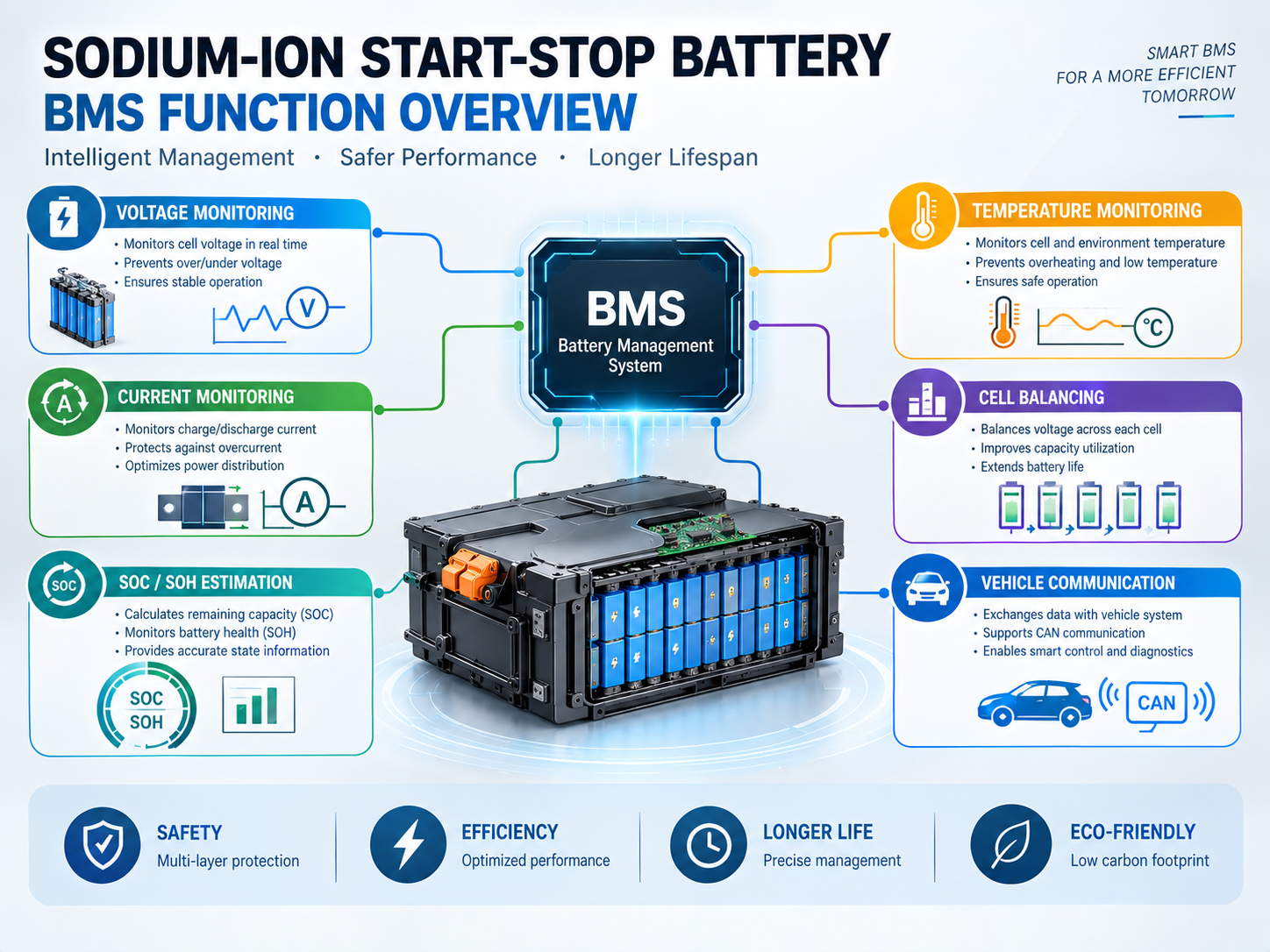
The cells are only half of a commercial sodium-ion battery. The other half is the battery management system — the electronics board that monitors each cell or group of cells, controls charge and discharge, balances cell states, and protects the pack against unsafe events. In a Start-Stop battery the BMS typically handles:
• Voltage monitoring across every cell, so that no cell is driven outside its safe voltage window.
• Current monitoring during both charge and discharge, including the very high cranking current pulses demanded by the starter motor.
• Temperature monitoring at multiple points in the pack, often including sensors on the cells, the terminals, and sometimes the BMS board itself.
• Cell balancing during charging, so that cells in series stay at similar states of charge and the pack does not lose usable capacity over time.
• State-of-charge (SOC) and state-of-health (SOH) estimation, which the vehicle can use to decide when to enable or disable Start-Stop, dim accessories, or warn the driver.
• Communication with the vehicle electrical system, typically through a LIN or CAN bus, depending on the application.
The chemistry inside the cells is sodium-ion, but the role of the BMS is essentially the same as in a lithium-ion pack. For B2B buyers, this means the evaluation criteria for a sodium-ion BMS — firmware quality, sensor accuracy, automotive-grade components, validation history, and communication protocol compliance — are not entirely new. They are the same criteria buyers already use on lithium-ion automotive batteries, applied to a different silicon in the cell.
_______________________________________________________________________
Cell Format and Pack-Level Assembly
At the cell level, sodium-ion products use one of three main formats. Cylindrical cells — similar in concept to the 18650 and 21700 formats common in lithium-ion — stack jellyroll electrodes inside a metal can. Prismatic cells pack layered electrodes inside a rigid rectangular metal housing. Pouch cells use a flexible laminated film enclosure and rely on external structure for mechanical support.
At the pack level, a commercial sodium-ion battery for an automotive Start-Stop application usually arranges cells in series to reach a nominal 12 V system voltage, then adds the BMS, busbars, terminals, thermal management features, and a rugged enclosure sized to fit a standard automotive battery tray. The pack assembly choices — cell format, series-parallel configuration, terminal orientation, venting path, and BMS placement — directly determine whether the finished battery can be installed as a direct replacement for a conventional lead-acid or AGM Start-Stop battery.
Two packs with the same cell chemistry and the same nominal capacity can deliver very different real-world performance if the pack assembly is poor. Heat dissipation, vibration tolerance, terminal corrosion protection, and BMS placement inside the housing are all engineering decisions, not chemistry decisions. For buyers, the pack-level specification sheet — not the cell chemistry label — is the right document to compare.
_______________________________________________________________________
What Component Choices Mean for Automotive Start-Stop Buyers
The reason a buyer should care about the components inside a sodium-ion battery — rather than treating it as a black box labelled “sodium-ion” — is that the component choices drive the practical questions procurement teams actually ask:
• Will it crank the engine at −20 °C? That depends on cathode family, electrolyte formulation, hard carbon surface area, and BMS cold-current limits — not on the word “sodium-ion” on the label.
• How many engine restarts will it survive? That depends on cycle life of the chosen chemistry, depth-of-discharge limits enforced by the BMS, and the temperature the pack actually operates at.
• Will it fit the existing battery tray? That depends on cell format and mechanical pack dimensions, not on cell chemistry.
• Will it talk to the vehicle properly? That depends on the BMS communication protocol and validation, not on cell chemistry.
• How much usable capacity will it retain after two years? That depends on cathode stability, SEI quality, electrolyte composition, and operating conditions — not on cell chemistry in isolation.
In short, the component choices determine whether a sodium-ion battery is a real candidate for a specific Start-Stop vehicle. The chemistry label only tells a buyer where in the design space to look.
_______________________________________________________________________
FAQ
What is the main material inside a sodium-ion battery?
The two main active materials are the cathode — typically a sodium-containing layered oxide, polyanion compound, or Prussian blue analogue— and the anode, which is most commonly hard carbon. The electrolyte, separator, current collectors, and BMS together make up the rest of the cell and pack.
Do sodium-ion batteries use lithium, cobalt, or nickel?
Sodium-ion batteries are designed to use sodium as the working ion instead of lithium. Some cathode chemistries still use transition metals such as nickel, manganese, or iron, but cobalt is not a required material in mainstream sodium-ion cathode formulations. The exact metal mix depends on the cathode family.
Why do sodium-ion cells use aluminum on both sides?
Sodium does not alloy with aluminum at the typical cell operating voltage. This means aluminum foil can be used as the anode current collector, removing the need for the copper foil that lithium-ion cells require on the anode side. Aluminum is lighter and cheaper than copper, which is one of the factors behind sodium-ion's potential cost advantage.
Are sodium-ion battery components the same as lithium-ion battery components?
Several components are similar in concept — separator, electrolyte approach, current collectors, BMS architecture — but the active materials are different. Sodium-ion cells use sodium-based cathodes, hard carbon anodes, and sodium-salt electrolytes instead of lithium-based cathodes, graphite anodes, and lithium-salt electrolytes.
What should a buyer look for first when comparing sodium-ion batteries for vehicles?
Start with the pack-level specification sheet, not the chemistry label. Look at cold-cranking amps (CCA), cycle life under partial state of charge, operating temperature range, BMS communication protocol, dimensions and terminal layout, and the manufacturer's validation evidence for the specific vehicle class.
 Hot News
2026-10-30
2026-10-26
2026-10-22
2026-10-14
2026-10-07
2026-10-02

Pittar Power is a professional manufacturer specializing inenergy storage solutions.
Room 302, Building 1, No. 10, Huangjin First Road, Nancheng District, Dongguan City, Guangdong Province, China
Copyright © Shenzhen Pittar Power Co., Ltd. All Rights Reserved Privacy Policy
 EN