Why the Question Has No Single Number
A buyer or workshop technician asking how many times does a start-stop battery start a car is asking a perfectly natural question, and it is also one of the hardest to answer with a single figure. The honest answer is that no universal number exists, and any vendor who tries to give one is simplifying a duty cycle that is fundamentally shaped by the driver, the vehicle, and the chemistry inside the case.
Three categories of input control the answer. First, the vehicle and its electrical system: how often the engine shuts off at a stop, how much accessory load runs while it is off, and how aggressively the alternator and regenerative braking system push charge back in. Second, the chemistry and the cell design chosen for the battery itself, which set a theoretical envelope of how many restarts the hardware can survive before capacity drops below useful levels. Third, real-world conditions: climate, commute length, parking habits, and the health of the charging system. Change any one of these and the same battery can deliver a very different number of starts over its service life.
For that reason, the question a buyer should be asking is not “how many times” in the abstract, but rather “how is this restart capacity measured, what conditions were used, and how will my fleet’s actual duty cycle compare to that test.” This article walks through what governs that number, how different chemistries frame it, and what diligence questions a B2B buyer should put to a supplier before committing to a start-stop battery programme.
_______________________________________________________________________
What One Engine Start Actually Costs the Battery
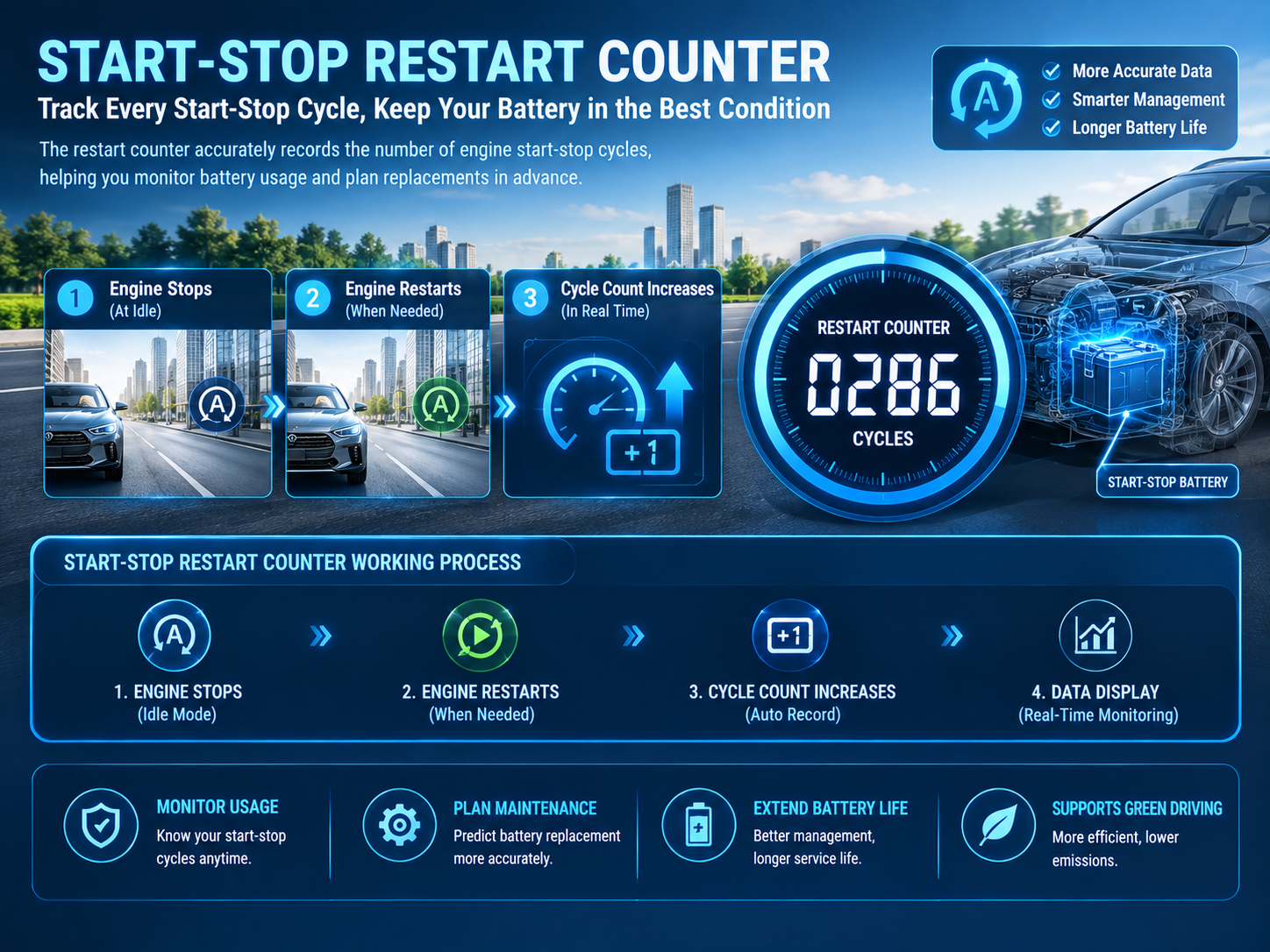
Looking at the question one crank at a time makes the answer easier to grasp. A single engine start is a short, high-current event during which the battery has to deliver enough cranking amps to turn the engine through compression until it fires. In a non-start-stop car that event happens once per trip, and the battery spends the rest of the drive at near-full state of charge, absorbing a steady top-up from the alternator.
In a start-stop car the same battery is being asked to do that event over and over, often with very little recovery time between events. Each crank draws a slice of usable capacity, raises the internal temperature of the cells, and leaves the pack at a slightly lower state of charge than it was before the stop. Layer the HVAC blower, infotainment, lighting and sensor load on top during the engine-off window, and the battery can spend a meaningful fraction of every commute at partial state of charge while it is also being asked to crank the engine again.
Understanding what one start costs is what makes the number of starts a credible engineering question. The answer is not just a count of events but a count of high-current events the chemistry and thermal design can absorb before capacity fade, internal resistance rise, or active material degradation makes the next crank unreliable.
_______________________________________________________________________
How Cycle Life Is Measured, and Why Cycle Counts Alone Mislead
Most battery vendors quote cycle life rather than engine-start count, and the two are not interchangeable. A cycle is a defined test pattern of discharge and recharge, and the way the test is written shapes the number that comes out of it. Different industries use different conventions, and the same cell chemistry can produce very different headline numbers depending on which cycle a vendor chooses to publish.
Three cycle conventions show up repeatedly on automotive 12 V battery datasheets. Microcycle tests focus on the small slices of capacity that an engine stop and the subsequent engine-off load consume, then re-introduce the charge from the alternator. These tests are the closest proxy to what a start-stop battery experiences in real traffic. Standard cycle tests use a deeper depth of discharge (for example, 50 percent or 80 percent) and give a more general sense of how the chemistry ages under repeated use. Endurance or calendar tests combine cycle ageing with elevated temperature and time, and are more relevant for predicting total service life in hot engine bays.
What this means in practice is that a spec sheet that lists “X cycles” without naming the test method is almost worthless to a buyer. A cell rated for 1,000 deep cycles at room temperature may deliver only a few hundred thousand microcycles in a hot engine bay, while a cell engineered for microcycles at partial state of charge may run for many years in a start-stop vehicle without ever seeing a 100 percent depth of discharge. Cycle counts are inputs, not outputs, and the only way to compare vendors fairly is to compare like-for-like test conditions.
_______________________________________________________________________
What Different Start-Stop Chemistries Claim About Engine Starts
Within the 12 V automotive space, three battery families are regularly specified for start-stop service: enhanced flooded batteries (EFB), absorbed glass mat batteries (AGM), and newer sodium-ion batteries designed around the same duty cycle. Each family has a different way of describing how many restarts it can deliver, and each comes with caveats a buyer should read.
EFB batteries are the entry-level choice for vehicles with basic start-stop functions and modest regenerative braking. They are rated for noticeably more cycles than a flooded starter battery, but their engine-start count under heavy urban traffic is still the limiting factor in many real fleets. AGM batteries raise the cycle count substantially through compressed plate packs, retained electrolyte and tighter internal resistance, which is why they are the default specification for many premium start-stop vehicles with aggressive regenerative braking.
Sodium-ion batteries are an emerging option for the same duty cycle. Their published claims focus on cold-weather cranking stability, tolerance of irregular charge pulses, and cycle behaviour that holds up across a wide state-of-charge window. Real-world engine-start counts are driven less by the headline cycle rating and more by the chemistry’s tolerance for partial state of charge and the design of the battery management system (BMS) inside the pack. As with any chemistry, the actual number of engine starts a sodium-ion battery can deliver depends on the cell design, the BMS strategy, the thermal envelope, and the operating conditions the vehicle imposes.
_______________________________________________________________________
Real-World Variables That Drive the Restart Count
Even when two vehicles carry the same battery spec on the window label, the actual number of engine starts delivered over the battery’s life can vary by an order of magnitude. Understanding which variables drive the count helps a buyer set realistic expectations and design the right diligence list.
Five variables tend to dominate the answer. Commute pattern and stop frequency: a city delivery van in dense traffic cycles the start-stop system many more times per kilometre than a commuter car on a suburban arterial road. Engine-off accessory load: vehicles with HVAC, heated seats, rear seat entertainment, and always-on telematics draw more from the battery during every engine-off window. Charging system behaviour: alternators and DC-DC converters vary in how cleanly they top up the battery between starts, and how well they recover from regenerative braking pulses. Climate: cold weather increases cranking load and slows recharge, while hot engine bays accelerate plate corrosion and electrolyte loss in legacy chemistries. State of maintenance: a battery that sits at low state of charge because the vehicle is driven only short distances, or because a parasitic draw has been left undiagnosed, will deliver far fewer restarts than a healthy battery that is regularly topped up.
These five inputs combine multiplicatively rather than additively. A vehicle that scores poorly on three of them can halve the effective restart count of a battery that would otherwise be considered correctly specified for the fleet.
_______________________________________________________________________
What Shortens the Restart Count
Most of the reasons a start-stop battery retires early trace back to a small handful of failure mechanisms. Knowing what shortens the count is the most efficient way for a buyer to extend it.
Chronic partial state of charge is the single biggest driver. When a battery spends more time below 80 percent state of charge than above it, plate sulfation accelerates in flooded and EFB chemistries, and usable capacity drops faster than the cycle test would suggest. Inadequate dynamic charge acceptance is the second driver: if the alternator cannot push enough current back into the battery between stops, every crank leaves the pack a little emptier than the last, and the BMS is forced to disable the start-stop function earlier to protect the cells. Thermal stress in a poorly vented engine bay accelerates calendar ageing and works against every chemistry, including sodium-ion, even though sodium-ion has a more favourable thermal profile in published comparisons.
Frequent short trips that never let the battery reach a full state of charge are a particularly common culprit in fleet use. Buyers who spec a battery based on capacity alone without looking at dynamic charge acceptance and the BMS strategy often see the battery fail in the second year of service even though the cycle rating was well above what the calendar age would suggest.
_______________________________________________________________________
How to Read a Vendor.s Engine-Start Claim
Once a buyer knows that the raw cycle number is only one input into the real-world restart count, the spec sheet becomes much easier to interrogate. Four diligence questions tend to surface the most important differences between vendors.
First, ask what test standard was used. EN 50342-6, SAE J2801, and several OEM-specific procedures are common in the 12 V automotive space, and they are not interchangeable. Second, ask what depth of discharge and what state-of-charge window the test was run at;
partial-state-of-charge cycling is the test that maps onto real start-stop service, and vendors that cannot produce it should be treated with caution. Third, ask how the vendor defines end-of-life: a battery rated for 1,000 cycles to 80 percent of rated capacity behaves very differently from one rated to 50 percent. Fourth, ask for field data: at what average monthly restart count was the battery operated, under what climate, and what was the observed end-of-service-life distribution?
Vendors that can answer those four questions clearly are far easier to plan a multi-year programme around than vendors who publish a single cycle number with no test method attached.
_______________________________________________________________________
What Buyers Should Ask Before Sizing a Start-Stop Programme
Translating all of this into a sourcing decision means building the restart question into the procurement checklist rather than treating it as a spec sheet footnote. A practical diligence list covers the cycle rating together with the way the battery will actually be used.
Buyers and sourcing teams should confirm the cell format and the chemistry family (EFB, AGM, sodium-ion), the published cranking amps at the lowest expected deployment temperature, the cycle rating at the closest available partial-state-of-charge test, the dynamic charge acceptance claim under the alternator profile of the target vehicle, the BMS strategy and how it integrates with the vehicle’s energy management system, the warranty terms and the field-failure thresholds the vendor is willing to commit to, and the second-source path if the chosen cell format or chemistry becomes constrained.
Distributors and importers should also ask how the vendor supports technical training on engine-start diagnosis and what aftermarket diagnostic data the BMS exposes, because most premature start-stop battery failures are diagnosed downstream rather than at the workshop bench. Brands such as PITTAR, which operate as battery suppliers serving automotive battery importers, distributors, wholesalers, dealers, and OEM and ODM buyers, typically make this kind of sizing-and-diligence support available as part of a sodium-ion or AGM programme; the more clearly the supplier can answer the questions above, the easier that programme is to manage at scale.
_______________________________________________________________________
Frequently Asked Questions
Can a start-stop battery really deliver hundreds of thousands of engine starts?
The headline number depends entirely on what cycle convention is being used and on the operating conditions the vehicle imposes. Well-designed AGM and sodium-ion batteries engineered for start-stop service can sustain very high restart counts in controlled duty cycles, but the real-world count is governed by commute pattern, accessory load, climate, and the health of the charging system. Treat any single published number as an input rather than a guarantee.
Why does the same battery spec deliver very different restart counts in different fleets?
Because the spec sheet describes the envelope the cell can survive, not the workload the vehicle will actually impose. Two fleets running the same battery can see different restart counts because one drives long highway commutes and the other makes short urban deliveries, because one operates in a mild climate and the other in extreme cold or extreme heat, or because the charging system in one fleet keeps the battery near full state of charge while the other leaves it chronically under-charged.
Does a higher cycle rating mean the battery will last longer in service?
Not necessarily. Cycle rating, calendar ageing, and operating conditions all contribute to service life, and a battery with a modest cycle rating but excellent thermal tolerance and strong charge acceptance can outlive a battery with a higher cycle rating but poor behaviour at partial state of charge. Treat the cycle number as one of several inputs into the diligence list rather than as a stand-alone predictor.
What is the most useful single number for a buyer to focus on?
Cycle count at partial state of charge, expressed against a named test standard. That single line on the datasheet maps most directly onto the actual start-stop workload a vehicle imposes, and it is the easiest benchmark to compare vendors on when the rest of the diligence list has been satisfied.
Is the engine-start count the same thing as battery lifespan?
No. Engine-start count is a measure of how many cranking events the battery can deliver before its capacity drops below a useful threshold. Battery lifespan is the broader question of how many years of service the battery will deliver before retirement, and that depends on climate, duty cycle, charging system health, BMS behaviour, and whether the vehicle ever sits at deep discharge for long periods. A battery can technically have a high restart count and still fail early if it is operated in conditions the chemistry was not designed for.
 Hot News
2026-10-30
2026-10-26
2026-10-22
2026-10-14
2026-10-07
2026-10-02

Pittar Power is a professional manufacturer specializing inenergy storage solutions.
Room 302, Building 1, No. 10, Huangjin First Road, Nancheng District, Dongguan City, Guangdong Province, China
Copyright © Shenzhen Pittar Power Co., Ltd. All Rights Reserved Privacy Policy
 EN