A distributor will ask this question in an email, usually in one line, and the temptation is to answer it with a paragraph about chemistry. That answer will not survive contact with the buyer's actual problem. A car does not contain one battery load. It contains several, and they are not alike.
A pack that is excellent at pushing a burst of current into a cold engine can be unremarkable at storing energy for a long drive. A cell that looks ordinary on a datasheet can be the right choice once freight mass, winter reliability and lead exposure are priced into the decision. So are sodium-ion batteries good for cars? The honest answer is narrower than the question: good for which job, in which vehicle, at what stage of the programme.
Stated plainly: for the 12 V auxiliary and start-stop job, sodium-ion is now a credible option, and pack-level execution decides more about the outcome than the chemistry label. For long-range traction, it is not competitive on energy density today. For cold-climate short-trip duty, it holds an advantage on discharge and gives part of that advantage back on charging. The rest of this article shows how those three statements are reached, and how to test them against a specific vehicle rather than a general impression.
_______________________________________________________________________
A Car Asks a Battery to Do Several Different Jobs
The first step is to stop treating “car battery” as a single category. The five jobs below place very different demands on a cell, yet they are routinely discussed as if they were one.
Battery slot |
What the vehicle asks of it |
Binding constraint |
Where sodium-ion stands |
High-voltage traction pack |
Store enough energy for the required range, then deliver it across years of deep cycles |
Energy per kilogram and per litre |
Behind nickel-rich lithium-ion today; workable for short-range and light vehicles |
12 V auxiliary with start-stop |
Crank thousands of times, carry accessory load with the engine off, recharge between trips |
Power at low temperature and charge acceptance at partial charge |
Credible today; the outcome depends on pack calibration and fitment |
High-voltage buffer in a hybrid |
Absorb and release large power pulses inside a narrow charge window |
Throughput, heat rejection, cycle endurance |
Technically plausible; public evidence base is thinner than for lithium-ion |
Commercial vehicle auxiliary |
Run accessories and overnight loads, then recharge from a limited source |
Depth-of discharge tolerance and charge efficiency |
Promising where freight mass and lead exposure are real cost lines |
Two- and three-wheel traction |
Cover a short daily range at low cost in hot or cold ambient |
Cost per kilowatt-hour and pack simplicity |
One of the earliest commercial footholds for the chemistry |
Read the last column as a position rather than a verdict. A chemistry can be the best available answer in one row and the wrong answer in the next. Lead-acid spent a century being exactly right for one row and being stretched badly in the others.
The rows also explain why supplier claims so often miss the point. A cell-level energy density figure answers the traction row and says nothing about the auxiliary row, where the buyer's problem is a cold crank at six in the morning followed by a recharge that has to happen in fifteen minutes of driving.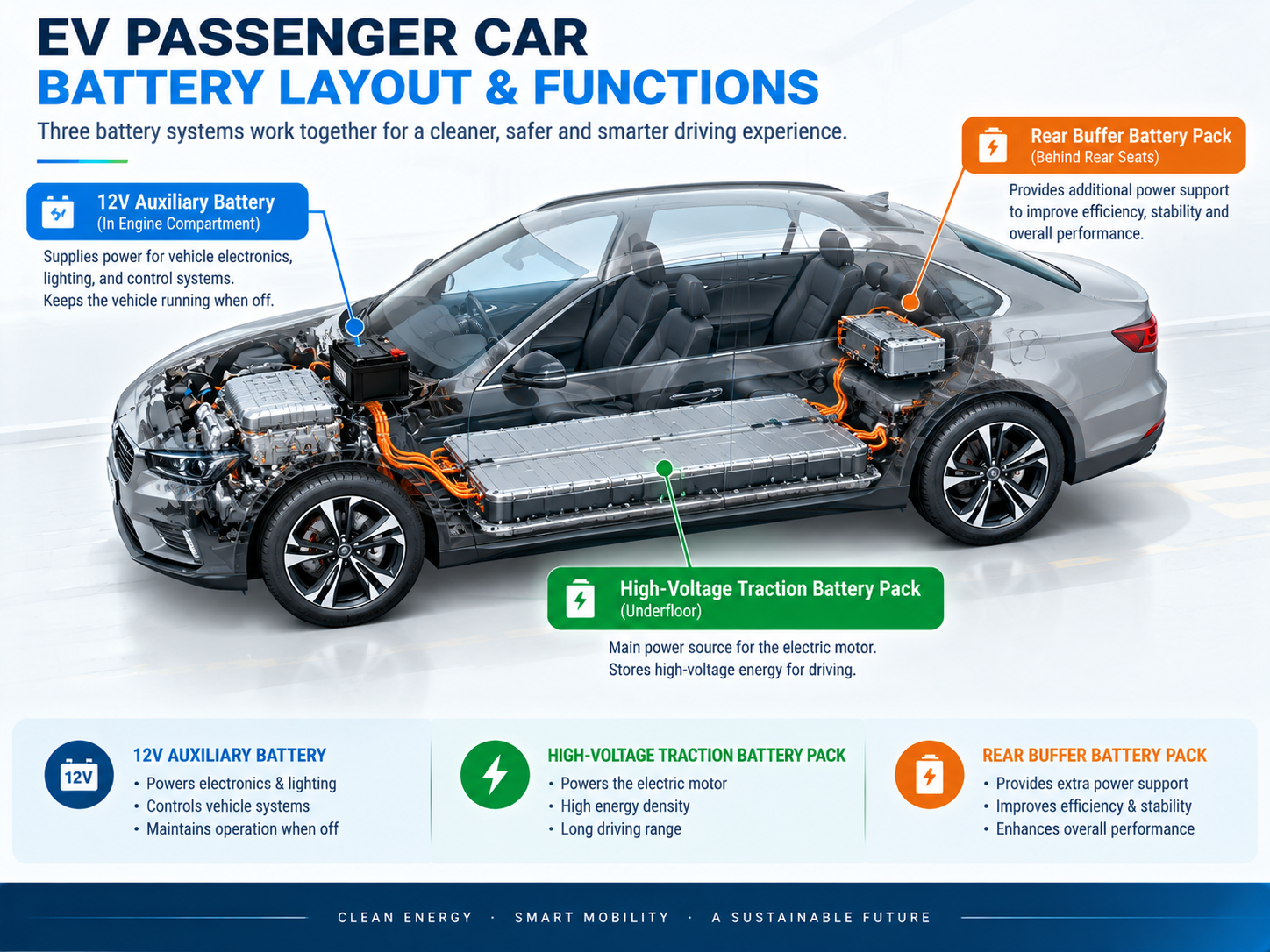
_______________________________________________________________________
The Five Tests Every Car Battery Has to Pass
Whatever the slot, a battery in a vehicle has to pass the same five tests. They are worth naming because each one has a specific piece of evidence attached, and most procurement conversations skip four of them.
Cranking current at the temperature the vehicle really sees. A cold cranking figure measured at a standard laboratory temperature is a starting point, not an answer. The question is what the pack delivers after an overnight soak at the coldest ambient the fleet actually operates in, and how much margin survives two winters of aging. Ask for the test temperature and the state of charge at which it was run. A number without those two conditions cannot be compared with a competitor's number.
Charge acceptance when the battery is not empty. A start-stop vehicle lives in the upper middle of its charge range rather than cycling from full to flat. Accepting charge at seventy percent is a different electrochemical problem from accepting it at twenty, and a chemistry with an excellent full cycle rating can still be slow in the window the vehicle actually uses. This is the test that separates a battery which works on a bench from one which works on a delivery route.
Survival of the real cycling pattern. Bench cycles are usually constant current, controlled temperature and full depth. Vehicle cycles are shallow, irregular and thermally messy. A cycle count quoted without depth of discharge, temperature and end-of-test criterion is a marketing number rather than a specification. When two suppliers quote different cycle lives, the useful move is to ask what each test looked like, not to compare the digits.
The thermal environment. An engine bay is not a laboratory. Heat accelerates most aging mechanisms in every chemistry; cold cuts available power and can block charging outright. How heat leaves the cells, whether the pack has any active management, and where it sits relative to the exhaust manifold and the radiator matter more than the chemistry name printed on the case.
Talking to the vehicle's electrical system. The alternator or DC-DC converter has a voltage setpoint and a regulation strategy. The pack's management system has an acceptance window. When those two disagree, one of two things happens: the pack never reaches a healthy state of charge, or the management system protects itself and the driver sees a warning light. Neither outcome is a chemistry failure, and neither appears on a cell datasheet. It is a calibration problem, and calibration is the supplier's responsibility.
_______________________________________________________________________
Where Sodium-Ion Already Earns Its Place
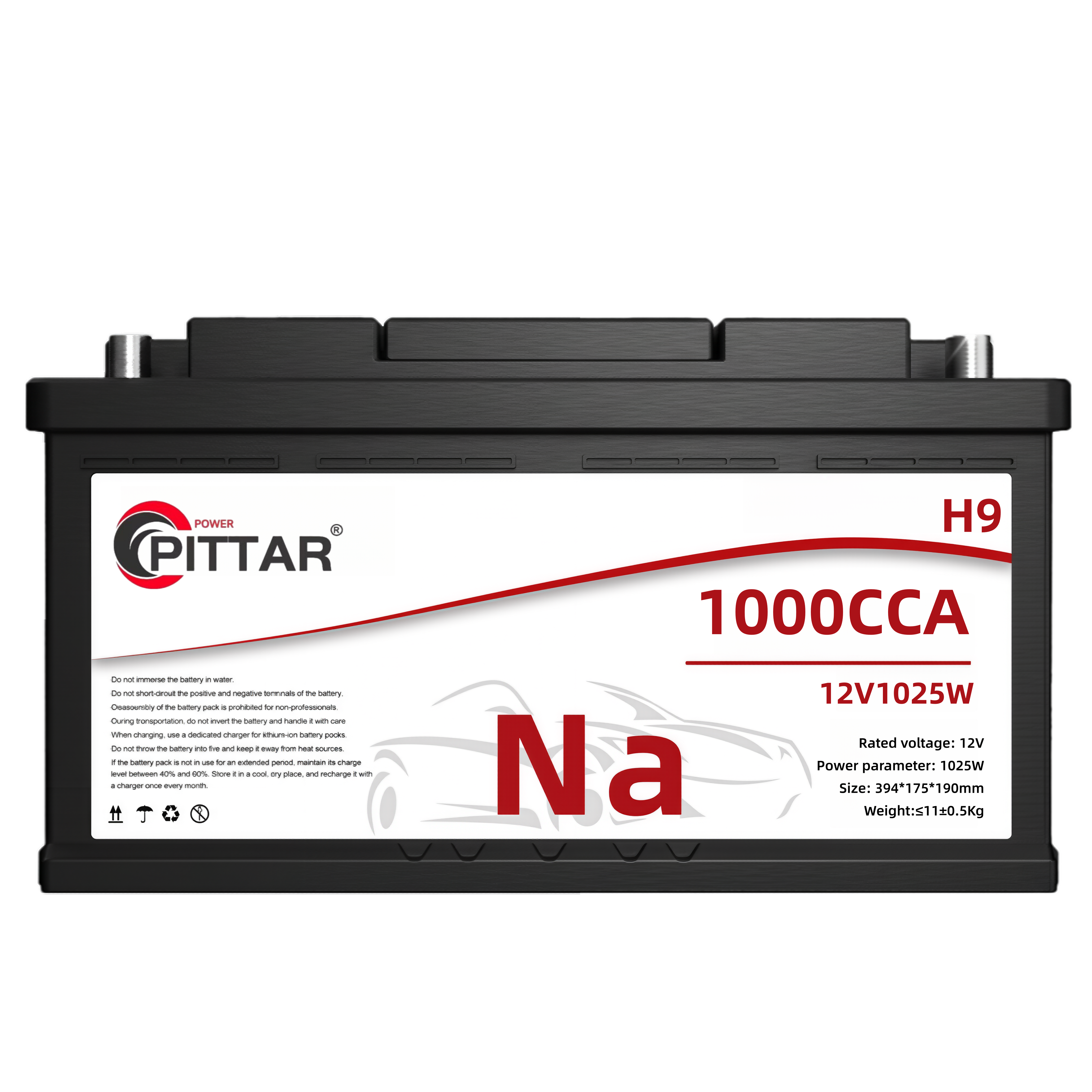
The auxiliary slot is the strongest case. A 12 V sodium-ion pack is asked for power rather than energy, and the chemistry's behaviour in the cold, its tolerance of sitting at partial charge and the absence of lead all line up with what that duty cycle wants. Products are commercially available, though the supply base is narrower than the lead-acid channel and format coverage is thinner. Whether a specific vehicle should take one is a fitment question rather than a chemistry question, and it is handled in the start-stop material rather than settled here.
Entry-level traction is the second case. Where range requirements are modest, as in urban delivery fleets, two- and three-wheelers and low-speed commercial vehicles, the energy density penalty is survivable because pack volume has somewhere to go and the buyer's cost drivers sit elsewhere. Sodium-ion competes there on cost trajectory and cold performance rather than on range, which is the right way round for those vehicles.
Commercial auxiliary circuits are a third. A second battery running a liftgate, a sleeper cab or a refrigeration unit is closer to a deep-cycle application than to a starting application, and the depth-of-discharge tolerance that punishes a flooded block matters less here. Weight removed from a heavy vehicle is also revenue rather than an engineering saving.
What these three have in common is that none of them is decided by energy density. That is the pattern worth remembering. Sodium-ion is not arriving as a universal replacement; it is arriving in the slots where its weaknesses do not bind.
_______________________________________________________________________
Where Sodium-Ion Is Not Yet the Right Answer
Long-range traction is the clearest no. A sodium-ion cell stores less energy per kilogram than the nickel-rich lithium-ion chemistries used in long-range packs. The gap can be closed by adding cells, but the added cells add mass and volume, which adds mass again, so the penalty compounds through the vehicle instead of staying inside the pack. For a passenger car that has to cover several hundred kilometres between charging stops, energy density is the binding constraint, and no amount of cost or cold-weather advantage compensates for a pack that does not suit the vehicle's job.
Charging near freezing is the second. Sodium-ion has earned a reputation as a cold-weather chemistry, and on the discharge side that reputation is deserved. Charging is the other half of the story. As cell temperature approaches freezing, the risk of sodium plating forcs the management system to limit or stop charge current. A vehicle that starts without complaint at minus twenty can still finish the week undercharged if every trip is short and the pack never gets warm enough to accept a proper charge. The answer is thermal management or a current strategy, not a better datasheet.
The service ecosystem is the third, and it is the one that costs importers money. Lead-acid arrives with group sizes that fit existing trays, test procedures every technician knows, a core-return loop that subsidises the next sale and a scrap market that absorbs failures. Sodium-ion has none of that at comparable depth. An importer selling a pack into a market with no diagnostic path carries the warranty risk personally, and that risk belongs in the landed cost calculation rather than in a footnote.
Certification evidence is the fourth. The dossier behind a sodium-ion automotive product is generally thinner than the one behind an established lead-acid or LFP product, and OEM approval cycles consume calendar time that a launch plan may not have. A programme needing full documentation in the current quarter should be scheduled differently from one holding two quarters of validation margin.
Supply depth is the fifth. Fewer cell manufacturers, fewer standard formats and allocation that can move when one supplier's ramp slips. A single-source sodium-ion programme is a bet on one factory's schedule, and that bet should be written down rather than assumed.
_______________________________________________________________________
What the Cell Does Not Decide
The vehicle never sees a cell. It sees a pack, and between the two sit the management system, the thermal path, the terminal geometry, the hold-down, the enclosure and the registration behaviour. Those are engineering decisions made by the pack builder, and in practice they move the outcome further than the chemistry choice does.
Two packs built on cells from the same production line can behave very differently in the same vehicle. One accepts charge across the window the alternator provides and reaches a healthy state of charge on a short commute. The other protects early, sits permanently undercharged and produces an intermittent warning light the workshop cannot reproduce. The cells are identical. The calibration is not.
This is why whether sodium-ion batteries are good for cars is settled at pack level rather than at chemistry level, and why a supplier who answers at chemistry level has not answered the question. What a buyer can actually evaluate sits one level down: cell consistency from lot to lot, the logic the management system applies at both ends of the temperature range, aging data collected on a comparable duty cycle, the service documentation a distributor's technicians will have to work from, and how engineering changes are communicated after approval.
A good chemistry in a badly integrated pack is a bad product. The reverse is also true, and it is the more common story in this segment: a chemistry with no dramatic advantage, integrated carefully, delivering years of uneventful service.
_______________________________________________________________________
How to Test the Claim Against a Specific Vehicle
The sequence below produces a defensible answer. The order is deliberate, because the cheap checks come first and most mismatches are found before anyone needs a test report.
• Write the duty cycle down before contacting suppliers: trips per day, distance per trip, engine-off time, accessory load, parking type and the climate the vehicle will actually live in. No supplier can calibrate against an average.
• Fix the cold end. The lowest ambient at which the vehicle must start, and how long it soaks at that temperature, define the cranking requirement.
• Ask for cranking data at that temperature and at the state of charge the vehicle will be in when it starts. Room-temperature figures answer a different question.
• Ask for charge acceptance across the window the vehicle uses, not at one convenient point on the curve.
• Place the alternator or DC-DC setpoint next to the pack's acceptance window and require written confirmation that they overlap. This is the most common cause of a “failed” battery that was never charged properly in the first place.
• Check the physical interface: group size, terminal type and orientation, hold-down, overall height and the venting path if the pack has one.
• Confirm the vehicle-side procedure: registration, adaptation and battery sensor reset wherever the platform requires it.
• Request aging evidence from a comparable duty cycle, plus the field return rate and the reasons behind those returns. A return rate without reasons is not evidence.
• Establish the exit. If the programme has to change pack supplier, what does re-validation cost in time and money?
_______________________________________________________________________
Reading a Supplier's Answer Without Being Misled
Most misleading claims in this category are not lies. They are true statements applied to the wrong question, and they share recognisable shapes.
• “Drop-in replacement” with no mention of the charge profile. Physical interchangeability is the easy half; the electrical match decides whether the pack survives its warranty.
• A cycle number without depth of discharge, temperature and end-of-test criterion. Without those three, the number cannot be compared with anything else on the market.
• Cell-level energy density offered as an answer to a pack-level question. The buyer's constraint is what the assembled pack weighs and occupies in the vehicle.
• “Works in any climate” with no cold-charging caveat. Discharge and charge behave differently at low temperature, and the omission is rarely accidental.
• A warranty written on capacity retention without defining the test that measures it. An undefined test is a discretionary claim.
• Absolute safety language. No chemistry is risk-free, and pack safety is an integration property built from cell design, management system, thermal path, enclosure and installation together.
A supplier worth a programme will answer these points with a document and a test reference. One who answers with adjectives has told the buyer something useful about the programme as well as about the product.
PITTAR supplies sodium-ion battery products to automotive battery importers, distributors, wholesalers, dealers, and OEM and ODM buyers. The engineering questions above are the ones worth putting to any supplier in this category, including this one.
_______________________________________________________________________
Frequently Asked Questions
Can I fit a sodium-ion battery to my car today?
Only where a product exists for that vehicle's battery group and the charge profile has been confirmed. Physical fit is the easy part. The pack's acceptance window has to match what the alternator or DC-DC converter provides, and the platform may need registration or adaptation afterwards. Skipping that check is how a good product becomes a warranty claim.
Do sodium-ion batteries start a car in very cold weather?
Discharge performance holds up better than lead-acid in most designs, which is why the chemistry attracts attention in cold markets. Charging is the constraint: near freezing, the management system limits or stops current to avoid plating. A vehicle that starts cleanly at minus twenty can still end the week undercharged if the trips are too short to warm the pack.
Are sodium-ion car batteries lighter than lead-acid?
At pack level, usually yes, since there is no lead and both current collectors are aluminium. Compare the assembled pack including case, terminals and electronics rather than the cell alone, because that is the mass that affects handling, freight and installation.
Will sodium-ion replace lithium-ion in electric cars?
Not in long-range passenger vehicles in the near term. Energy density decides that segment. The nearer overlap is in smaller vehicles, auxiliary batteries and applications where the density penalty is affordable because the pack has volume to spare.
Are sodium-ion batteries safer than lithium-ion?
The chemistry has favourable thermal characteristics and tolerates deep discharge better, because aluminium collectors do not dissolve at low voltage the way copper does. That is not the same as safe. Safety is a property of the finished pack, built from cell design, management system, thermal path, enclosure and installation.
 Hot News
2026-10-30
2026-10-26
2026-10-22
2026-10-14
2026-10-07
2026-10-02

Pittar Power is a professional manufacturer specializing inenergy storage solutions.
Room 302, Building 1, No. 10, Huangjin First Road, Nancheng District, Dongguan City, Guangdong Province, China
Copyright © Shenzhen Pittar Power Co., Ltd. All Rights Reserved Privacy Policy
 EN