What Is a Sodium-Ion Automotive Start-Stop Battery?
Most modern passenger cars sold today come with some form of start-stop system. When the vehicle halts at a traffic light, the engine shuts off instead of idling. When the brake is released, the engine restarts. The fuel savings and emissions reductions this delivers are small per cycle but add up to meaningful numbers over the life of a car.
The battery under the hood has to make that system work. It has to crank the engine hundreds of thousands of times across its service life, accept high in-rush charge current from the alternator every time the vehicle is moving, and keep powering cabin electronics, headlights, infotainment, and dozens of ECUs while the engine is off.
A standard flooded lead-acid battery, designed for a duty cycle of one crank per trip, can degrade quickly under start-stop service. That is why automakers moved first to EFB (enhanced flooded battery) and AGM (absorbent glass mat) batteries for start-stop vehicles. Sodium-ion is now being evaluated as a third chemistry path for this application. This article is a foundational overview: what a start-stop system is, what a start-stop battery has to do, what sodium-ion chemistry brings to this duty cycle, how it compares to lead-acid, EFB, and AGM, and what B2B buyers should verify before sourcing.
_______________________________________________________________________
What Is an Automotive Start-Stop System?
A start-stop system — sometimes called stop-start, idle stop, or micro-hybrid — automatically shuts down the internal combustion engine when the vehicle comes to a halt and restarts it when the driver wants to move again. The system is engaged most of the time during city driving: at traffic lights, in stop-and-go traffic, at level crossings, in queueing at drive-throughs.
The purpose is straightforward. An idling engine burns fuel without delivering useful motion. Eliminating that idle time reduces fuel consumption and tailpipe emissions. The reductions depend on the vehicle, the driving cycle, and how often the system activates, but most published estimates place fuel savings in the 5–10% range for typical urban driving.
There are several layers of start-stop sophistication. The most basic systems shut the engine off at a complete stop and restart when the brake is released. More advanced systems shut the engine off while the vehicle is coasting to a stop, or briefly while it is still rolling. Regenerative braking — where the alternator is reversed to act as a generator during deceleration — is often paired with start-stop, and the battery has to accept that regenerated energy every time the vehicle slows down. All of this places unusual demands on the battery that did not exist in the older cranking-battery duty cycle: high current many times per trip, irregular high-current charge acceptance, long stretches at partial state of charge, and the same engine-bay temperature range as the lead-acid battery it succeeded.
_______________________________________________________________________
What Does a Start-Stop Battery Have to Do?
A start-stop battery has three core jobs that overlap throughout every trip.
It has to crank the engine. Cranking current is the highest current the battery delivers in service — a burst that lasts a fraction of a second to a few seconds, drawing several hundred amps from the battery to spin the starter motor. The voltage must stay above the threshold the starter motor needs throughout the burst.
It has to power the electrical system while the engine is off. Headlights, climate control fan, infotainment, instrument cluster, body control modules, and a long list of smaller ECUs continue to draw current when the engine is shut down. This is sometimes called the resting load or accessory load, and it can easily exceed several amps in a modern vehicle.
It has to accept charge from the alternator (and from regenerative braking) when the engine is running. Start-stop vehicles generate a lot of irregular charge events. The alternator pushes current back into the battery every time the engine restarts and every time the brake is released, in patterns that look very different from the slow, steady top-up charge profile of a non-start-stop vehicle.
These three jobs add up to a duty cycle much harsher than what a regular car battery is designed for. A regular car battery is expected to crank the engine a few hundred times across its life and stay close to full charge most of the time. A start-stop battery is expected to crank the engine thousands or tens of thousands of times, sit at partial state of charge, and absorb irregular high-current charge pulses without damage. Modern start-stop systems also monitor state of charge, state of health, and temperature continuously — disabling the start-stop function below a charge threshold and pre-heating the battery in winter — to protect the battery from being asked to crank when it cannot reliably do so.
_______________________________________________________________________
What Is a Sodium-Ion Automotive Start-Stop Battery?
A sodium-ion automotive start-stop battery is, at its core, a 12-volt (or in some platforms 24-volt) automotive auxiliary battery in which the cells use sodium-ion chemistry instead of lead-acid, AGM, EFB, lithium-ion, or any other chemistry. From the outside it has the same job description as any other start-stop battery: crank the engine, power the electrical system when the engine is off, accept charge from the alternator.
What changes is the internal chemistry. Sodium-ion cells use sodium-ion movement between a cathode and an anode through a sodium-ion conducting electrolyte, with aluminum current collectors on both sides. For an automotive start-stop article, what matters is what the chemistry delivers in this duty cycle:abundant sodium raw material, aluminum-on-both-sides current collectors (unusual among commercial chemistries), and demonstrated low-temperature discharge behavior — all of which map reasonably well onto the start-stop duty cycle.
What sodium-ion chemistry does not currently bring is energy density parity with high-energy lithium-ion cells. Sodium-ion cell-level energy density is lower than mainstream lithium-ion, although it is more than adequate for an auxiliary 12-volt battery that does not need to store traction-pack energy. Sodium-ion is also at an earlier stage of commercial maturity than lithium-ion for automotive service, which has its own implications for buyer diligence.
_______________________________________________________________________
Why Sodium-Ion Chemistry Is Entering Start-Stop Applications
Several practical factors are pushing sodium-ion chemistry into start-stop evaluation programs.
• Resource availability. Sodium is one of the most abundant elements in the earth's crust and in industrial brines. Sodium raw-material supply does not carry the same concentration risk that lithium, cobalt, or nickel supply carries in the long term.
• Cold-weather cranking. Sodium-ion chemistry has demonstrated useful low-temperature discharge behavior. Cranking an engine at sub-zero temperatures is exactly where a battery's internal resistance matters most, and a chemistry that holds lower internal resistance at low temperatures has a real edge.
• Raw-material cost trajectory. Sodium-ion cells use aluminum on both sides and avoid cobalt and nickel in most cathode families. Whether those choices translate into lower cell cost in practice depends on the manufacturer, cell format, production volume, and cathode family —but the structural cost case is more favorable than chemistries built around scarcer and more volatile materials.
• Supply-chain diversification. Many OEMs and Tier-1 suppliers are reducing single-chemistry dependency. Sodium-ion gives a start-stop program historically locked into AGM or EFB a third chemistry option.
• Maturity alignment with the duty cycle. Sodium-ion chemistry is at the right maturity level for the auxiliary battery duty cycle. It does not need to match traction-pack energy density to deliver useful performance in a 12 V or 24 V auxiliary battery.
These factors do not make sodium-ion the right answer for every start-stop program. They do make sodium-ion a credible candidate that more automotive buyers are evaluating seriously.
_______________________________________________________________________
How a Sodium-Ion Start-Stop Battery Compares to Lead-Acid, AGM, and EFB
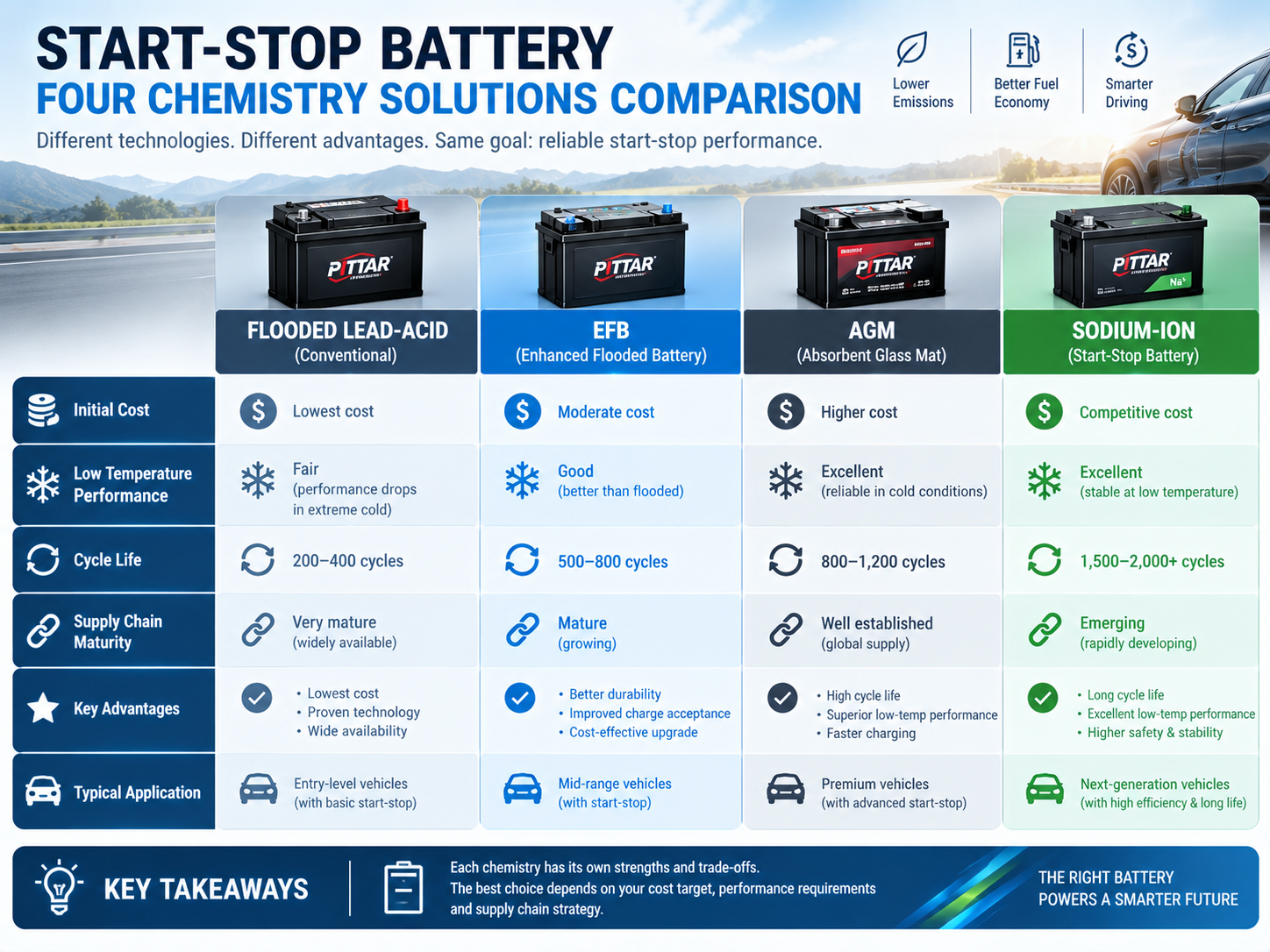
Lead-acid, AGM, and EFB are the incumbent chemistries in automotive start-stop service. Sodium-ion sits alongside them as a fourth option with a different set of trade-offs.
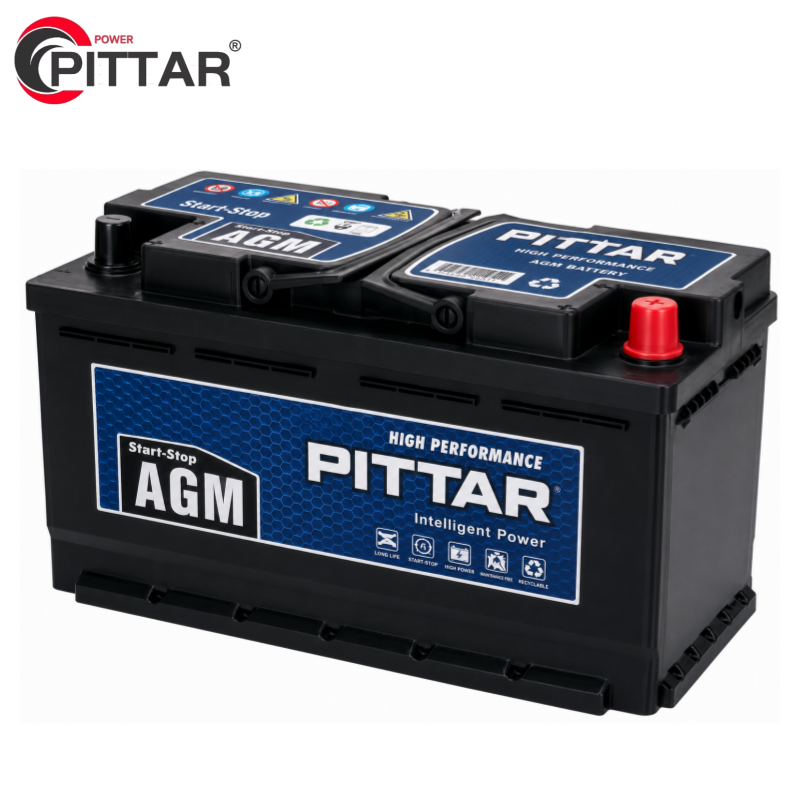
Lead-acid flooded batteries are the legacy option — inexpensive, widely available, well understood, but they degrade quickly under the start-stop duty cycle at partial state of charge. EFB batteries are flooded batteries with reinforcement (typically a polyester scrim, improved active material, higher dynamic charge acceptance) designed for entry-level start-stop vehicles. AGM batteries are the premium incumbent: the electrolyte is held in a glass mat separator, internal resistance is lower, cycle life and dynamic charge acceptance are higher — standard equipment on many mid-range and premium start-stop vehicles, but more expensive than flooded or EFB.
Sodium-ion sits between EFB and AGM on most performance parameters in published data. It has demonstrated strong low-temperature discharge behavior, a flatter cycle-life curve under partial state-of-charge service in some chemistries, and does not require water-topping service. On the other side, sodium-ion is a less mature automotive technology with fewer validated field programs and a smaller supply base.
The right framing is fit for the program, not a blanket technology preference. A fleet in cold climates that values supply-chain diversification and can support a multi-year sourcing commitment may find sodium-ion a better fit than AGM. A fleet that prioritizes lowest unit cost today, operates in mild climates, and wants the broadest service network may find AGM a better fit. The chemistry decision belongs to the program, not to the technology.
_______________________________________________________________________
Where Sodium-Ion Start-Stop Batteries Make Sense — and Where They Don't
Sodium-ion is well matched to several automotive use cases and less well matched to others.
• Cold-climate passenger vehicles with start-stop. Sodium-ion chemistry's low-temperature discharge behavior is a structural fit for markets where winter cranking is the weak point of the incumbent chemistry set.
• 12 V and 24 V auxiliary battery service. The energy storage requirement is modest, the cranking current requirement is well within sodium-ion's capability, and the cold-weather discharge advantage is useful in many markets.
• Sourcing strategies that value chemistry diversification. Fleets and OEM programs that want to reduce single-chemistry dependency away from cobalt-, nickel-, and lithium-concentrated supply chains can use sodium-ion as a credible third option alongside AGM and EFB.
• Programs that can support a multi-year volume commitment. Earlier-stage chemistries grow capacity faster when buyers commit to multi-year volumes. Sodium-ion fits programs structured around a real sourcing partnership, not programs that want a one-off lowest-cost purchase.
It is less well matched to programs that need the broadest service-network coverage today, where lead-acid and AGM infrastructure is more established, and to programs that need a deeply validated multi-year field track record in their specific vehicle architecture. Sodium-ion automotive programs have been deployed, but the field-history depth is not yet as deep as the AGM field history. These boundaries do not disqualify sodium-ion from start-stop service. They define where the chemistry is most credible as a procurement candidate today.
_______________________________________________________________________
What Buyers Should Verify Before Sourcing
For a B2B procurement team evaluating sodium-ion automotive start-stop batteries, several checks belong in the supplier diligence process.
• Confirm the chemistry and cell format. Different sodium-ion cathode families, different anode materials, different cell formats, and different pack designs lead to different performance. A buyer should know which cathode family is being supplied, which cell format is being used, and which manufacturer made the cells. The same sodium-ion label can hide meaningfully different products.
• Verify cranking performance at deployment temperatures. Cranking amps (CA), cold cranking amps (CCA), and the voltage profile during the cranking burst should be tested at the temperatures the vehicles will actually see in service. Marketing numbers from a 25 °C test bench are not a substitute for cold-weather validation.
• Verify cycle life under the actual duty cycle. Cycle life numbers from a manufacturer should be qualified by depth of discharge, temperature, charge rate, and end-of-life criterion. The same chemistry from two suppliers can show different results in the same field test, and the same supplier can show different numbers in marketing versus a third-party test.
• Verify automotive certification status. ECE R100 or equivalent regional homologation, UN 38.3 transport testing, IATF 16949 quality management for the cell and pack supplier, and customer-specific validation programs all matter. Sodium-ion chemistry is at an earlier stage of certification coverage than lithium-ion; the buyer should map which certifications the specific product holds, and which the supplier holds, before committing.
• Verify commercial stability and support infrastructure. Earlier-stage chemistries demand more active supplier diligence than mature chemistries. Financial stability, multi-year capacity commitments, warranty processes, technical support teams, and document trails should all be part of the evaluation.
• Evaluate the second-source path. Sodium-ion cell format standardisation is still forming, so locking in a single cell supplier creates more supply risk than locking in a single cell supplier in a mature chemistry. A buyer should think about backup supply, what backup plans are practical, and how much cost the backup introduces.
A buyer who walks into sodium-ion start-stop sourcing aware of these verification points — and who structures the supplier relationship to address them— is in a much stronger position than a buyer who walks in expecting sodium-ion to behave exactly like a mature AGM supply. As a battery and energy storage supplier serving automotive battery importers, distributors, wholesalers, dealers, and OEM and ODM buyers, PITTAR works with sodium-ion cell programs suited to start-stop and auxiliary duty. Where the chemistry fits a specific sourcing strategy — cold-climate reliability, supply-chain diversification, multi-year volume commitments— the conversation is worth having. Where the chemistry does not yet fit, the right move is to stay with the incumbent option until the fit changes.
_______________________________________________________________________
Frequently Asked Questions
What is the difference between a regular car battery and a start-stop battery?
A regular car battery is built for a simple duty cycle: crank the engine, accept a slow top-up charge, and supply accessory load when the engine is off. A start-stop battery is built for a much harsher duty cycle: thousands of cranks, long stretches at partial state of charge, irregular high-current charge pulses, and accessory load while the engine is off. Start-stop batteries use reinforced chemistry — EFB, AGM, or sodium-ion — to handle those demands.
Can a regular car battery be used in a start-stop vehicle?
It may operate briefly in entry-level start-stop systems but will degrade quickly under the duty cycle. Most automakers specify EFB, AGM, or (in newer programs) sodium-ion, because standard flooded batteries are not designed for the harsher cycling pattern.
Is sodium-ion better than AGM for start-stop cars?
Neither is universally better. AGM has a deeper field-history track record, broader service infrastructure, and a more mature supply chain. Sodium-ion offers useful cold-weather discharge, favorable raw-material supply, and cost potential — but at an earlier stage of automotive deployment. The right answer depends on the program.
Why is sodium-ion considered for start-stop batteries?
Sodium-ion maps well onto the duty cycle, sodium raw materials are more abundant than lithium or cobalt, sodium-ion cells can use aluminum on both sides, and the technology has reached the maturity level needed for auxiliary-battery service. Several OEMs and Tier-1 suppliers have disclosed sodium-ion start-stop programs.
Are sodium-ion start-stop batteries available now?
Yes, from a smaller number of suppliers than AGM or EFB. Buyers should verify supplier commercial stability, cell and pack certifications, and validation status for the target vehicle architecture before committing to volume.
 Hot News
2026-10-30
2026-10-26
2026-10-22
2026-10-14
2026-10-07
2026-10-02

Pittar Power is a professional manufacturer specializing inenergy storage solutions.
Room 302, Building 1, No. 10, Huangjin First Road, Nancheng District, Dongguan City, Guangdong Province, China
Copyright © Shenzhen Pittar Power Co., Ltd. All Rights Reserved Privacy Policy
 EN