Introduction.
The runtime of a camping battery depends on battery energy capacity, appliance power consumption, usable depth of discharge, inverter efficiency, temperature, and how often the load actually operates. A larger battery does not automatically mean proportionally longer runtime if the camp also increases the load or leaves the battery at a higher reserve state of charge. Real runtime is an estimate, not a guarantee.
This guide walks through the calculation method, provides a worked example, lists common camping appliances with representative power ranges, and shows how a 12V 100Ah, 200Ah, or 300Ah LiFePO4 battery translates into usable kWh and runtime at three illustrative loads.
__________________________________________________________________________________________________
How Long Can a Lithium Battery Run Camping Equipment?
A lithium battery can power camping equipment for a few hours, an overnight camp, or multiple days, depending on battery size, appliance power, simultaneous load, operating hours, usable depth of discharge, and inverter efficiency. Runtime is not a fixed label on a battery; it is the outcome of the load profile interacting with usable energy.
A practical answer therefore has three layers:
1. Document the camp loads and how long each runs each day.
2. Convert battery voltage and Ah into usable kWh.
3. Estimate runtime from the usable energy divided by the active load, with reasonable inverter losses.
The sections below explain this calculation in detail.
__________________________________________________________________________________________________
How to Calculate Lithium Battery Runtime
Runtime estimation uses three linked formulas.
Step 1. Battery nominal energy:
Battery Energy (Wh) = Voltage (V) × Capacity (Ah)
Step 2. Usable energy after reserve and depth of discharge:
Usable Energy (Wh) = Battery Energy (Wh) × Usable Depth of Discharge
Step 3. Estimated runtime for a DC load:
Estimated Runtime (hours) = Usable Energy (Wh) ÷ Load (W)
For an AC load driven through an inverter, inverter efficiency reduces usable energy: Estimated Runtime (hours) = (Usable Energy × Inverter Effciency) ÷ Load (W)
Worked example (DC load)
Battery: 12V 100Ah LiFePO4 Nominal energy:
12 × 100 = 1,200Wh
If the usable depth of discharge is around 90%:
1,200 × 0.90 = 1,080Wh
If the camping load consumes 100W continuously:
1,080 ÷ 100 ≈ 10.8 hours
Worked example (AC load through an inverter)
Battery: 12V 100Ah LiFePO4
Nominal energy: 1,200Wh
Usable energy at 90% DoD: 1,080Wh
Inverter efficiency at 90%: 1,080 × 0.90 = 972Wh If the appliance draws 200W:
972 ÷ 200 ≈ 4.86 hours
These values are examples only. Real results vary with battery age, temperature, reserve settings, cable losses, appliance actual draw, inverter no-load loss, and the compressor duty cycle in a fridge. Cold temperatures can reduce usable capacity, while hot weather can shorten charge acceptance.
Step |
Formula |
Example |
Nominal energy |
V × Ah |
12 × 100 = 1,200Wh |
Usable energy |
× usable DoD |
× 0.90 = 1,080Wh |
Inverter-adjusted energy (AC) |
× inverter efficiency |
× 0.90 = 972Wh |
Runtime (DC) |
usable Wh ÷ load W |
1,080 ÷ 100 ≈ 10.8h |
Runtime (AC) |
adjusted Wh ÷ load W |
972 ÷ 200 ≈ 4.86h |
For a broader LiFePO4 selection framework, see [LiFePO4 Battery for Camping] .
__________________________________________________________________________________________________
How Long Can a Lithium Battery Run Common Camping Equipment?
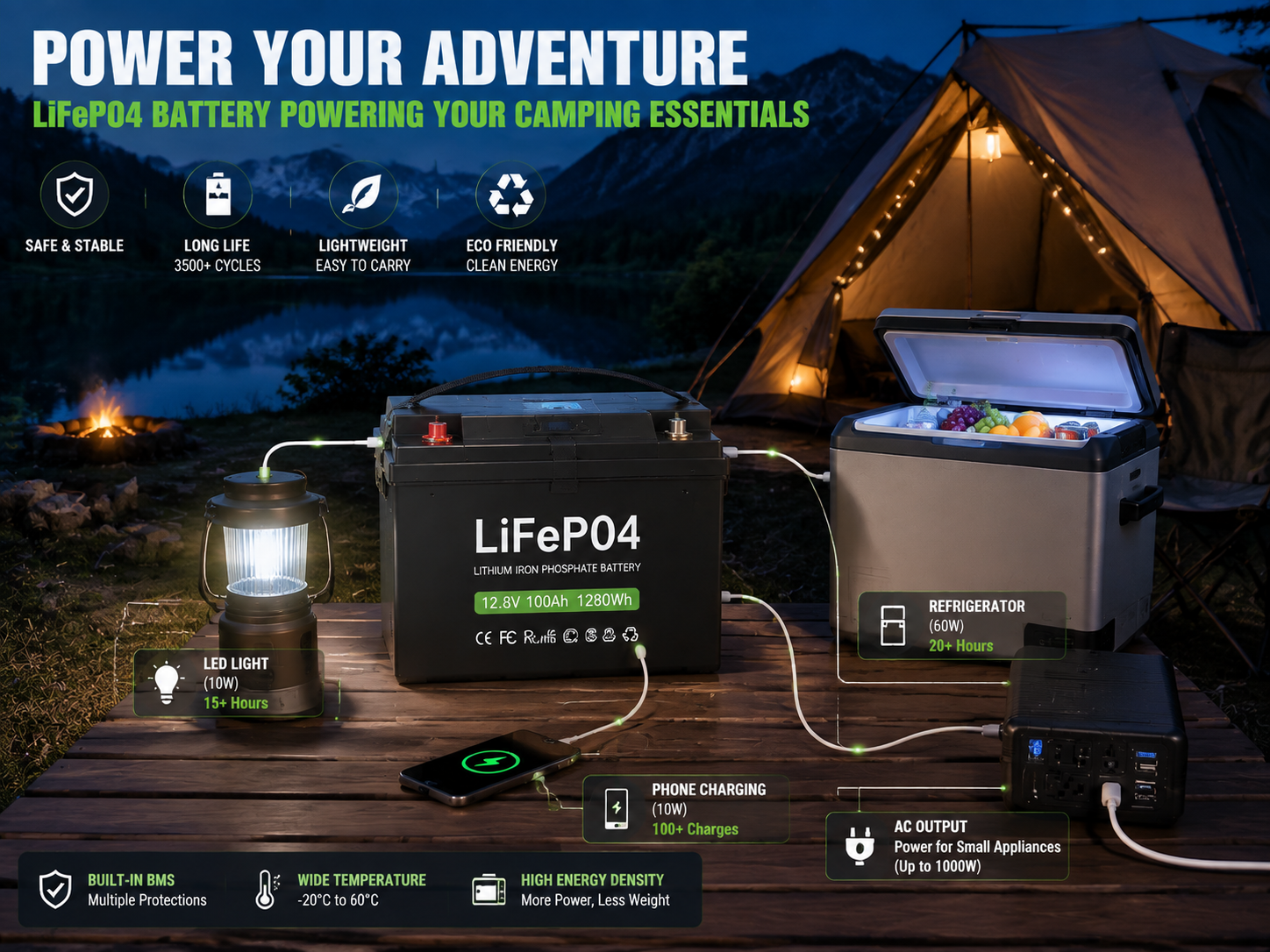
The table below shows representative power ranges and estimated runtime for a 12V 100Ah LiFePO4 battery at 90% usable DoD. Actual appliance power varies by model, operating mode, and ambient conditions, so these numbers should be treated as planning examples rather than guarantees.
Appliance |
Typical Power |
12V 100Ah Runtime (≈1,080 Wh usable) |
Notes |
LED lights (5-15W) |
10W |
≈ 108 hours |
Long runtime at low draw; add other loads to refi ne |
Smartphone charging |
10-20W |
≈ 54-108 hours |
Frequent small loads add up quickly |
Laptop |
30-100W |
≈ 11-36 hours |
Higher draw for fast-charging laptops |
Wi-Fi router |
5-20W |
≈ 54-216 hours |
Continuous but low draw |
Camping fan |
10-30W |
≈ 36-108 hours |
Variable speed settings change runtime |
Portable refrigerator (compressor type) |
40-100W continuous plus start surge |
≈ 11-27 hours of compressor runtime |
Compressor duty cycle typically 25-50% |
Camera equipment charging |
20-50W |
≈ 22-54 hours |
Depends on charging mode |
Television |
30-80W |
≈ 14-36 hours |
Screen size and brightness affect draw |
Coffee maker (through inverter) |
600-1,200W |
≈ 0.8-1.6 hours |
High current; check inverter and BMS limits |
Microwave (through inverter) |
800-1,500W |
≈ 0.6-1.2 hours |
High current; intermittent use |
Three practical points emerge:
__________________________________________________________________________________________________
Why Battery Capacity Is Not the Only Factor
A battery may have enough stored energy for a load but still be unable to run it if the system cannot deliver the required current or surge. Three additional specifications matter:
Continuous discharge current. The BMS must supply the inverter and DC load during normal operation. A battery with adequate kWh but a low continuous current rating will struggle with multi-load situations.
Peak or surge current. Motor-driven appliances create start-up surges that can be several times their running wattage.Refrigerator compressors, water pumps, fans, and air-conditioners all create momentary peaks. The inverter surge rating and battery BMS peak current must both support these events.
Inverter sizing. An undersized inverter limits AC loads regardless of stored energy. The inverter must be matched to the battery, the loads, and the expected peak events.
These three values turn a kWh figure into an operational system. Without them, runtime estimates become unreliable.
__________________________________________________________________________________________________
How Long Can a 12V 100Ah, 200Ah, or 300Ah Battery Last?
The table below converts three common battery sizes into usable energy and shows estimated runtime at three illustrative loads. The values are planning examples using 90% usable depth of discharge and no inverter losses. AC loads through a typical inverter should be calculated using an inverter efficiency closer to 85-90%.
Battery Size |
Nominal Energy |
Usable Energy (≈90% DoD) |
100W DC Load |
300W DC Load |
500W DC Load |
12V 100Ah |
≈ 1,200Wh |
≈ 1,080Wh |
≈ 10.8h |
≈ 3.6h |
≈ 2.2h |
12V 200Ah |
≈ 2,400Wh |
≈ 2,160Wh |
≈ 21.6h |
≈ 7.2h |
≈ 4.3h |
12V 300Ah |
≈ 3,600Wh |
≈ 3,240Wh |
≈ 32.4h |
≈ 10.8h |
≈ 6.5h |
Real-world usable energy is lower because of inverter losses, cable drop, battery age, BMS reserve, and temperature. A 100W DC load on a 12V 300Ah battery may run closer to 26-28 hours rather than 32 hours when those factors are included. AC loads through an inverter will deliver roughly 80-90% of these values.
For RV-based camping or larger mobile storage systems, see [Best Lithium Battery for RV] .
__________________________________________________________________________________________________
How to Estimate Your Camping Battery Requirement
A practical estimating process is straightforward:
1. List the appliances. Include DC lights, fans, refrigerator, communications, charging devices, and any inverter-driven AC loads.
2. Record the power rating of each appliance. Use the nameplate or the average draw if it varies (for example, a compressor fridge with a duty cycle).
3. Estimate daily operating hours for each appliance. Be honest: a phone charging for two hours is not the same as a fridge that runs 50% of the day.
4. Calculate daily energy consumption in Wh. Multiply each appliance power (W) by daily hours (h) and sum them.
5. Add a system-loss allowance. Inverter, cabling, BMS reserve, and temperature typically remove 10-25% of the stored energy before it reaches the appliance.
6. Select battery capacity. Convert the target daily Wh consumption plus a margin into battery kWh at the chosen system voltage.
7. Check continuous and peak power requirements. Confi rm that the battery BMS and inverter can support the largest planned load.
Worked example (weekend camping)
Appliance |
Power |
Hours/day |
Daily Wh |
LED lights |
15W |
5h |
75Wh |
Refrigerator |
50W |
12h × 50% duty cycle |
300Wh |
Phone charging |
15W |
3h |
45Wh |
Laptop |
60W |
4h |
240Wh |
Fan |
20W |
8h |
160Wh |
Wi-Fi router |
10W |
12h |
120Wh |
Subtotal |
|
|
940Wh |
With a 15-20% loss allowance, the camp needs around 1,100-1,150Wh usable energy per day. A 12V 100Ah LiFePO4 battery at 90% DoD provides roughly 1,080Wh usable, so a single battery is close to the daily need, while a 200Ah battery offers headroom for overnight cloud cover or an extended stay.
For a larger mobile platform with air-conditioning or a microwave, the battery size and inverter rating must grow together.
__________________________________________________________________________________________________
LiFePO4 vs Lead Acid for Camping Runtime
LiFePO4 and lead-acid batteries can both run camping equipment, but they behave differently when the goal is usable energy.
Factor |
LiFePO4 Battery |
Lead-Acid / AGM / Gel Battery |
Usable energy |
Often higher at comparable nominal capacity |
Lower at recommended DoD for long life |
Weight |
Lower for comparable usable energy |
Heavier |
Charging efficiency |
Higher within approved limits |
Usually lower, slower near full charge |
Depth of discharge |
Often deeper without accelerated aging |
Shallower to preserve cycle life |
Cycle life |
Stronger in frequent cycling |
More sensitive to repeated deep discharge |
Maintenance |
Monitoring, connection checks |
Flooded requires water/equalization |
For runtime estimation, the practical difference is usable energy per kg and the ability to use more of the nominal capacity. A 100Ah lead-acid battery set to a 50% usable depth of discharge provides less usable energy than a 100Ah LiFePO4 battery set to 90% usable depth of discharge. The chemistry does not change the calculation; it changes the usable DoD and the system weight.
__________________________________________________________________________________________________
Factors That Can Reduce Actual Battery Runtime
Runtime estimates rely on assumptions that may not hold in real outdoor conditions.
Cold temperatures. Lithium batteries lose some usable capacity below freezing. Charging may also require low-temperature protection. Cabin temperatures, vehicle overnight temperatures, and shoulder-season camping all reduce available runtime.
Inverter losses. Most inverters are 85-95% efficient at typical loads. Small loads, idle current, and overload events can reduce efficiency further. Pure resistive loads lose less than motor-driven loads.
Battery aging. A battery that has cycled for several years will provide less usable energy than when new. Internal resistance, BMS reserve drift, and cell imbalance affect usable capacity over time.
High continuous loads. A small inverter-driven appliance that draws 500W will exhaust a 1,080Wh usable battery in roughly 2 hours. Even modest AC loads can drain energy faster than expected.
Startup surge. Compressors, pumps, fans, and air-conditioners create brief peaks. A battery with adequate kWh but low BMS peak current may not start them.
Poor wiring and connections. Voltage drop on undersized cables reduces usable voltage at the inverter and creates heat. A poor connection can cause voltage sag and apparent capacity loss.
Simultaneous appliance usage. Real runtime drops sharply when several appliances operate together. Document expected simultaneous load, not just total daily consumption.
Incorrect capacity estimation. A campsite that grows a daily load from 800Wh to 1,200Wh without resizing the battery will see runtime drop by about a third.
For long-term battery life expectations, see [How Many Cycles Can a LiFePO4 Battery Provide?] .
__________________________________________________________________________________________________
Buyer Checklist Before Calculating Camping Battery Runtime
Use this checklist before fi nalizing any camping runtime estimate so the assumptions in the calculation match the actual setup.
1.Document every appliance you intend to run. Include DC loads and inverter-driven AC loads. List each item's rated or average power in watts.
2.Estimate realistic daily operating hours. Account for compressor duty cycle, fan speed, and intermittent device charging.
3.Confirm battery voltage and capacity. Convert V × Ah into Wh and check that the battery actually delivers the labeled capacity rather than the marketing nominal.
4.Apply a realistic usable depth of discharge. Use the manufacturer's approved DoD, not a marketing maximum.
5.Include inverter effciency for AC loads. Use 85-90% for typical mobile inverters and adjust for very small or overload conditions.
6.Check continuous and peak discharge current. Confi rm the battery BMS and inverter can handle the largest planned simultaneous load and start-up surge.
7.Allow for temperature effects. Cold nights reduce usable capacity; hot conditions affect charge acceptance.
8.Compare runtime to charging capability. A battery is only useful if solar, alternator, or shore power can restore its usable energy before the next use cycle.
Once these points are clear, the runtime formula becomes a practical planning tool rather than a generic number. It allows the buyer to compare capacity choices, understand charging requirements, and align the battery with the camp's real load profile.
A few additional habits improve the usefulness of any runtime estimate. Compare energy and power separately, because a battery with sufficient kWh can still fail on surge. Treat solar or alternator charging as a separate constraint, because runtime without recovery is just stored energy waiting to deplete. Use a realistic DoD rather than the maximum number on a datasheet, because sustained deep discharge shortens battery life. Plan a margin between estimated daily Wh and the chosen battery kWh so that unexpected loads, cloudy weather, or longer camping nights do not run the battery to reserve before the next charge cycle. Use the calculation as a starting point, then adjust after a few real camp trips based on actual load patterns. Update the estimate whenever equipment changes, such as swapping a fridge, adding a larger inverter, or carrying a new phone or laptop charger, because the daily energy sum can shift significantly.
The runtime number should always be reported with the underlying assumptions: battery Wh, usable DoD, inverter efficiency, the appliance power used in the calculation, and the operating hours used in the daily energy sum. These assumptions make the number comparable across battery options, charger options, and trip plans. Without them, the same runtime figure may describe very different camping setups, and the buyer cannot tell which one truly matches their use case. The arithmetic itself is simple. The discipline is in keeping the assumptions honest, recording the inputs, and revisiting the estimate whenever the system or the trip pattern changes. This is how a single battery can serve many different camps with predictable behavior rather than surprises.
__________________________________________________________________________________________________
Frequently Asked Questions
How long will a 100Ah lithium battery run a refrigerator? With a compressor fridge averaging 40-60W and a 12V 100Ah LiFePO4 battery at roughly 1,080Wh usable energy, compressor runtime is roughly 18-27 hours depending on ambient temperature, door opening, and load size. Actual runtime varies.
How long will a 100Ah battery run a camping fridge? A small 12V compressor camping fridge drawing 30-50W can typically operate for 20-36 hours from a 100Ah LiFePO4 battery at 90% usable depth of discharge, with actual results varying by model and ambient conditions.
How long can a lithium battery run a laptop? A laptop drawing 50W on a 12V 100Ah LiFePO4 battery at 1,080Wh usable runs for roughly 21-22 hours. Larger gaming or workstation laptops can draw 100W and halve that figure.
Can a lithium battery power a microwave while camping? It can, but the inverter must support the microwave's running wattage and start-up surge, and the battery must support the continuous current. A 12V 100Ah LiFePO4 battery can deliver roughly 0.7-1.2 hours of microwave use through an inverter, but other loads should be minimized during that period.
How do I calculate battery runtime? Use Wh = V × Ah to fi nd stored energy, multiply by usable depth of discharge, reduce by inverter efficiency if the load is AC, and divide by the appliance wattage. The result is an estimate that varies with temperature, age, and load behavior.
Is a 100Ah battery enough for weekend camping? For a light camp with LED lighting, phone charging, a small fridge, and a fan, a 12V 100Ah LiFePO4 battery is often sufficient for a two-day weekend if solar recovery is available. Larger inverter loads, longer stays, or limited charging require more capacity.
 Hot News
2026-08-20
2026-08-16
2026-08-12
2026-08-03
2026-07-30
2026-07-26

Pittar Power is a professional manufacturer specializing inenergy storage solutions.
Room 302, Building 1, No. 10, Huangjin First Road, Nancheng District, Dongguan City, Guangdong Province, China
Copyright © Shenzhen Pittar Power Co., Ltd. All Rights Reserved Privacy Policy
 EN
EN