Introduction.
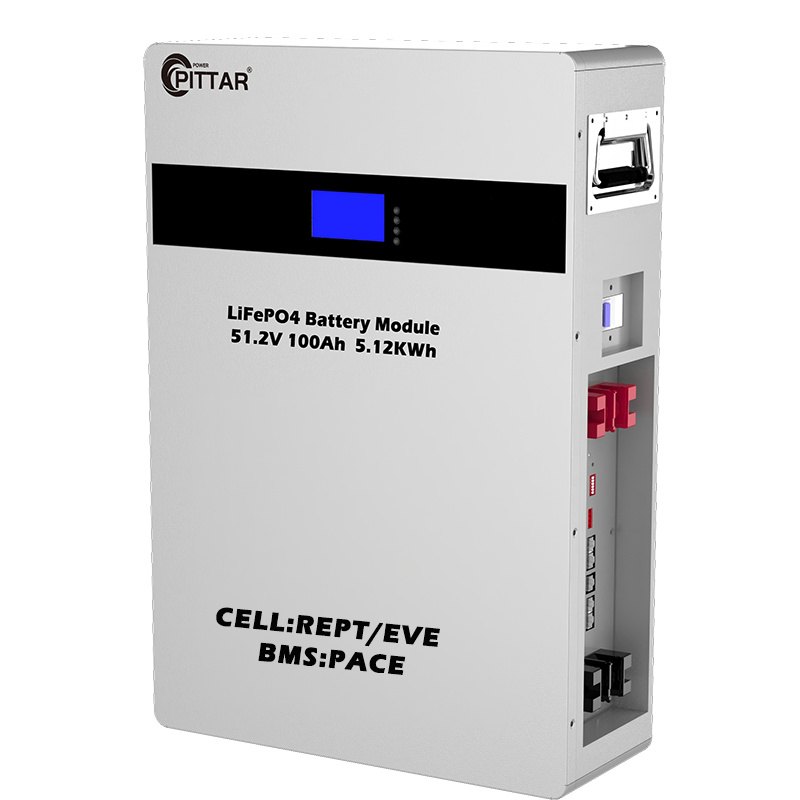
A LiFePO4 battery for camping can store electricity for outdoor use and supply lighting, refrigeration, electronics, communications, water management, and small appliances when shore power or solar is limited. The right battery, however, depends on actual energy consumption, required runtime, capacity, power output, weight, charging method, and outdoor temperature. The same battery that suits a single-night car-camping setup may be unsuitable for a multi- day group camping site with cooking, refrigeration, lighting, and an inverter-driven cooler.
LiFePO4 chemistry is frequently considered for camping because it combines usable capacity, cycle behavior, lower weight, reduced maintenance, and a stable chemistry that works well in enclosed battery housings. Those qualities matter when the battery is regularly moved, charged from solar panels, charged from a vehicle, or stored across seasons. They do not make LiFePO4 the correct choice for every camping setup. The final selection depends on compatibility with the existing 12V wiring, the inverter, the charging source, and the way the camping load is actually used.
For outdoor equipment distributors, retailers, portable power solution providers, and informed campers, the right question is not “Which LiFePO4 is best?” It is “Which LiFePO4 fits this camp’ s loads, charging conditions, weight limits, and operating plan?” This guide explains the technical points that answer that question.
__________________________________________________________________________________________________
What Is a LiFePO4 Battery for Camping?
A LiFePO4 battery, or lithium iron phosphate battery, is a rechargeable lithium battery chemistry known for thermal and chemical stability, strong cycle performance, and practical energy density for stationary and mobile storage. In camping applications it is used as the energy source for DC house loads, inverter loads, and solar recovery, usually combined with a Battery Management System (BMS) and a charger or charge controller.
A LiFePO4 battery differs from a generic lithium-ion battery in three practical ways:
Chemistry |
Practical Camp Behavior |
LiFePO4 |
Stable thermal behavior, strong cycling, lower risk of thermal runaway |
NMC / NCA |
Higher energy density, but more sensitive to heat, impact, and overcharge |
LTO |
Longest cycle life, but lower energy density and higher cost |
For outdoor use, LiFePO4 is commonly selected because it provides a useful trade-off between usable energy, weight, and safety for transportable battery housings, while still supporting repeated cycling from solar or vehicle charging.
__________________________________________________________________________________________________
Why Use LiFePO4 Batteries for Camping?
Each characteristic below matters during real outdoor use, not just on a data sheet.
Long cycle life. A camping battery that cycles daily across a trip, or weekly across a season, is exposed to real cycle stress. LiFePO4 can support a high number of cycles when depth of discharge, charge current, temperature, and charge behavior stay within manufacturer limits. The actual lifetime depends on how the battery is used, not just the chemistry label. Buyers should compare cycle claims only when test conditions are stated.
Usable capacity. Nominal capacity and usable capacity are different. A LiFePO4 battery may support a deeper high-Depth-of- Discharge operation than many lead-acid options, which means more stored energy is available for actual loads. Cold temperatures reduce available capacity, while reserve settings and BMS protection reduce usable energy further. Real usable kWh, not the box label, determines how long lighting, refrigeration, and electronics can operate.
Lower maintenance. LiFePO4 batteries do not require watering or equalization cycles associated with fiooded lead-acid batteries. The maintenance model shifts to monitoring state of charge, reviewing BMS or inverter alarms, inspecting cables and connectors, checking solar connection, and managing storage conditions.
Stable chemistry. LiFePO4 has favorable thermal characteristics compared with some other lithium chemist ries. That does not remove the need for an appropriate BMS, correct charger, protected cables, secure mounting, and respect for low-temperature charging limits. Chemistry reduces some risks; it does not replace proper installation.
Weight compared with lead-acid. For carry-in tent camping or rooftop tent setups, weight matters as much as capacity. LiFePO4 batteries typically deliver more usable energy at lower weight than equivalent lead-acid banks. For RV-based camping with fixed battery compartments, weight still matters for payload.
Repeated charging and discharging. Solar charging, vehicle alternator charging, and AC shore charging all benefit from a battery that accepts efficient charge cycling. The chemistry is only one part of this; the charger, controller, and BMS must also be compatible.
For a broader lithium battery overview, see [What Is a Lithium Battery?] .
__________________________________________________________________________________________________
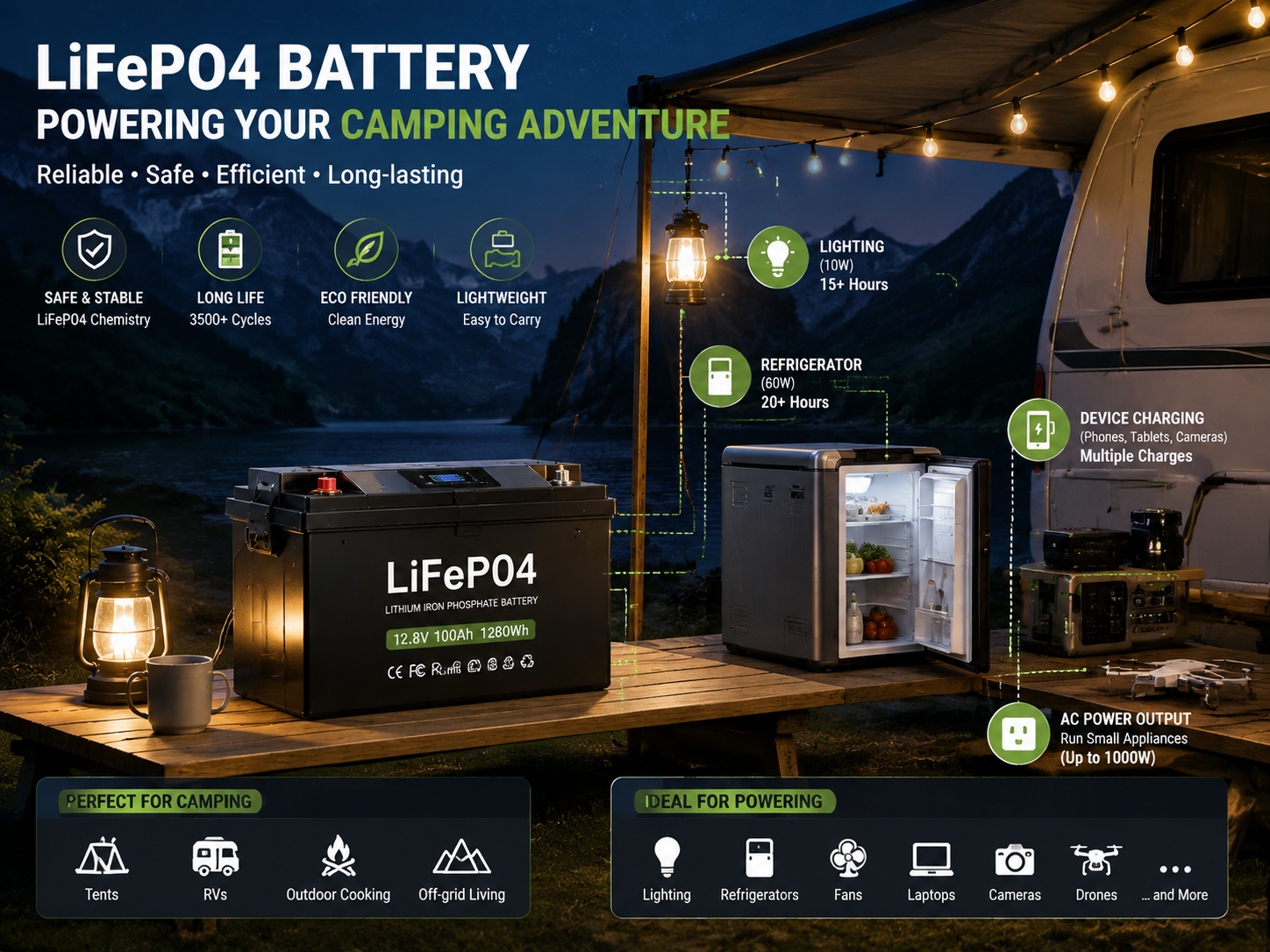
What Can a LiFePO4 Battery Power While Camping?
A camping battery powers loads with both an energy requirement and a power requirement. These must be evaluated separately.
Energy capacity decides how long a load can run. Power output decides which loads can run at the same time and whether motor-starting events can be supported.
Camping Load |
Energy vs Power Question |
LED lights |
Low power, long runtime, modest daily energy |
Phones, tablets, cameras |
Low power, long runtime, frequent recharging |
Laptops |
Moderate power, long runtime when work is continuous |
Camping fan |
Low to moderate power, several hours of overnight use |
Portable refrigerator |
Moderate continuous power plus compressor start surge |
Water pump |
Short runtime, motor-starting current |
Camera and lighting gear |
Variable; review steady draw and battery management |
Wi-Fi router |
Modest continuous draw |
Coffee maker, small induction, microwave |
Short runtime, but high inverter power and battery current |
A battery may have enough stored energy to operate a refrigerator overnight, but may still be unable to operate a microwave or coffee maker at the same time if the inverter is undersized or the BMS current limit is reached. This is the difference between capacity and power.
In practice, camping power works best when loads are organized into tiers: DC essentials run continuously, modest inverter loads run selectively, and high-demand AC loads run only when battery state of charge and charging conditions allow. This load hierarchy often provides more real-world value than a larger battery used without planning.
__________________________________________________________________________________________________
How Much LiFePO4 Battery Capacity Do You Need for Camping?
Capacity should be calculated from real energy use, not a generic assumption. Start by listing the DC and AC loads the battery is expected to support, then estimate how many hours each load operates between charging opportunities.
A useful relationship is:
Wh= V × Ah
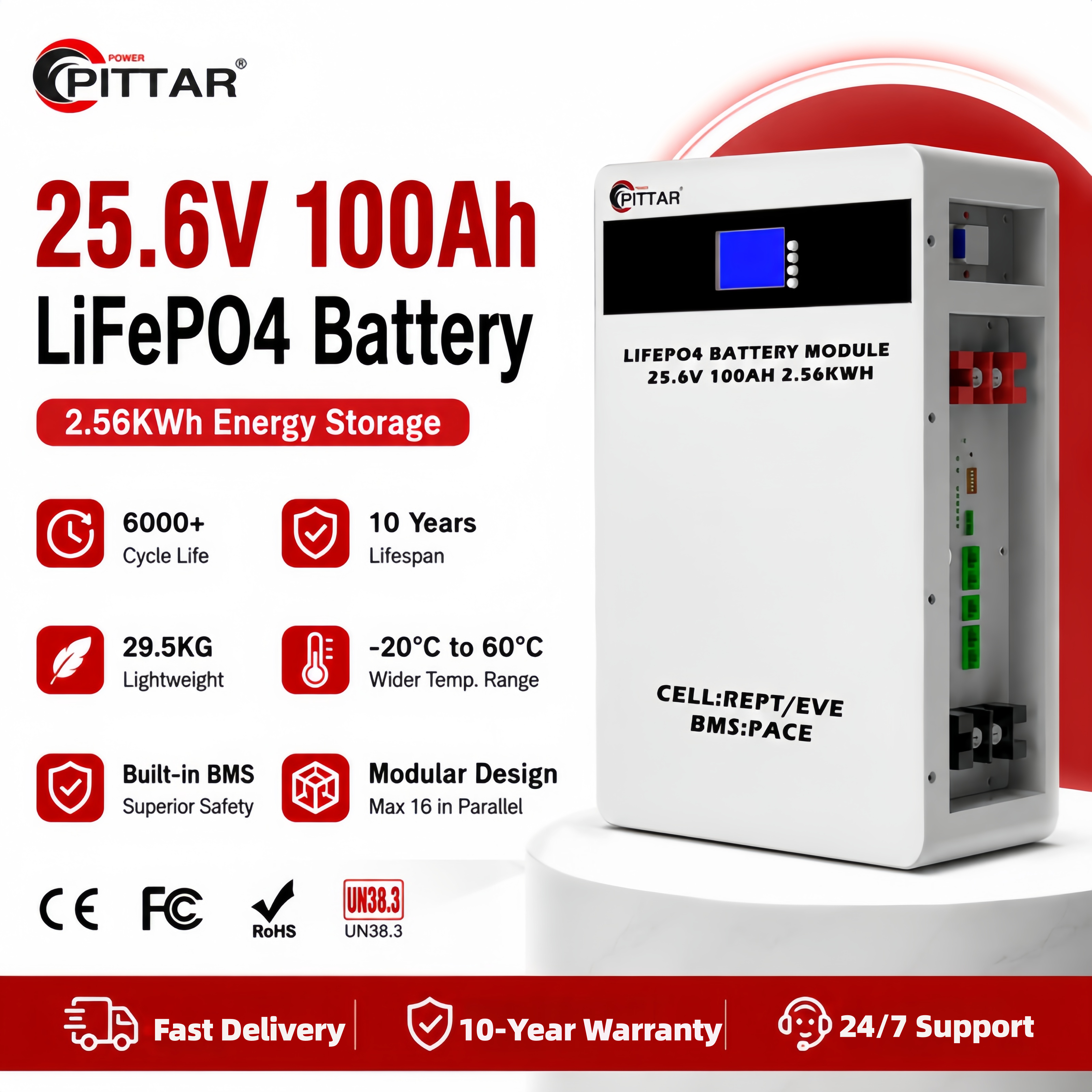
This equation shows why voltage matters. Two batteries with the same Ah rating may store different amounts of energy if their voltages differ. A 12.8V 100Ah battery stores about 1,280Wh; a 25.6V 100Ah battery stores about 2,560Wh. When the system voltage and usable depth of discharge are considered together, the practical usable energy for a camping system becomes clearer.
One-night camping. A short camp may use a small amount of energy for lights, phone charging, and a portable fridge. A modest 12V LiFePO4 battery may be sufficient if there is an opportunity to recharge the next day.
Weekend camping. A weekend camp adds longer runtimes for refrigeration, additional lighting, and occasional AC appliances. Usable kWh should be sized for the actual load profile, with a plan for recharging.
Multi-day off-grid camping. A longer camp with higher daily energy demand requires a larger usable capacity, stronger solar recovery, or a generator plan. Capacity must be matched against daily consumption, weather, available sun, and access to shore or vehicle charging.
Usable capacity is not the same as nameplate capacity. DoD, reserve state of charge, inverter efficiency, cabling, and temperature losses reduce the energy available at the load. A practical sizing estimate uses usable kWh rather than the marketing label, and verifies that solar, alternator, or shore charging can restore that energy before the next demand cycle.
__________________________________________________________________________________________________
12V LiFePO4 Battery vs 24V for Camping
Voltage selection should match the existing electrical equipment first. Camping systems commonly use 12V because many RV and portable appliances are designed for 12V DC.
12V systems are common because they match existing camping and RV house loads, off-the-shelf 12V accessories, and simple portable power station architectures. As inverter loads increase, 12V requires higher current for the same power, which means thicker cables, careful fusing, and tight voltage drop management.
24V systems can serve larger camping platforms with higher inverter output or longer cable runs. They can reduce current at the same power level and may suit larger RV or expedition systems. They also require compatible chargers, solar controllers, and DC-DC conversion for 12V accessories.
Voltage |
Camp Application |
Practical Review Point |
12V |
Tents, small trailers, portable power stations, RV 12V house loads |
High current at larger inverter output |
24V |
Larger RV or expedition rigs, longer cable runs |
Compatibility with 12V appliances and chargers |
No voltage is universally correct for camping. Confi rm the existing 12V appliances, inverter, solar controller, alternator charging path, and shore charger before changing voltage. A change in voltage architecture can be useful but typically requires multiple component changes.
__________________________________________________________________________________________________
How to Choose a LiFePO4 Battery for Camping
A useful buying framework is to use each specification to eliminate unsuitable batteries before comparing price.
Capacity. Convert voltage and Ah into usable kWh after reserve state of charge, temperature effects, and inverter losses. Confi rm that capacity can be restored between expected charging opportunities.
Continuous discharge current. Check the continuous current the battery BMS can support. Compare this with the planned inverter output and DC load profile.
Peak discharge capability. Review motor-starting surges from refrigerator compressors, water pumps, fans, and inverter loads. Peak current must stay within BMS limits.
Voltage. Match the battery voltage to the inverter, solar controller, charger, and existing DC loads.
BMS protection. Review overcharge, over-discharge, overcurrent, short-circuit, and temperature protection, plus low- temperature charge protection. Alarms and remote monitoring can be valuable for fieet and rental applications.
Physical dimensions. Measure the camping battery housing, cable access, mounting points, ventilation, and service clearance. A battery that does not fit the available space is not a suitable choice.
Weight. Evaluate carry weight for tent camping, vehicle loading for RV or rooftop tent camping. Weight reduction only adds value if the battery is mechanically supported and balanced.
Charging method. Confi rm the battery is compatible with the planned solar controller, AC shore charger, vehicle alternator charger, or generator. Mismatched charging settings are a common cause of poor battery performance.
Operating temperature. Check the temperature range for camping, especially for cold nights and hot vehicle interiors. Low- temperature charge protection may be required in cool conditions.
Expansion capability. If a larger bank may be needed later, confi rm that parallel modules can be added under supplier rules and that charger, inverter, and cable capacity can grow.
Warranty and support. Review warranty scope, cycle or throughput conditions, dealer support, diagnostic access, and replacement availability. For distributors and rental operators, the support model can be as important as the battery itself.
__________________________________________________________________________________________________
How Can You Charge a LiFePO4 Battery While Camping?
Charging compatibility is often the deciding factor for outdoor power systems. A LiFePO4 battery must be charged with a profile that respects its voltage, current, temperature, and BMS settings.
Solar panels. Solar is a common charging method at camping sites. The PV array must connect to a compatible solar charge controller set for the LiFePO4 battery voltage. Panel wattage, controller capacity, orientation, shading, weather, and panel tilt determine how much usable energy the array returns per day.
Vehicle alternator. Alternator charging during travel can keep the battery topped up. Most vehicles require a DC-to-DC charger to control voltage and current; direct alternator connection is rarely suitable for a LiFePO4 battery in camping applications.
AC shore charger. When AC power is available at a campsite or cabin, an AC charger provides a controlled top-up. Charger voltage, current profile, and battery communication must be matched to the battery.
Portable generator. A small portable generator can recharge the battery through an AC charger. The generator must be appropriate for the charger’ s input and must be used outdoors with safe ventilation and exhaust handling.
Solar charging is rarely a constant rate. Cloud cover, season, panel orientation, and campsite shading reduce energy harvest. A battery selection should account for the realistic daily recharge potential, not only nominal solar array capacity.
__________________________________________________________________________________________________
LiFePO4 vs Lead Acid for Camping
Lead-acid, AGM, gel, and lithium chemist ries can all be used in camping. The right choice depends on trip duration, frequency, charging equipment, weight limits, and maintenance tolerance.
Decision Factor |
LiFePO4 Lithium Battery |
Lead-Acid / AGM / Gel Battery |
Weight |
Lower for comparable usable energy |
Heavier, harder to carry in tent camping |
Usable capacity |
Often higher |
Lower for long life under deep cycling |
Cycle life |
Strong in frequent cycling |
More sensitive to deep discharge |
|
Charging efficiency |
Usually higher |
Usually lower |
Maintenance |
Monitoring and connections |
Flooded needs water/equalization; sealed needs correct profile |
Initial cost |
Often higher |
Often lower |
Long-term cost |
Often favorable in higher use camping |
May suit lower-frequency, budget-led use |
A higher initial purchase price may be justified when the camp cycles the battery regularly, weight is constrained, or charging is limited. A lower-cost lead-acid bank may still suit a low-frequency seasonal camp with strict budget.
The relevant comparison is cost per usable delivered kWh across the expected service life, including weight, transport, charging setup, and replacement risk.
For related mobile-power and RV selection criteria, see [Best Lithium Battery for RV] .
Common camping-battery mistakes fall into the same categories covered by the checklist below: choosing only by Ah, ignoring actual consumption, ignoring inverter power, ignoring weight or dimensions, ignoring charger compatibility, ignoring low- temperature limits, and selecting on price alone. The checklist provides a direct response to each of those mistake categories.
__________________________________________________________________________________________________
Frequently Asked Questions
Is LiFePO4 good for camping? LiFePO4 is widely considered for camping because it can provide usable capacity, cycle behavior, lighter weight, and reduced maintenance. Final suitability depends on charging compatibility, temperature, weight limits, physical fit, and the real camp load profile.
What size LiFePO4 battery do you need for camping? The right size depends on actual daily energy use, expected runtime, charging opportunity, inverter loads, weight tolerance, and operating temperature. Estimate daily consumption fi rst, then size usable capacity to that consumption with reserve for weather and inverter losses.
How long will a LiFePO4 battery last while camping? Service life depends on cycle frequency, depth of discharge, temperature, charge behavior, BMS limits, and storage conditions. Review manufacturer cycle-test conditions, warranty terms, and your own operating plan rather than relying on a general lifespan claim.
Can a LiFePO4 battery run a camping refrigerator? It can, but the system must support the compressor current and continuous inverter load. Modest compressor fridges usually work well; high-output residential-style fridge/freezers may require a larger inverter, a higher BMS current limit, and a strong charging plan.
Can I charge a LiFePO4 battery with solar panels? Yes. The PV array should connect to a compatible MPPT or PWM charge controller set to the LiFePO4 profile. Array size, weather, controller limits, and battery capacity determine how much usable energy is returned per day.
Is LiFePO4 better than lead acid for camping? LiFePO4 is often better when the battery cycles often, weight is constrained, or low maintenance matters. Lead-acid can still suit a low-cost, low-cycle, or stationary camping setup. The decision should be based on the actual operating profile, not chemistry preference alone.
__________________________________________________________________________________________________
Buyer Checklist Before Choosing a Camping LiFePO4 Battery
Confirm the following points before selecting a camping battery:
1.Daily DC and AC energy use is documented from a realistic camping profile.
2.Battery capacity is compared in usable kWh, not Ah a lone.
3.Continuous and peak inverter demand are checked against BMS current limits.
4.Battery voltage matches the existing DC loads, inverter, solar controller, and charger.
5.Physical dimensions, mounting, ventilation, and service clearance match the planned housing.
6.Carry or vehicle payload is acceptable after battery weight is added.
7.Solar, vehicle alternator, AC shore, and generator charging paths are compatible with the battery.
8.Operating temperature and low-temperature charge limits are considered for the camping climate.
9.High-power appliance use is balanced against inverter capability and battery current limits.
10.Expansion rules, additional charger capacity, and module matching are understood before scaling up.
11.Warranty, dealer support, diagnostics, and replacement availability are clear.
The right camping battery is a system decision. When capacity, voltage, power, charging sources, weight, temperature, and operating strategy are aligned, a LiFePO4 battery can power a dependable outdoor experience without relying on optimistic runtime claims.
For a deeper look at cycle behavior, see [How Many Cycles Can a LiFePO4 Battery Provide?] .
 Hot News
2026-08-20
2026-08-16
2026-08-12
2026-08-03
2026-07-30
2026-07-26

Pittar Power is a professional manufacturer specializing inenergy storage solutions.
Room 302, Building 1, No. 10, Huangjin First Road, Nancheng District, Dongguan City, Guangdong Province, China
Copyright © Shenzhen Pittar Power Co., Ltd. All Rights Reserved Privacy Policy
 EN
EN