A purchasing manager who asks whether sodium-ion car batteries are safe is rarely asking for a chemistry lecture. The question normally sits underneath a decision: whether to load the product into a container, whether to fit it into vehicles that carry a warranty, and whether the person who signs for the batch can defend the choice eighteen months later if a unit comes back swollen.
Answered at that level, sodium-ion car batteries can be safe, and the chemistry gives a designer useful room to work with. But safety does not belong to a chemistry. It belongs to a finished product that has a cell design, a protection board, a case, a mounting position and an installer. Two 12 V sodium-ion batteries built from comparable cells can differ more in field behaviour than two batteries built on different chemistries, because the layers above the cell decide what happens when something goes wrong.
So the useful version of the question is not whether sodium-ion is safe, but which hazards exist in a given product and which layer is supposed to contain each one.That version has an answer a buyer can verify. What follows works through it in order: what can actually burn or rupture inside the cell, which abuse conditions produce that outcome, which layer of the product is meant to stop each one, what an engine bay does to all of it, and which documents settle a claim before an order is released. The chemistry-versus-chemistry comparison is a different question and is handled in the sodium-ion against lithium-ion comparison piece.
_______________________________________________________________________
The Direct Answer, and the Three Parts It Is Made Of
In normal service, in a correctly specified vehicle, a well-built sodium-ion auxiliary battery is not a high-risk item. It is a sealed 12 V-class product with a protection board, no liquid to top up and no lead to handle. That is the plain answer most buyers want.
Where the answer changes is outside normal service. A cell that is overcharged past its upper limit, crushed in a collision, shorted across its terminals, charged at a temperature where the anode cannot accept sodium quickly enough, or built with a separator defect that should never have shipped, will behave like any electrochemical cell under the same abuse. It will generate heat, it may vent, and the vented material is flammable. No chemistry removes that property. A supplier who says otherwise is quoting a single test result and calling it a product characteristic.
That gives three parts to the answer. The first is the hazard inventory of the chemistry, which is narrower than the marketing suggests and different from lithium-ion in specific, nameable ways. The second is the containment stack, which is where most of the actual safety in a shipped product lives. The third is evidence, because the first two are invisible from outside the case.
_______________________________________________________________________
What Is Actually Flammable Inside a Sodium-Ion Cell
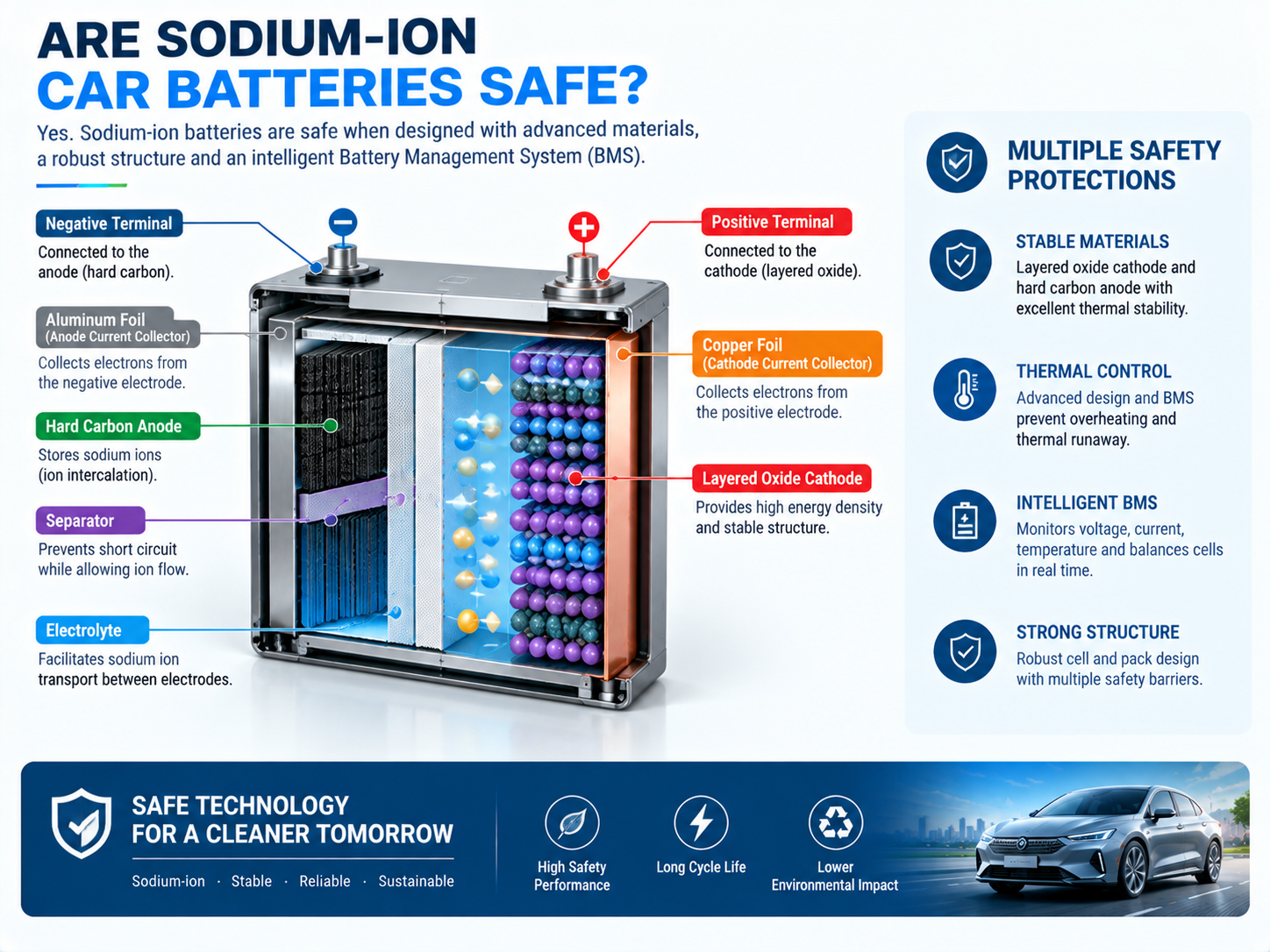
Start with a correction that matters for handling and transport: a commercial sodium-ion cell contains no metallic sodium. Sodium is held in the cathode lattice and in the hard carbon anode, the same way lithium is held in a lithium-ion cell. Nothing in the product reacts with water the way sodium metal does. Sodium ion batteries have their own entries in the UN Model Regulations and are shipped under the packaged-cell testing framework rather than the reactive-metal framework.
The flammable component is the electrolyte. Most sodium-ion cells use organic carbonate solvents carrying a sodium salt, and those solvents burn. What varies between products is how much energy is available to ignite them and how much oxygen the cathode can supply once it is hot.
On that point the cathode family matters more than the word sodium. Layered oxide cathodes store more energy per unit mass and, like high-nickel lithium oxides, can release oxygen once they are heated far enough, which is what turns a local hot spot into a self-sustaining event. Polyanion cathodes hold their framework together at higher temperature and give up less oxygen. Prussian blue analogue cathodes are mechanically robust because of their open framework, but their thermal decomposition can release cyanide-containing species, which is a different hazard rather than an absent one. Two sodium-ion products with the same headline capacity may therefore carry three different risk profiles.
At the anode, hard carbon avoids the solvent co-intercalation and exfoliation problems that graphite shows, which is part of why sodium-ion performs usefully at low temperature on discharge. The failure mode to know is sodium plating. If the cell is charged near freezing, or at a high rate when the anode is nearly full, sodium can deposit as metal on the surface instead of intercalating into the structure. Plated sodium is reactive, it decomposes the electrolyte, and it builds the kind of irregular surface that later produces a soft short. This is the same class of problem as lithium plating, and it is why low-temperature charge limits belong in a safety conversation rather than only in a performance one.
One structural difference is genuinely safety-relevant and is usually missed in buyer-facing material. Sodium-ion cells commonly use aluminium foil as the current collector on both electrodes, because sodium does not alloy with aluminium at low potential the way lithium does. Copper, the negative-side collector in most lithium-ion cells, dissolves if a cell is driven deeply discharged and can then re-plate as a conductive path through the separator, which is a known internal-short mechanism after over-discharge. An aluminium negative collector removes that specific path, and it also makes long storage at low voltage less risky than it would be for a copper-based cell. It does not make over-discharge harmless. It removes one of the mechanisms by which over-discharge becomes a fire.
The separator is the last cell-level item. A polyolefin separator with a shutdown layer is designed to close its pores and interrupt current once it gets hot. Whether a given product uses one, at what thickness, and with what coating is a design decision the buyer cannot see from the outside, which is exactly why the safety question is answered by documents rather than by the chemistry line on a datasheet.
All of this is product-specific. Actual behaviour depends on chemistry, cell design, manufacturer and operating conditions, and a single abuse-test result belongs to one cell design rather than to sodium-ion as a class.
_______________________________________________________________________
Four Abuse Conditions, and Only Three of Them Are Electrical
Field failures sort into four groups, and the grouping maps onto who is responsible for prevention.
• Electrical abuse. Overcharge past the upper voltage limit, over-discharge below the lower one, an external short across the terminals, or reverse connection at installation. Prevention sits with the protection board and with the person holding the spanner.
• Thermal abuse. A battery soaking in an engine bay after shutdown, charging immediately after a hot run, or charging at sub-zero ambient without derating. Prevention is split between pack design and the charging strategy the vehicle applies.
• Mechanical abuse. Crush in a collision, penetration, vibration fatigue of an internal weld, or a terminal stud over-torqued at fitting. Prevention belongs to the case, the cell format and the installation instructions.
• Manufacturing defects. A metal particle inside the cell, a misaligned separator, a weak weld. These are the cases a BMS cannot see and cannot interrupt, which is why process control and lot traceability are safety controls rather than paperwork.
The fourth group explains why a quality file matters more than a safety brochure.A protection board can interrupt a current in milliseconds. It cannot detect a particle that will only become a problem in year three, and no amount of chemistry selection compensates for a line that ships contaminated cells.
_______________________________________________________________________
Where the Protection Actually Comes From
Safety in a finished battery is a stack of four layers, and each layer fails in its own way. Reading the stack is more useful than reading a chemistry claim, because the buyer is purchasing all four whether or not the supplier describes them.
The cell layer. Cathode family, separator construction, vent design, and where fitted a current-interrupt device that permanently opens the cell on over pressure. This layer sets the ceiling on what the rest of the stack can achieve.
The electronics layer. Thresholds for over-voltage, under-voltage, over-current and temperature, whether a trip latches or auto-recovers, how charge current is derated as temperature falls, and what the vehicle electrically sees during a protection event. That last item is where safety and availability collide. A board that opens the circuit to protect the cell looks exactly like a dead battery to the driver and to the counter. A board tuned to avoid nuisance trips protects the customer relationship but narrows the margin. The defensible answer is a documented policy, not a quiet preference.
The pack layer. Mechanical retention, venting direction, terminal insulation and covers, fuse rating, ingress protection, and the thermal path from cell to case. A pack can contain a cell event or spread it, and the difference is usually a few millimetres of design attention.
The installation layer. Correct group size, hold-down engaged, terminal torque, vent clearance, no reverse connection, and registration so that the vehicle's charging strategy treats the battery as what it is. Every one of these is somebody's job at fitting time, and every one of them has produced a warranty claim that was recorded as a battery failure.
Hazard |
Layer that contains it |
Evidence to hold |
Overcharge past the upper limit |
Protection board charge cut-off,working with the vehicle's voltage regulation |
Pack-level overcharge report, threshold specification, and the pack charge window checked against the regulation the vehicle actually applies |
External short across the terminals |
Fuse, terminal insulation and covers, board current limit |
Short-circuit test report, fuse rating, and the terminal cover drawing |
Charging below freezing |
Board charge derating, plus a heating strategy where one is fitted |
Derating curve against temperature, and a test at the coldest temperature the destination market reaches |
Crush, penetration or vibration fatigue |
Case structure, cell format, hold-down and mounting hardware |
Crush and vibration reports, dimensioned drawing, terminal torque specification |
Venting from a cell event |
Cell vent design, pack vent path, and clearance at the installation |
Vent direction and clearance requirement, stated in the installation instructions rather than assumed |
A defect built into the cell |
Process control and end-of-line testing, because no electronics can detect it |
Lot record pulled for a randomly chosen serial, end-of-line data, and a worked failure-analysis example |
Read that table from the right-hand column backwards. If a supplier cannot produce the document in the third column, the claim in the first column is an opinion, and opinions do not survive a recall.
_______________________________________________________________________
Thermal Reality in an Engine Bay
An auxiliary battery lives in one of the least forgiving places on a vehicle. It sees radiant heat from the exhaust side, a soak period after shutdown when coolant stops moving, and its own resistive heating during every crank. A sodium-ion product with a wider thermal margin handles that environment better than a chemistry with a narrower one, but the margin buys design room rather than immunity.
What the margin actually buys is placement. It lets a pack engineer put the battery closer to a heat source and still keep cell temperature inside its window. It does not remove the need to measure that temperature in the real vehicle, because two vehicles with the same battery in the same nominal position can differ substantially depending on heat shielding and airflow. A supplier who quotes a cell temperature limit and stops there has described a component, not an installation.
Venting deserves its own sentence because it is the requirement most often lost in aftermarket fitting. A cell that vents has to vent somewhere. If the battery sits in a sealed enclosure, or in a cabin or luggage compartment with no path out, the vent path becomes an installation problem that the cell supplier never sees. Instructions that state vent direction and clearance are a safety document, not an afterthought.
Low-temperature charging is the winter half of the same subject. A hard carbon anode accepts sodium more slowly as temperature falls, so the safe charge current falls with it. A board that derates charge current in the cold is protecting the cell. A board that does not, combined with a vehicle that applies full charging voltage the moment the engine starts on a cold morning, is the combination that produces plating. For a cold-climate market this is the single most important behaviour to test, and it is a behaviour rather than a number: it has to be measured on the actual product at the temperatures the market actually reaches.
_______________________________________________________________________
Safety Claims and the Documents That Settle Them
Four phrases should end a conversation rather than open one: “ 100% safe” , “no fire risk” , “explosion-proof” and “military grade” . Each is either meaningless or an unstated reference to a specific test on a specific sample. A supplier who leads with them is telling the buyer that the documentation will have to be extracted rather than supplied.
What a buyer can hold instead falls into five groups. For transport, a test summary for the cell and for the pack configuration actually being shipped. For abuse, reports covering overcharge, external short, crush or penetration and thermal exposure, at cell level and preferably at pack level, with conditions stated rather than summarised. For mechanical and environmental behaviour, vibration, shock and an ingress-protection rating tested to a named level instead of claimed in a sentence. For the electronics, a specification listing thresholds, latch behaviour and the low-temperature charge-derating curve. For installation, instructions carrying terminal torque, vent clearance and mounting requirements in the language of the destination market.
Which standards apply depends on the market, the vehicle programme and the customer's own specification, so the buyer's task is to confirm the scope of what is offered rather than to assume that a familiar mark covers the case at hand. A certificate covering a cell family does not automatically cover the pack being shipped, and a report on a sample built in a different format is evidence about a different product. The wider evidence set for a purchase, including traceability and supplier capability, is set out separately; the list above is the subset that speaks directly to safety.
_______________________________________________________________________
What This Means for the Channel
Most safety events reach a supplier through a channel rather than a laboratory. A distributor finds three swollen units in a pallet that spent the summer in a hot warehouse. A workshop reports a battery that vented after a jump start with the leads reversed. A fleet reports a no-start in the first cold week, and by the time the report arrives the workshop has already replaced the battery under warranty.
Three practices reduce the damage. Quarantine rather than recharge: a swollen or vented unit should not be charged, tested or returned to stock, and the rest of its lot should be checked before the pallet moves again. Separate defect from abuse in the warranty decision, because reverse connection, a missing hold-down and an unvented enclosure are installation faults, and a warranty that does not distinguish them prices that risk into every unit sold. And treat the installation instructions as part of the product: a torque figure, a vent clearance and a registration step that never reach the installer do not exist.
Stock handling is the quieter half of the same problem. Sodium-ion packs tolerate low-voltage storage better than copper-based lithium packs, but they do not tolerate a hot warehouse or a year on a shelf without a state-of-charge check. A distributor who opens a pallet after a summer and finds units that will not accept charge is looking at a storage failure that will be reported as a quality failure.
PITTAR supplies sodium-ion battery products to automotive battery importers, distributors, wholesalers, dealers, and OEM and ODM buyers, and confirms safety documentation against the destination market and the programme's own requirement rather than asserting that a chemistry is safe in the abstract. For a buyer opening a first sodium-ion programme, the starting point is the same as for any other chemistry: a defined duty cycle, a documented protection strategy, and a document trail that survives an audit.
_______________________________________________________________________
Frequently Asked Questions
Can a sodium-ion car battery catch fire?
It can, under abuse. The flammable material inside the cell is the organic electrolyte, and a cell that is overcharged, shorted, crushed or overheated can vent and ignite. What differs between products is how much energy is available at the point of failure and how the protection layers respond. A supplier who answers no to this question is telling the buyer something about the documentation rather than about the product.
Do sodium-ion batteries contain lithium or cobalt?
Typically neither lithium nor cobalt, and often little or no nickel. That matters for supply chain and cost, but it is not by itself a safety claim. A cell can be entirely cobalt-free and still contain a flammable electrolyte and a cathode that releases oxygen when heated.
Is over-discharge dangerous on a sodium-ion battery?
Less dangerous than on a copper-collector lithium cell, because aluminium is used on both electrodes and does not dissolve at low potential. It is still a condition to avoid. A deeply discharged pack should be assessed before charging rather than connected to a charger and hoped for, and the protection board should prevent the vehicle from reaching that state in service.
Can a sodium-ion battery be installed in the cabin or the boot?
Only if the product is specified for that location. Placement inside the vehicle turns venting and enclosure into the deciding questions, and the instructions should state vent direction and clearance. A battery designed for the engine bay is not automatically suitable for a sealed compartment, and an installer who assumes otherwise has removed a vent path the design depended on.
What should I do with a sodium-ion battery that has swollen in stock?
Quarantine it, do not charge or test it, keep it away from ignition sources and out of saleable stock, and check the rest of its lot. Transport and disposal of a damaged unit follow different rules from a new one, so confirm the route with the forwarder before the pallet is moved.
 Hot News
2026-11-04
2026-11-03
2026-10-30
2026-10-26
2026-10-22
2026-10-14

Pittar Power is a professional manufacturer specializing inenergy storage solutions.
Room 302, Building 1, No. 10, Huangjin First Road, Nancheng District, Dongguan City, Guangdong Province, China
Copyright © Shenzhen Pittar Power Co., Ltd. All Rights Reserved Privacy Policy
 EN