Introduction.
Home backup batteries store electricity and release it when the grid is unavailable or when a solar-plus-storage system is configured to serve selected loads. The right battery is determined by energy demand, backup duration, battery chemistry, inverter compatibility, installation environment, and the homeowner’s operating priorities.
For a homeowner, the practical question is often simple: which loads must keep running during an outage? For an installer or distributor, the answer requires a more detailed review. Refrigeration, lighting, internet, security, medical devices, water pumps, garage doors, and selected outlets each add energy and power requirements. A system that can keep a refrigerator running for many hours may still be unable to start a large pump or support central air conditioning unless the inverter and battery current capability are specified correctly.
The Best Lithium Battery for Home Backup Power is therefore not a universal product. It is a battery solution matched to critical loads, available installation space, expected outage duration, local climate, solar integration, service model, and future expansion plan. This article explains how professional buyers and residential energy providers should evaluate that match.
__________________________________________________________________________________________________
What Is a Lithium Battery for Home Backup Power?
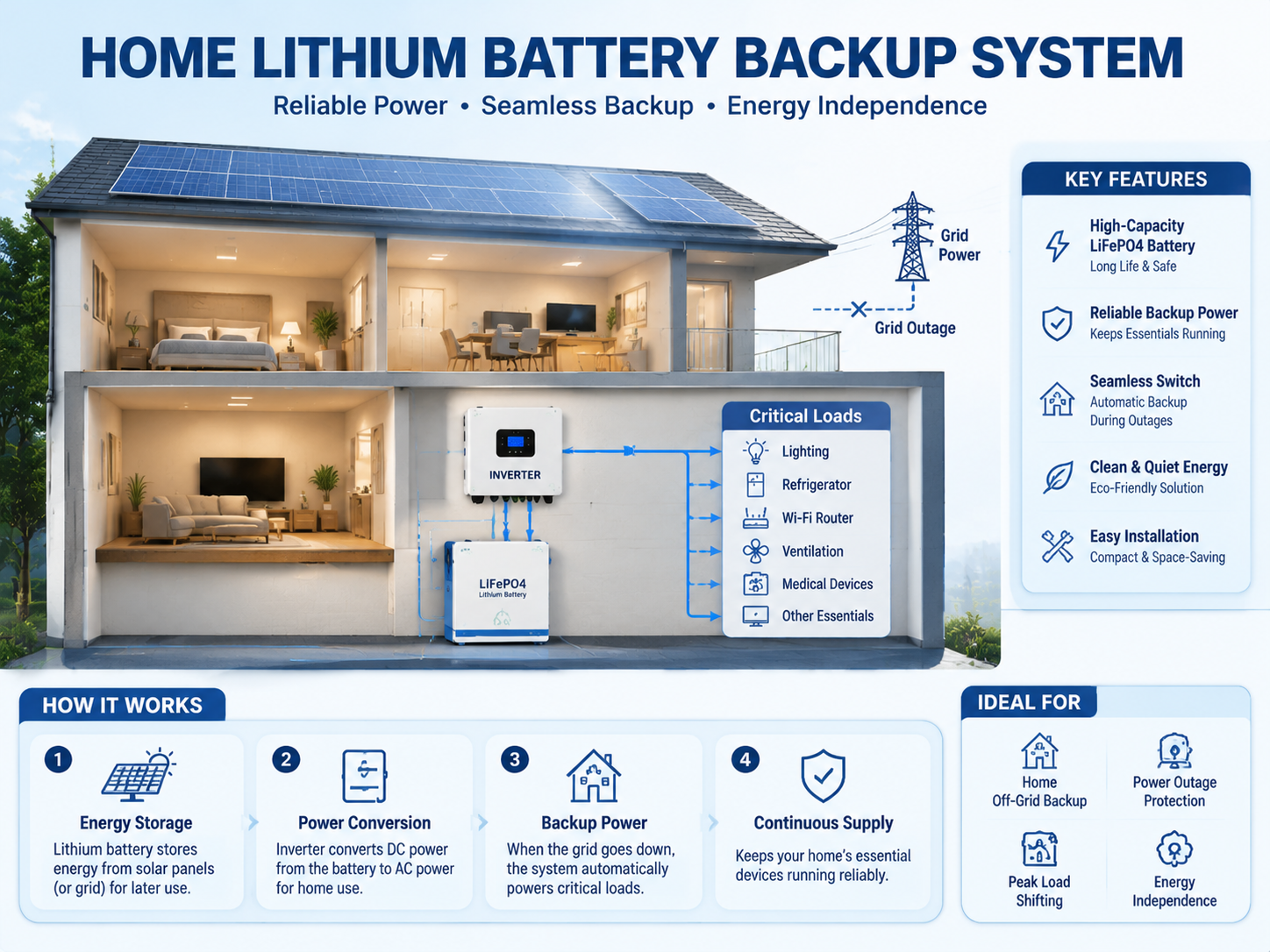
A lithium battery for home backup power is a rechargeable energy-storage system that retains electrical energy and supplies it through an inverter when normal grid power is unavailable or when the system is instructed to use stored energy. In aresidential installation, the battery is normally combined with an inverter or hybrid inverter, protection equipment, monitoring, and a critical-load panel or managed backup circuits.
The battery does not power the home alone. It operates as part of an energy system. Solar panels may charge it during daylight. The grid may charge it when permitted or economically useful. The inverter converts battery DC energy into AC electricity for household circuits. The Battery Management System (BMS) monitors battery voltage, current, temperature, and protection conditions.
The most useful way to explain home backup is through three separate quantities:
Requirement |
What It Determines |
Usable energy, measured in kWh |
How long selected loads can run |
Continuous power, measured in kW |
Which loads can operate together |
Surge power |
Whether pumps, compressors, or motors can start |
A home battery should be specified from the load schedule rather than from the size of the property. A small apartment with a refrigerator, router, lighting, and medical device may need a different system from a larger home with a well pump, multiple refrigerators, security equipment, and a large critical-load panel.
For a technical foundation on battery technology and operating limits, see [What Is a Lithium Battery?] .
__________________________________________________________________________________________________
Why Lithium Batteries Are Used for Home Backup Systems
Lithium batteries are commonly selected for residential backup because their operating profile often suits the requirements of modern homes: limited installation space, intermittent outages, solar integration, monitored operation, and a desire to reduce routine maintenance.
Service life under actual use. A home battery may cycle daily in a solar self-consumption system or may remain mostly charged until an outage occurs. These are different duty cycles. Lithium batteries are attractive because they can support repeated cycling when current, temperature, and depth of discharge stay within approved limits. Buyers should review the stated test conditions, capacity-retention warranty, and energy-throughput terms rather than rely on a single lifespan claim.
Usable energy in a limited footprint. In many homes, the battery must fit in a utility room, garage, equipment closet, or exterior enclosure. Lithium systems often provide a larger usable portion of nominal capacity than traditional lead-acid products, which can reduce the physical space required for a defined backup target.
Charging efficiency and solar coordination. A battery connected to a solar system must accept energy during the available production window. Lithium systems can often support efficient solar charging within their approved limits. This can help a household capture daytime PV production for evening loads or maintain a backup reserve before an expected outage.
Maintenance model. Lithium batteries do not require electrolyte watering or equalization associated with flooded lead-acid batteries. The maintenance work moves toward reviewing alarms, state-of-charge trends, temperature, inverter communications, connections, enclosure condition, and the charge profile.
Space and installation efficiency. Lower weight and compact energy storage can simplify wall-mounted, rack-mounted, or floor-standing installations. That advantage should still be reviewed against mounting requirements, service clearances, ventilation, and local installation rules.
__________________________________________________________________________________________________
What Makes the Best Lithium Battery for Home Backup Power?
Quality should be judged by the complete battery solution, not by capacity label or chemistry name alone. A procurement review should cover the following factors.
Battery chemistry. LiFePO4 is widely used in residential storage because it offers stable chemistry, strong cycle performance, and a practical balance of usable energy and maintenance. Other lithium chemist ries can serve different applications. The correct choice depends on the system design, supplier support, and expected operating conditions.
Capacity and power. Capacity in kWh determines duration; continuous and surge power determine which circuits can run together. A system should be able to support the target energy load and the highest expected power event. Pump starts, refrigerator compressors, garage doors, and HVAC equipment can drive inverter and BMS requirements even when daily kWh use appears modest.
Voltage and inverter compatibility. The battery voltage, communication protocol, BMS behavior, inverter firmware, and approved equipment list should be reviewed together. Incompatibility can create commissioning delays, limited functionality, nuisance trips, or warranty disputes.
Cycle life and depth of discharge. Cycle claims should be compared only when test conditions are comparable. Review DoD, charge/discharge current, temperature, and the remaining capacity used to define end of life. A high usable DoD can improve practical kWh, but the backup reserve should reflect the homeowner’s risk tolerance and solar recharge plan.
Safety features and BMS. The BMS should provide appropriate voltage, current, temperature, and fault protection, along with alarms and communications where required. Enclosure design, cables, breakers, disconnects, installation workmanship, and monitoring all contribute to system safety.
Warranty and support. Review calendar years, capacity-retention conditions, throughput limits, installation requirements, claims process, local service coverage, and module availability. A warranty has more value when the installer and owner understand what operating conditions it assumes.
Evaluation Area |
Buyer Question |
Usable kWh |
What energy is available after reserve and DoD settings? |
Continuous and surge power |
Which critical loads can run simultaneously? |
BMS |
What current, temperature, and fault protections are provided? |
Inverter integration |
Is the model officially supported and correctly configured? |
Warranty |
What capacity, throughput, and installation conditions apply? |
Expansion |
Can additional modules be added without replacing the original bank? |
__________________________________________________________________________________________________
Why LiFePO4 Batteries Are Popular for Home Energy Storage
LiFePO4 is frequently specified for residential energy storage because it fits the way many home backup systems operate. The value comes from the combination of thermal characteristics, cycle behavior, usable capacity, and service requirements.
Safety characteristics. LiFePO4 has thermal and chemical characteristics that make it a common choice for stationary residential storage. That does not remove the need for system-level protection. Cell quality, BMS settings, cable and breaker ratings, enclosure design, placement, and installation procedures remain part of the safety case.
Cycle performance. A household with solar may use the battery daily to shift PV energy into the evening. Another household may only cycle during outages. LiFePO4 can serve both patterns when the system is sized and configured correctly. Daily-cycle projects should examine throughput and capacity-retention terms; outage-only projects may place more emphasis on calendar warranty and standby behavior.
Thermal stability and installation context. Home batteries are installed in varied conditions: garages, utility rooms, basements, exterior cabinets, and hot climates. Battery selection should include operating temperature, low-temperature charging protection, ventilation, moisture protection, clearances, and service access. The battery chemistry is one part of this review, not the entire review.
Practical daily use. Higher usable capacity and efficient charging can help homeowners support critical circuits while storing more solar energy for later use. For a solar-connected home, the battery must work with the PV inverter or hybrid inverter, and the control logic must preserve the intended reserve for backup.
For readers assessing solar-linked home storage options, see [Best Lithium Battery for Solar Storage] .
__________________________________________________________________________________________________
How to Choose the Right Battery Capacity for Home Backup
Sizing starts with the loads that the homeowner expects to keep running. Capacity should be based on a documented backup plan, not a general claim that the system will power “the whole home.”
Household electricity consumption. Start with the household’s normal energy records, then isolate the loads expected during an outage. A home can consume a large amount of energy over a day, but only a portion may be designated as critical backup load.
Critical loads. Typical critical loads can include refrigeration, LED lighting, internet equipment, security systems, garage doors, selected outlets, medical equipment, and water pumps. High-load appliances such as electric heating, central air conditioning, electric ovens, clothes dryers, EV charging, and workshop equipment should be considered separately because they can change both kWh and kW requirements.
Backup time. Define whether the target is a few hours, one overnight period, a full day, or longer. A solar system can extend backup duration when it can recharge the battery during the day, but the design must account for weather, season, array production, and reserve settings.
Sizing example. A small apartment with a refrigerator, router, lighting, device charging, and medical equipment may have a relatively low energy target but require reliable overnight backup. An average household may need more capacity for multiple refrigerators, security, lighting, communication, and selected pumps. A larger home backup system may need a managed critical-load panel and modular capacity, rather than attempting to support every circuit without load control.
Home Backup Profile |
Typical Selection Focus |
Key Engineering Check |
Small apartment |
Essential circuits and overnight energy |
Inverter output for refrigerator and medical loads |
|
Average household |
Refrigeration, lighting, internet, security, selected circuits |
Usable kWh and surge power for pumps/compressors |
Large home |
Managed critical-load panel or whole-home strategy |
Load prioritization, inverter power, modular expansion |
A practical planning formula is:
Nominal Battery Capacity = Battery-Supported Energy Need ÷ (Usable DoD × Estimated System Efficiency)
The formula does not complete the design. It must be checked against peak power, inverter surge, battery current, solar recharge, temperature, aging allowance, and local installation requirements.
Load priority should be documented before capacity is quoted. A useful residential design groups circuits into three classes: essential loads that must continue, discretionary loads that can be switched off during an outage, and high-demand loads that require a deliberate operating rule. This prevents a frequent expectation gap in home projects: the owner sees a battery capacity figure and assumes that every appliance can be used as normal. A clear critical-load schedule gives the installer a defensible basis for battery, inverter, and backup-panel selection.
Starting loads deserve a separate review. Refrigerators, freezers, well pumps, sump pumps, garage-door motors, and some HVAC equipment can draw more power during start-up than during normal operation. The battery bank may contain enough usable energy for the planned backup period, yet the inverter or BMS may still limit the system if its surge capability is not sufficient. Procurement documents should identify the highest expected starting event, the number of simultaneous motors, and whether load sequencing is available.
Backup strategy affects capacity decisions. Some homeowners want a quiet system that carries essential loads until the grid returns. Others want solar to recharge the battery each day, while a third group expects generator support for multi-day outages. These strategies require different reserve settings and capacity margins. Defining the operating strategy before selecting modules is usually more valuable than adding nominal capacity after the design is complete.
For a detailed sizing method, see [How Much Battery Capacity Do You Need for Solar Storage?] .
__________________________________________________________________________________________________
Lithium Battery vs Traditional Backup Power Options
Home backup decisions are often made between lithium batteries, lead-acid battery banks, and fuel generators. These options solve different problems and may be combined in a hybrid resilience plan.
Factor |
LiFePO4 Battery System |
Lead-Acid Battery Bank |
Fuel Generator |
Lifespan under frequent use |
Often favorable when correctly sized and operated |
More sensitive to repeated deep discharge |
Depends on engine hours, fuel and maintenance |
Maintenance |
Monitoring and connection checks |
Higher for flooded types; charge-profile management |
Oil, filters, fuel, exercise runs, mechanical service |
Operating cost |
Electricity or solar charging; low routine service |
Charging losses and replacement cycles |
Fuel and maintenance cost continue with operation |
Convenience |
Automatic operation possible with compatible equipment |
Can support backup but often requires more space |
Requires fuel logistics, noise and outdoor operation |
Efficiency |
Often high within approved limits |
Usually lower |
Fuel-to-electricity conversion loss |
Indoor use |
Subject to compliant installation |
Subject to compliant installation |
Not suitable indoors because of exhaust |
Lead-acid can remain suitable for low-cycle, low-budget, or existing installations where maintenance is available and space is not constrained. Generators remain useful for extended outages and high continuous loads when fuel is accessible. A lithium battery is often selected where quiet operation, rapid response, solar integration, low maintenance, and usable energy in a compact footprint are priorities.
The appropriate solution can be hybrid. A battery can cover critical loads and short interruptions, while a generator supports extended low-solar or long-duration events. The selection should follow the home’s risk profile and operating plan.
__________________________________________________________________________________________________
Common Mistakes When Choosing a Home Backup Battery
Choosing only by price. A low module price may not represent a lower backup-system cost. Installation labor, usable capacity, inverter compatibility, maintenance, replacement cycles, service coverage, and operating limitations can change the comparison.
Incorrect capacity calculation. Buyers sometimes use total household electricity use without defining critical loads, or they select kWh without reviewing backup time and system losses. Others size energy correctly but ignore power and surge demand.
Ignoring inverter compatibility. The battery, inverter, BMS protocol, firmware, current limits, and protection settings must be evaluated as one system. A battery bank can be large enough in kWh but still fail to operate as intended with an unsupported inverter profile.
Not considering future expansion. A homeowner may later add solar panels, a pump, air conditioning, EV charging, more appliances, or an additional household occupant. Check whether expansion requires matching battery modules, compatible firmware, more inverter capacity, additional PV, and reserved installation space.
Ignoring the installation environment. High heat, freezing conditions, moisture, dust, limited ventilation, and poor service access affect product choice and warranty compliance. The battery location should be reviewed before procurement, not after delivery.
Procurement Risk |
Better Buyer Action |
Capacity quoted in Ah only |
Compare usable kWh at the intended voltage and settings |
Inverter chosen independently |
Confirm official compatibility and power/current limits |
No circuit priority plan |
Identify essential, discretionary, and high-load circuits |
No site review |
Validate temperature, clearances, mounting, and ventilation |
No growth plan |
Reserve physical, electrical, and PV capacity for expansion |
What size lithium battery do I need for backup power? Begin with the energy use of critical loads and the required backup period. Apply usable DoD and system efficiency, then verify inverter power, surge demand, BMS current, solar recharge, and future expansion. The correct size is a project-specific calculation.
Are LiFePO4 batteries good for home storage? LiFePO4 batteries are widely used for home storage because they can provide strong cycle performance, usable capacity, stable chemistry, and low routine maintenance. Final suitability depends on system compatibility, installation environment, load profile, and support model.
How long do home backup batteries last? Service life depends on chemistry, cycle profile, depth of discharge, temperature, charging behavior, BMS protection, and maintenance. Review capacity-retention, throughput, and calendar warranty terms rather than relying on a single lifespan figure.
__________________________________________________________________________________________________
Buyer Checklist Before Selecting a Home Backup Battery
Before specifying a home backup battery, confirm the following points:
A reliable home backup system is a controlled energy solution, not a single battery purchase. When the load plan, inverter, battery, BMS, installation environment, and service process are aligned, a lithium storage system can provide practical resilience without creating unplanned operating or maintenance burdens.
 Hot News
2026-08-20
2026-08-16
2026-08-12
2026-08-03
2026-07-30
2026-07-26

Pittar Power is a professional manufacturer specializing inenergy storage solutions.
Room 302, Building 1, No. 10, Huangjin First Road, Nancheng District, Dongguan City, Guangdong Province, China
Copyright © Shenzhen Pittar Power Co., Ltd. All Rights Reserved Privacy Policy
 EN
EN