Introduction.
Battery capacity determines how much solar energy a system can retain and use after production falls. Selecting the right capacity is not a matter of choosing the largest battery cabinet available. It requires a view of daily energy consumption, backup requirements, usable battery capacity, conversion losses, peak power, solar recharge capability, environmental conditions, and the project’s future load plan.
For installers, integrators, distributors, and procurement managers, capacity errors usually appear in one of two forms. The first is undersizing: the battery reaches reserve limits before critical loads are covered, or the inverter trips when a motor starts. The second is oversizing: capital is tied up in storage that the PV array cannot replenish during low-sun periods. Both outcomes come from treating battery capacity as a product label instead of a system-design variable.
This article explains the calculation and selection logic used in solar storage projects. The focus is not on a generic recommendation; it is on the technical questions a buyer should resolve before specifying a LiFePO4 battery bank or issuing a purchase order.
__________________________________________________________________________________________________
What Does Battery Capacity Mean in Solar Storage?
Battery capacity is the amount of energy a battery can store and make available over time. In solar storage, it is usually discussed in kilowatt-hours (kWh), while battery modules may also be rated in amp-hours (Ah). Both measurements are useful, but they answer different questions.
kWh describes energy. It shows how much work the battery can perform over time. A 10kWh battery can theoretically deliver 1kW for ten hours, but actual output to loads will be lower after reserve settings, usable depth of discharge, inverter losses, temperature effects, and standby consumption are considered.
Ah describes electrical charge. Ah is not sufficient for comparing storage energy unless voltage is included. The relationship is: Energy (Wh) = Voltage (V) × Capacity (Ah)
A 51.2V 100Ah module stores 5.12kWh. A 12V 100Ah module stores roughly 1.2kWh. They have the same Ah rating but very different energy capacity. Procurement comparisons based on Ah alone can therefore be misleading.
Usable energy is the procurement number that matters. A battery may have a nominal 10kWh label, but the energy available to a load depends on its configured depth of discharge, state-of-charge reserve, temperature, BMS limits, and system efficiency.
Capacity Term |
Buyer Interpretation |
Nominal kWh |
Rated stored energy on the battery data sheet |
Usable kWh |
Energy available after DoD and reserve settings |
Load-side kWh |
Usable energy after inverter and wiring losses |
Continuous power |
Load level that can run for a sustained period |
Peak power |
Short-duration power available for motor starts or surges |
This distinction prevents a common mistake: selecting a battery that stores enough energy on paper but cannot deliver the current required by the inverter and the loads.
__________________________________________________________________________________________________
Why Correct Battery Capacity Matters for Solar Systems
Battery capacity affects reliability, operating efficiency, investment cost, and battery life. It also affects the way the solar array, inverter, generator, and load-control strategy are designed.
Energy reliability. A battery bank must cover the planned load through the expected period without solar production. In a home, that may mean essential circuits overnight. At an off-grid site, it may mean one or more days of autonomy. In a commercial project, it may mean supporting a defined load class until a generator starts or a grid event ends.
System efficiency. A storage bank that is too small may be deeply discharged repeatedly. A bank that is excessively large may remain partially charged for long periods if the array cannot replenish it. Neither condition supports the intended operating profile. Capacity should be balanced with PV production and seasonal irradiation.
Investment cost. Battery cost is not limited to the module price. It includes racking, enclosure volume, transport, commissioning, cabling, protection devices, inverter capacity, and possibly HVAC or heating. Oversizing can add cost across the system, not just in the battery line item.
Battery lifespan. Depth of discharge, current, temperature, state of charge, and charging behavior influence battery aging. A correctly sized bank can operate in a more moderate range than an undersized bank forced to its lower limit every night. The objective is not to avoid cycling; it is to design the cycle profile within the battery’s approved operating conditions.
Sizing Outcome |
Project Consequence |
Undersized energy capacity |
Critical loads lose power before planned backup duration |
Undersized power capability |
Inverter or BMS may limit motor-starting or simultaneous loads |
Oversized capacity with limited PV |
Battery may not recover charge after low-sun periods |
No reserve policy |
Battery has little margin for weather, aging, or unexpected demand |
No expansion plan |
Later load growth can require replacement instead of module addition |
__________________________________________________________________________________________________
How to Calculate the Battery Capacity Needed for Solar Storage
A useful starting formula is:
Battery Capacity (kWh) = Daily Energy Consumption × Backup Days ÷ System Efficiency
For a nominal battery-bank estimate, add usable depth of discharge:
Nominal Battery Capacity (kWh) = Daily Battery-Supported Energy × Backup Days ÷ (Usable DoD × Estimated System Efficiency)
The formula is simple. The quality of the result depends on the inputs.
Daily energy usage. Build a load schedule from measured consumption, utility data, smart-meter records, or appliance-level estimates. Include the operating hours that occur when solar generation is unavailable. A refrigeration system, communications equipment, water pump, and lighting may each be small in isolation but significant together overnight.
Backup days. Define autonomy according to the operating model. A grid-connected home may only need a few hours of essential-load backup. A remote cabin may require overnight operation. A clinic, telecom site, farm, or off-grid home may require multiple days of reserve or a clear generator backup strategy.
Depth of discharge. DoD determines how much nominal battery energy the operator permits the system to use. LiFePO4 systems commonly support a high usable DoD, but reserve settings should match the project risk. A remote site with no rapid service access may require more reserve than a site with a reliable generator.
System losses. Energy is lost in the battery, controller, inverter, cables, and standby equipment. Use a conservative system- level estimate rather than treating every stored Wh as an available Wh at the load.
Illustrative calculation
A project has 8kWh of battery-supported daily loads and requires one day of autonomy. The design uses 90% usable DoD and estimates 90% system efficiency.
Nominal capacity = 8 × 1 ÷ (0.90 × 0.90) = 9.88kWh
That calculation indicates a nominal bank around 10kWh before additional project margins are considered. The final selection must still verify inverter surge demand, PV recharge window, temperature, battery aging allowance, reserve SOC, and compatible module sizes.
A second example illustrates why off-grid systems need more context. If a remote cabin consumes 5kWh per day and needs two days of autonomy under the same DoD and efficiency assumptions:
Nominal capacity = 5 × 2 ÷ (0.90 × 0.90) = 12.35kWh
The calculation does not automatically mean a 12.35kWh bank is the final specification. It prompts the next questions: Can the array recharge that bank after two cloudy days? Does the inverter handle pump surge? Is a generator part of the operating plan? What happens in winter? Sizing becomes credible only when those questions are answered.
For a deeper battery-technology selection framework, see [Best Lithium Battery for Solar Storage] .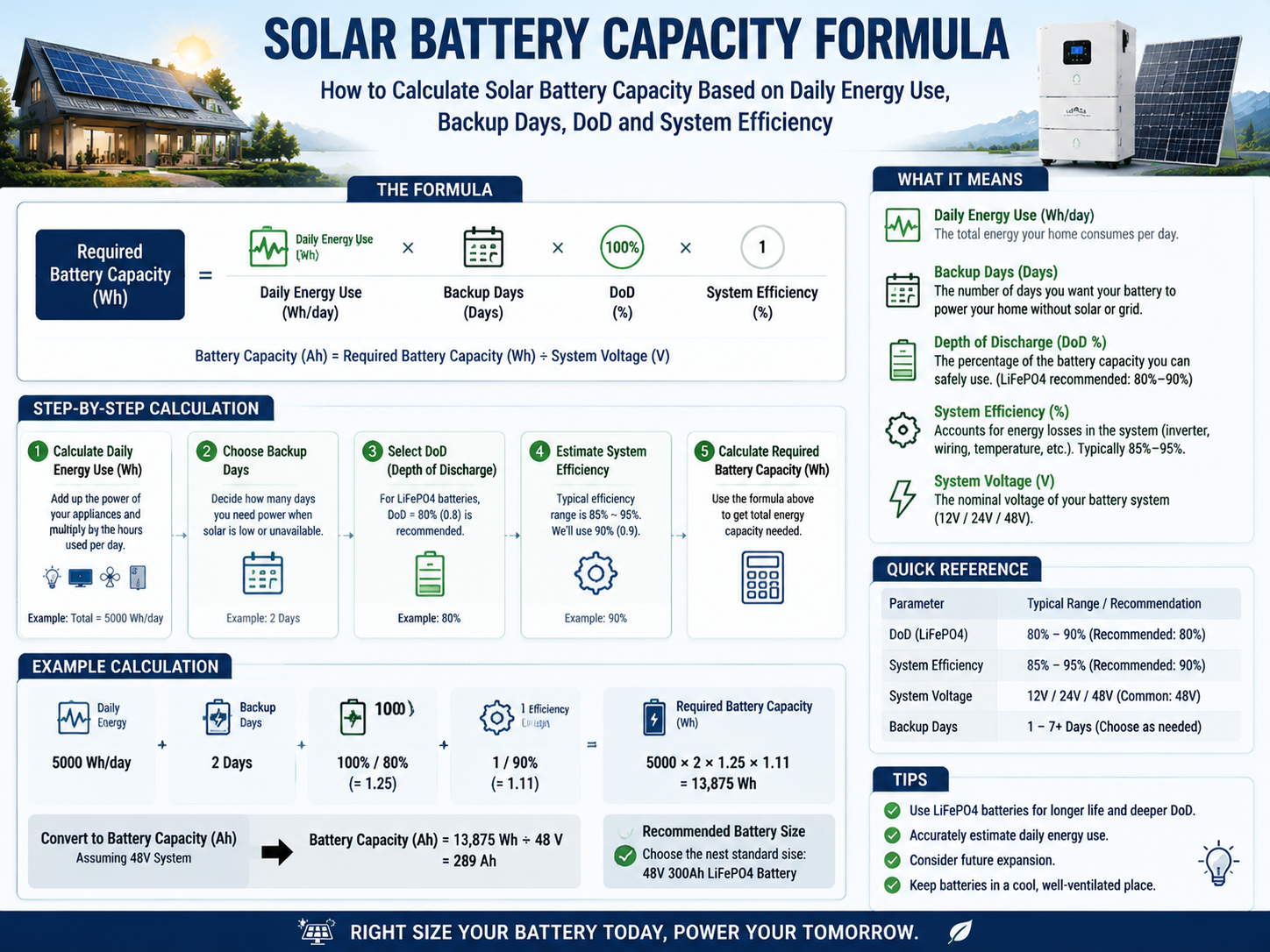
__________________________________________________________________________________________________
Solar Battery Capacity Examples for Different Applications
Applications differ more by load profile and operating risk than by customer label. The examples below are planning references, not standardized system designs.
Application |
Typical Battery-Supported Load |
Capacity Direction |
Critical Check |
Small |
Lighting, refrigeration, internet, |
Often 5-8kWh for |
Overnight runtime and inverter |
residential system |
selected outlets |
essential-load designs |
surge |
Large home backup |
Multiple circuits, pumps, refrigeration, communications |
Often 15kWh+ depending on load priorities |
Whole-home versus essential- load scope |
RV solar system |
DC refrigeration, water pump, devices, limited inverter loads |
Often 1-8kWh+ depending on travel profile |
Roof PV area, weight, alternator and shore-charge compatibility |
Off-grid cabin |
Lighting, refrigeration, communications, occasional pump |
Often 8-15kWh+ with autonomy reserve |
Winter production and generator plan |
|
Commercial application |
Telecom, farm process load, clinic, lodge, or worksite |
Project-specific modular bank |
Power-duration profile, service SLA, monitoring |
A small residential system may have modest energy needs but need enough inverter surge to start a refrigerator or pump. An RV may have restricted physical space and limited PV area, making charge recovery more important than nominal capacity. A commercial remote site may need redundancy, service access, and a generator dispatch plan in addition to battery kWh.
Capacity tables should never be used as quotation shortcuts. They are useful for shaping a discovery conversation, then the project should move to a load schedule, site review, and equipment compatibility check.
__________________________________________________________________________________________________
Factors That Affect Solar Battery Capacity Selection
Capacity selection changes when the load profile, energy source, environment, or operating policy changes.
Energy consumption pattern. The same daily kWh can lead to different battery designs. A site with steady DC load may favor a different configuration from a site with short, high-power motor loads. Time of use matters as much as total consumption.
Solar panel production. A battery bank is only useful if the PV array can recover its state of charge. Peak sun hours, panel orientation, shade, soiling, seasonal weather, array temperature, and controller limits all affect recharge capability. In many projects, adding PV capacity or managing loads is more effective than adding storage alone.
Weather conditions. Off-grid sizing should look at low-sun periods, not annual averages. A system that performs well in summer may face a different energy balance in winter. The project may need more capacity, more PV, a generator, or a lower load target during those periods.
Required backup time. A grid-connected system can often optimize for critical loads and short outages. An off-grid system needs a defined autonomy policy. Longer backup adds capacity, but it also increases the need for a realistic recharge plan.
Battery chemistry. Chemistry affects usable DoD, efficiency, cycle behavior, weight, maintenance, and temperature characteristics. LiFePO4 is frequently considered for regular solar cycling because it can provide high usable capacity and low routine maintenance, but the selected model must still fit the inverter, controller, climate, and service model.
Future expansion plans. Additional loads may come from air conditioning, refrigeration, water treatment, workshop equipment, new occupants, EV charging, or commercial growth. Expansion requires compatible battery modules, BMS communications, inverter capacity, physical room, electrical protection, and enough PV to recharge the larger bank.
Factor |
Capacity Impact |
Buyer Evidence |
Higher nighttime load |
More usable kWh |
Load profile by hour |
More autonomy days |
More capacity and PV recovery requirement |
Weather and generator strategy |
Larger motor surge |
More inverter and BMS power |
Pump/compressor start data |
Colder site |
More margin and charging protection |
Temperature range and enclosure plan |
Future loads |
Modular expansion requirement |
Expansion policy and infrastructure reserve |
For projects where autonomy and remote operation drive the design, see [LiFePO4 Battery for Off- Grid Solar Systems] .
__________________________________________________________________________________________________
Why LiFePO4 Batteries Are Commonly Used for Solar Storage
LiFePO4 is commonly evaluated for solar storage because its operating profile can fit systems that charge and discharge regularly. The benefit is not a single specification; it is the way several characteristics affect project economics.
Cycle performance. Daily solar shifting adds cycles over the project life. LiFePO4 can be a strong fit where the battery is expected to operate frequently, provided the system controls current, temperature, state of charge, and depth of discharge within approved limits. Buyers should request cycle-life data with test conditions, not only a headline number.
Usable capacity. A larger usable portion of nominal capacity can reduce the physical bank size needed to supply a target load. This affects cabinet space, transport weight, installation time, and the amount of reserve required to support critical loads.
Efficiency. Higher battery and system efficiency can improve how much of the PV energy collected during the day becomes load-side energy later. This matters where panel area is restricted, solar windows are short, or generator runtime is costly.
Maintenance requirements. LiFePO4 does not need electrolyte watering or equalization associated with flooded lead-acid products. The maintenance model shifts toward monitoring BMS alarms, SOC trends, temperature, communications, connections, enclosure condition, and correct charging behavior.
These characteristics are useful in residential storage, RV systems, off-grid homes, farms, telecom sites, and commercial remote power. They do not remove the need for correct sizing. An undersized LiFePO4 bank can still be overstressed; an oversized bank can still remain undercharged if PV capacity is inadequate.
__________________________________________________________________________________________________
Common Mistakes When Choosing Solar Battery Capacity
Selecting based only on price. The lowest module price may not represent the lowest delivered-energy cost. Compare usable kWh, expected cycle profile, maintenance labor, replacement risk, warranty conditions, shipping, commissioning, and downtime exposure.
Ignoring usable capacity. A nominal kWh rating does not explain how much energy is available at the load. DoD settings, reserve SOC, system losses, temperature, and BMS limits all change the operational figure.
Underestimating future demand. A system sized for lights and refrigeration may later add a pump, air conditioning, EV charging, workshop equipment, or commercial loads. If expansion is not planned, the first battery bank can become a stranded asset.
Choosing incompatible components. Battery voltage, BMS current rating, inverter power, MPPT or hybrid inverter settings, cables, breakers, fuses, communications, and monitoring must be evaluated as one system. Incorrect compatibility can cause failed commissioning, nuisance trips, and warranty disputes.
Not considering environmental conditions. High heat can accelerate aging. Cold can restrict charging and reduce available power. Humidity, dust, salt, vibration, and access constraints influence enclosure choice, maintenance procedure, and service cost.
Procurement Risk |
Better Practice |
Proposal lists Ah only |
Compare usable kWh at intended voltage and DoD |
PV output is not reviewed |
Verify recharge capability in the lowest-sun period |
Inverter selected separately |
Confirm voltage, power, current, and communications compatibility |
No expansion policy |
Confirm module-matching and PV-growth rules before purchase |
Warranty has no operating context |
Review capacity retention, throughput, installation, and temperature terms |
__________________________________________________________________________________________________
Frequently Asked Questions
How many kWh battery do I need for solar? The answer starts with battery-supported daily energy use and required backup duration. Apply usable DoD and an efficiency allowance, then check peak power, PV recharge, weather, and reserve policy. A 10kWh bank can be appropriate for some essential-load systems but inadequate for a larger home or multi-day off-grid site.
How do I calculate solar battery size? Use the planning formula: daily battery-supported energy multiplied by backup days, divided by usable DoD and estimated system efficiency. Then validate the result against inverter surge, battery current, temperature, PV production, and future expansion.
Is a larger battery always better? No. A larger bank increases investment and may not recharge fully if the array is undersized or the solar resource is weak. The right capacity balances usable energy, solar production, backup risk, operating cost, and expansion needs.
How much battery storage does an off-grid home need? It depends on daily load, desired autonomy, season, site climate, PV size, generator availability, and the distinction between essential and discretionary loads. Off-grid sizing should use low-sun conditions and a documented backup strategy, not annual average production alone.
 Hot News
2026-08-20
2026-08-16
2026-08-12
2026-08-03
2026-07-30
2026-07-26

Pittar Power is a professional manufacturer specializing inenergy storage solutions.
Room 302, Building 1, No. 10, Huangjin First Road, Nancheng District, Dongguan City, Guangdong Province, China
Copyright © Shenzhen Pittar Power Co., Ltd. All Rights Reserved Privacy Policy
 EN
EN