Introduction
Choosing the Best Lithium Battery for Solar Storage is not about selecting the largest battery or the lowest advertised price. The right solar energy storage battery must match your solar generation, daily energy use, inverter voltage, backup priorities, installation environment, and future expansion plan.
For most residential, off-grid, RV, and many commercial storage applications, LiFePO4 batteries are widely considered a practical choice because they combine strong cycle life, high usable capacity, stable chemistry, low maintenance, and good compatibility with modern solar inverters. However, a battery is only "best" when it is correctly sized and properly integrated into the wider solar system.
This buyer guide explains how solar installers, energy storage distributors, homeowners, off-grid users, renewable energy companies, and commercial buyers can compare lithium battery solutions objectively. For basic technology context, start with [ What Is a Lithium Battery?].
__________________________________________________________________________________________________
Why Lithium Batteries Are Popular for Solar Energy Storage
Solar panels generate electricity when sunlight is available, while many homes and businesses need power in the evening, overnight, or during grid outages. A solar energy storage battery captures surplus solar production for later use.
The U.S. Department of Energy describes solar-plus-storage as a battery system charged by a connected solar photovoltaic system. This combination can help owners use stored solar energy after sunset or when grid power is unavailable.
Lithium batteries are popular for solar storage because they typically offer:
Solar Storage Requirement |
Why Lithium Helps |
Daily cycling |
Designed for repeated charge-discharge use |
Limited installation space |
Higher usable energy in a compact footprint |
Evening self-consumption |
Stores daytime PV energy for later use |
Backup power |
Can supply essential loads through a compatible inverter |
Off-grid operation |
Supports renewable energy systems with regular cycling |
Remote monitoring |
Many systems support BMS and inverter communication |
For a broader explanation of market adoption, see [Why Are Lithium Batteries So Popular?] .
__________________________________________________________________________________________________
What Makes a Good Solar Storage Battery?
A good solar storage battery is not defined by capacity alone. It should provide usable energy, compatible voltage, sufficient power output, reliable protection, practical installation, and warranty terms that match the expected duty cycle.
A buyer should evaluate these questions:
1. How many kilowatt-hours of usable energy are needed each day?
2. Which appliances or loads must be backed up?
3. What inverter voltage and communication protocol are required?
4. Will the battery cycle daily, occasionally, or only during outages?
5. Can solar panels recharge the battery during the available daylight window?
6. What are the local temperature and installation conditions?
7. Is the system expected to expand later?
8. What warranty capacity-retention and throughput terms apply?
Solar Battery Buying Checklist
Decision Area |
What to Check |
Why It Matters |
Usable capacity |
kWh after DoD limits |
Determines real runtime |
Continuous power |
kW or rated current |
Determines simultaneous loads |
Inverter compatibility |
Voltage, CAN/RS485, approved list |
Prevents integration problems |
Cycle life |
Test conditions and end-of-life definition |
Supports lifecycle planning |
Round-trip efficiency |
Energy returned after charging |
Affects solar energy utilization |
Temperature range |
Charge and discharge limits |
Affects safety and availability |
Expandability |
Parallel or modular support |
Simplifies future growth |
Warranty |
Years, cycles, throughput, exclusions |
Defines long-term risk |
The best battery selection starts with a load profile and a system design, not a product catalog.
__________________________________________________________________________________________________
LiFePO4 vs Other Lithium Battery Chemistries for Solar Storage
Lithium battery chemistry affects energy density, cycle life, thermal behavior, cost, and system design. LiFePO4, also known as LFP, is commonly used in stationary solar storage because it balances durability, safety, and usable energy.
Chemistry |
Strength for Solar Storage |
Trade-Off |
LiFePO4 / LFP |
Long cycle life, stable chemistry, strong deep- cycle performance |
Lower energy density than some chemist ries |
NMC |
Higher energy density and compact pack design |
Requires careful thermal and battery management |
LTO |
Very long cycle life and fast charging potential |
Higher cost and lower energy density |
Lead-acid (not lithium) |
Lower initial price and broad familiarity |
Lower usable capacity, heavier, shorter life in deep cycling |
LiFePO4 does not automatically win every project. High-energy-density designs may use NMC, while specialized high-power or high-cycle systems may consider LTO. Still, for home solar battery storage, off-grid solar battery systems, RV systems, and many commercial applications, LiFePO4 is widely chosen because the combination of cycle life, safety, and low maintenance fits daily solar cycling.
For more detail, see [What Is LiFePO4 Battery?] , [Types of Lithium Batteries Explained] , and [ LiFePO4 vs NMC Battery.]
__________________________________________________________________________________________________
Key Factors to Consider When Choosing a Solar Battery
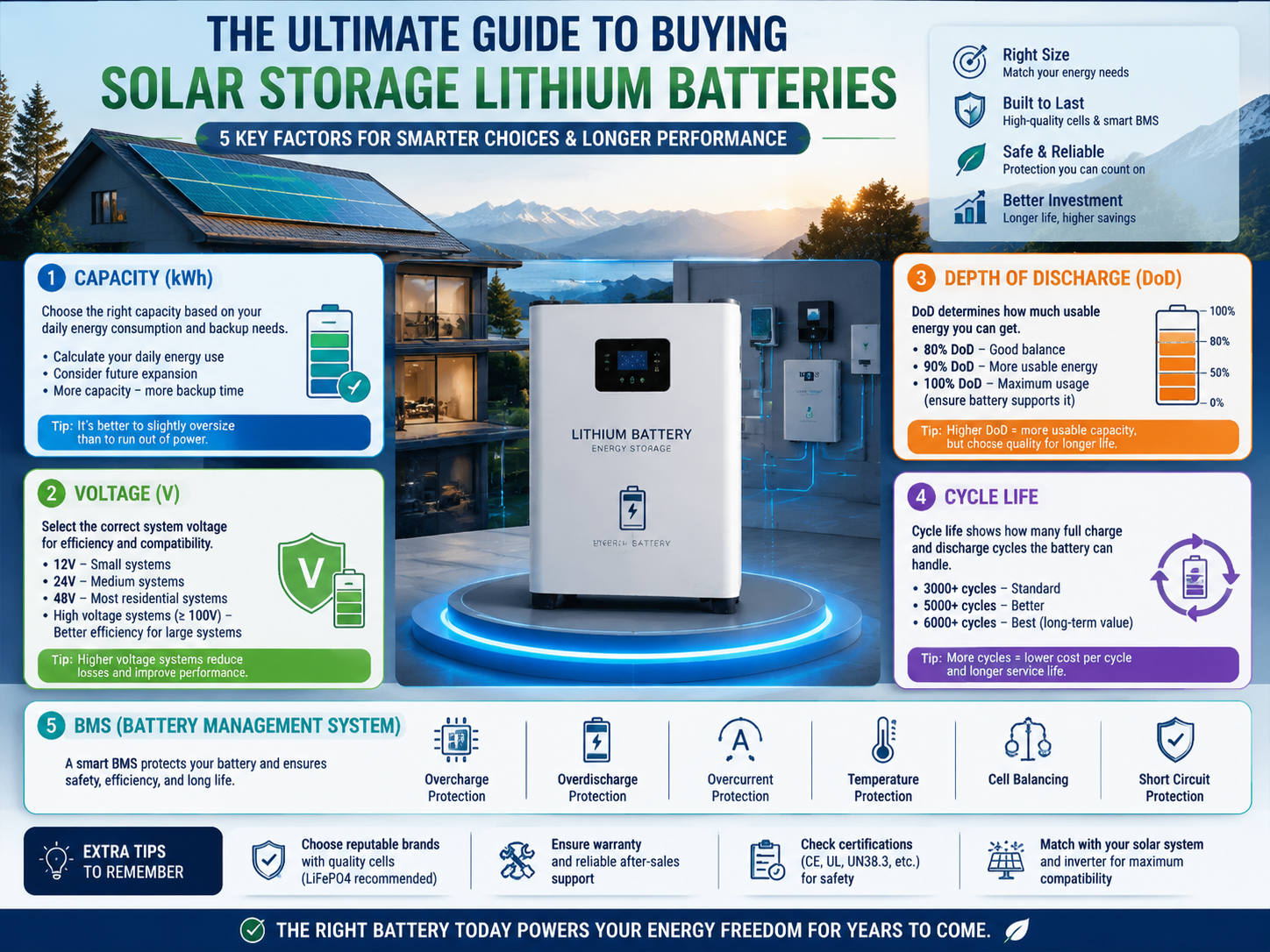
The Best Lithium Battery for Solar Storage should meet both energy and power requirements. The following factors should be evaluated together.
Battery Capacity (kWh)
Capacity is the amount of energy a battery can store. It is normally expressed in kilowatt-hours (kWh). A 10kWh battery can theoretically supply 1kW for 10 hours, but actual runtime depends on usable DoD, inverter losses, battery efficiency, and load variation.
For buyers, usable capacity matters more than nominal capacity. A system with 10kWh nominal capacity and 90% usable DoD can deliver less usable energy than the label suggests after reserve settings and conversion losses are considered.
Voltage Compatibility
The battery voltage must match the inverter architecture. Common solar battery designs include low-voltage 48V-class systems and high-voltage battery systems. Do not assume batteries can be mixed with any inverter. Check approved battery lists,communication requirements, voltage windows, and firmware compatibility.
Cycle Life
Cycle life indicates how many charge-discharge cycles a battery can deliver before capacity falls to a specified level. Compare ratings under the same DoD, current, temperature, and end-of-life conditions. A large cycle number without test conditions is less useful than a transparent datasheet.
Depth of Discharge (DoD)
DoD is the percentage of nominal capacity used before recharge. Higher usable DoD can reduce the amount of installed battery capacity needed for a given energy target. However,repeated extreme discharge may increase wear, so system settings should match the manufacturer recommendation.
Round Trip Efficiency
Round-trip efficiency is the ratio of energy discharged from a battery to energy used to charge it. Higher efficiency means more of the solar energy stored is available for later use. NREL defines round-trip efficiency as the percentage ratio of energy charged to energy discharged from a storage system.
Charging Speed
A battery must accept enough charge current to capture solar production during available sunlight. This is important where peak sunlight hours are limited, loads vary, or an off-grid system needs to recover after cloudy days. Charging current should remain within battery and inverter limits.
Battery Management System (BMS)
The BMS protects the battery and may communicate with the inverter. It should monitor voltage, current, temperature, state of charge, and alarms. For more background, see [How Does a Lithium Battery Work?] .
Safety
Safety depends on chemistry, cell quality, BMS design, enclosure, installation, cables, fusing, ventilation, and compliance with applicable standards. LiFePO4 is valued for thermal stability, but every solar battery system still requires correct installation.
Warranty
Read warranty terms closely. Check the calendar term, capacity-retention definition, cycle limit, energy throughput limit, installation requirements, and exclusions for temperature or improper commissioning.
Operating Temperature
Battery performance and lifespan change with temperature. High heat accelerates aging, while cold can reduce available capacity and restrict charging. Choose enclosure, location, and thermal protection suitable for the local climate.
Factor |
Strong Buyer Question |
Capacity |
How many usable kWh are available at the configured DoD? |
Power |
Can it start and run critical appliances simultaneously? |
Voltage |
Is it compatible with my inverter voltage range? |
BMS |
Does it communicate with the inverter and protect the pack? |
Cycle life |
Under what test conditions is it rated? |
Efficiency |
What is system-level round-trip efficiency? |
Temperature |
Can it charge and discharge in my climate? |
Warranty |
What capacity, throughput, and installation conditions apply? |
__________________________________________________________________________________________________
Why LiFePO4 Is Considered the Best Lithium Battery for Solar Storage
LiFePO4 is often considered the Best Lithium Battery for Solar Storage because solar applications demand repeated cycling, stable voltage, reliable protection, and long service life. It is not simply a chemistry trend; it addresses the practical needs of solar systems.
LiFePO4 advantages for solar include:
A LiFePO4 solar battery should still be selected carefully. Buyers should verify cell quality, BMS features, inverter compatibility, mounting format, temperature limits, and support availability. A poor system design can reduce the benefit of a good chemistry.
For lifecycle planning, see [How Long Does a Lithium Battery Last?] and [How Many Cycles Can a LiFePO4 Battery Provide?] .
[Soft CTA 1] Comparing LiFePO4 options for a solar project? Explore LiFePO4 solar batteries designed for daily cycling, inverter compatibility, modular expansion, and monitored long-term energy storage.
__________________________________________________________________________________________________
Lithium Battery vs Lead Acid Battery for Solar Storage
Lead-acid batteries have long been used in off-grid solar systems. They remain relevant in some low-budget or replacement scenarios, but lithium batteries often offer stronger lifecycle value for frequent cycling.
Factor |
LiFePO4 Lithium Battery |
Lead-Acid Deep Cycle Battery |
Usable depth of discharge |
Often higher |
Usually lower for long life |
Cycle life |
Usually longer under daily cycling |
Shorter under deep cycling |
Charging speed |
Usually faster with compatible charger |
Slower, especially near full charge |
Round-trip efficiency |
Usually higher |
Usually lower |
Weight |
Lower for comparable usable energy |
Higher |
Maintenance |
Low |
Higher for flooded models |
Upfront cost |
Often higher |
Often lower |
Long-term value |
Often stronger in high-cycle use |
Can suit low-budget, low-cycle use |
For a detailed comparison, see [LiFePO4 vs Lead Acid Battery].
The choice should be based on total cost of ownership, not only purchase price. Consider usable kWh, replacement frequency, maintenance labor, installation space, solar charging efficiency, and downtime risk.
__________________________________________________________________________________________________
Solar Battery Size Guide: How Much Storage Capacity Do You Need?
Solar battery sizing starts with energy demand, not panel wattage alone. First, identify the loads you want to support and how long you want to support them.
A practical estimate is:
Required usable battery capacity (kWh) = daily backup load (kWh) × target backup days Then adjust for usable DoD and system efficiency:
Nominal battery capacity = required usable capacity / (usable DoD × system efficiency)
Illustrative Example
Assume essential loads use 8kWh per day. The target is one day of backup. The selected battery configuration has 90% usable DoD and estimated 90% system efficiency.
Nominal capacity = 8 / (0.90 × 0.90) = 9.88kWh
In practice, a designer may choose a system around 10kWh or larger, depending on expansion, surge loads, weather, and reserve requirements. This example is illustrative only; a qualified installer should validate real loads, inverter limits, solar production, local regulations, and critical-load priorities.
Application |
Common Sizing Focus |
Key Question |
Residential backup |
Essential loads and overnight use |
Which circuits must remain powered? |
Off-grid home |
Daily use plus cloudy-day reserve |
How many low-sun days must be covered? |
RV solar |
Appliances, travel days, roof space |
Can solar restore energy each day? |
Commercial ESS |
Demand profile, peak s having, backup |
What power and duration are required? |
Avoid sizing only for energy. Also calculate peak power and motor starting surge. A battery may have enough kWh for a refrigerator but still need an inverter with enough surge capacity to start the compressor.
__________________________________________________________________________________________________
Best Lithium Battery Applications for Solar Systems
The best solar battery configuration depends on how the system is used.
Residential solar storage
Home solar battery storage often focuses on evening self-consumption, essential backup power, time-of-use savings, or resiliency. Wall-mounted or modular LiFePO4 battery systems are common where homeowners want quiet, low-maintenance backup for lights, refrigerators, Wi-Fi, security systems, medical devices, and selected circuits. For a residential planning framework, see [Home Energy Storage Battery Guide].
Off-grid solar systems
An off-grid solar battery must handle regular cycling and periods of limited solar generation. Buyers should prioritize usable capacity, efficient solar charging, inverter compatibility, temperature protection, and generator integration for extended low- sun conditions.
RV solar systems
RV solar systems benefit from lighter deep cycle lithium batteries, high usable capacity, and faster charging. The battery should match roof solar output, alternator charging, shore charger settings, inverter loads, and travel temperature conditions. For compact off-grid and outdoor energy options, see [Portable Power Station] .
Commercial solar energy storage
Commercial systems may support peak s having, demand management, backup power, self-consumption, or microgrid operation. Buyers need a full system assessment covering load profile, power rating, duration, battery rack design, thermal management, EMS integration, compliance, and service requirements.
Application |
Best Battery Priority |
Typical Configuration Direction |
Residential |
Essential-load backup and quiet operation |
Wall-mounted or modular low/high-voltage ESS |
Off-grid |
Daily cycling and autonomy |
Modular LiFePO4 with inverter and solar controller |
RV |
Weight, usable capacity, rapid recharge |
12V/24V LiFePO4 deep-cycle battery bank |
Commercial |
Power, duration, monitoring, serviceability |
Rack or cabinet ESS with EMS integration |
[Soft CTA 2] Need a solar storage system matched to your application? Explore home energy storage batteries and solar battery systems for residential backup, off-grid projects, RV power, and commercial energy storage.
__________________________________________________________________________________________________
How Long Does a Solar Lithium Battery Last?
Solar lithium battery lifespan depends on chemistry, cycle frequency, DoD, temperature, charge current, storage conditions, BMS quality, and installation design. A solar battery that cycles daily will accumulate cycles faster than a standby battery, but LiFePO4 is designed for this type of deep-cycle use.
Buyers should review both calendar warranty and cycle or energy-throughput warranty. A long calendar warranty is useful, but it should be read alongside the promised remaining capacity and operating conditions.
Practical ways to extend solar battery life include:
Size the battery so it is not deeply discharged unnecessarily.
Use manufacturer-approved inverter and charge settings.
Avoid excessive heat in battery rooms or cabinets.
Keep ventilation paths clear.
Monitor BMS and inverter alarms.
Store at recommended SOC during extended shutdowns.
Use proper cable, fuse, and breaker sizing.
For storage and degradation prevention, see [How to Store Lithium Batteries Properly] and [What Damages a Lithium Battery?] .
__________________________________________________________________________________________________
How to Maintain a Solar Storage Lithium Battery
Solar lithium batteries are low-maintenance, but regular system checks improve performance and help prevent avoidable faults.
Monthly or remote-monitoring checks
Seasonal checks
Long-term storage or seasonal shutdown
A solar installer should provide commissioning records, a maintenance schedule, and clear escalation steps for alarms. This is especially important for distributors, commercial operators, and remote installations.
__________________________________________________________________________________________________
Frequently Asked Questions
What is the best lithium battery for solar storage?
For many residential, off-grid, RV, and commercial solar applications, LiFePO4 is widely considered a strong option because it offers long cycle life, high usable capacity, stable chemistry, and low maintenance. The best battery still depends on system voltage, capacity, inverter compatibility, temperature conditions, and backup goals.
How much lithium battery storage do I need for solar panels?
Start with the energy you want to use when solar power is unavailable. Calculate critical load kWh, target backup time, usable DoD, and system efficiency. A qualified installer should also check peak power, surge loads, local weather, solar production,and inverter limits.
Is LiFePO4 better than lead-acid for solar storage?
LiFePO4 is often better for frequent solar cycling because it generally offers higher usable capacity, faster charging, lower maintenance, longer cycle life, and higher efficiency. Lead-acid can still suit lower-budget or low-cycle applications.
Can a solar battery power a house during an outage?
Yes, if the solar battery, inverter, transfer equipment, and backup circuits are designed for that purpose. The loads supported and runtime depend on battery capacity, inverter power, and whether solar can recharge the battery.
How long do LiFePO4 solar batteries last?
LiFePO4 solar battery life depends on cycle frequency, DoD, temperature, charging, BMS protection, and system design. Review both calendar warranty and cycle/throughput terms rather than relying on a single lifespan number.
__________________________________________________________________________________________________
Conclusion
The Best Lithium Battery for Solar Storage is the battery that fits the full system: your load profile, solar generation, inverter voltage, backup duration, safety requirements, climate, expansion plan, and lifecycle budget. For many solar applications,LiFePO4 batteries are a leading choice because they combine strong deep-cycle capability, high usable energy, stable chemistry, low maintenance, and good compatibility with modern energy storage systems.
Do not choose based only on nominal kWh or the lowest price. Compare usable capacity, continuous power, voltage and communication compatibility, cycle-life conditions, round-trip efficiency, BMS quality, operating temperature, warranty terms, and service support. A well-sized LiFePO4 solar battery system can improve solar self-consumption, backup readiness, off-grid autonomy, and long-term value.
[Soft CTA 3] Planning a solar battery project or OEM energy storage product? Explore LiFePO4 solar batteries, home energy storage batteries, solar battery systems, and custom battery solutions for OEM customers.
 Hot News
2026-08-20
2026-08-16
2026-08-12
2026-08-03
2026-07-30
2026-07-26

Pittar Power is a professional manufacturer specializing inenergy storage solutions.
Room 302, Building 1, No. 10, Huangjin First Road, Nancheng District, Dongguan City, Guangdong Province, China
Copyright © Shenzhen Pittar Power Co., Ltd. All Rights Reserved Privacy Policy
 EN
EN