Introduction.
Yes, a lithium battery can provide backup power for a house when it is correctly sized and integrated with aninverter, protection equipment, and an energy-management strategy. The actual result depends on household energy consumption, available battery capacity, required backup duration, inverter power, battery current limits, charging sources, and the loads the homeowner expects to keep operating.
The question is often presented as a simple yes-or-no decision. In project work, it is a scope question. A battery system can keep selected critical circuits operating for a defi ned period, or it can be engineered as a broader whole-home solution. These outcomes require different capacity, power, inverter, control, and budget decisions.
For a solar installer, distributor, or residential energy provider, the task is to convert a homeowner’ s expectations into a load plan. That plan determines whether the system should support refrigeration, lighting, internet, security, medical equipment, pumps, and selected outlets, or whether it must carry larger loads such as HVAC, electric cooking, and full-panel backup. This article explains how that decision is made from a battery supplier’ s perspective.
__________________________________________________________________________________________________
Can a Lithium Battery Power a House?
A lithium battery can power a house, but the phrase “ power a house” needs defi nition. In most residential projects, the battery is designed to support critical loads rather than every circuit. This approach lowers system cost, extends practical runtime, and gives the homeowner a predictable backup outcome.
A critical-load system may support a refrigerator, freezer, lighting, internet equipment, security system, garage door, medical devices, water pump, and selected outlets. A whole-home backup system may support most or all circuits, but it must be designed for higher energy demand, larger inverter power, greater motor-start capability, and a clear operating rule for high- consumption appliances.
Three measurements determine what the battery can do:
System Measure |
Practical Question |
Usable energy, kWh |
How long can selected loads operate? |
Continuous power, kW |
Which loads can run at the same time? |
Surge power |
Can compressors, pumps, or motors start? |
A battery with adequate kWh may still fail to support a home if the inverter cannot carry the load or if the battery BMS reaches its current limit. Conversely, a high-power inverter does not create additional runtime if the battery capacity is too small. A credible system design checks energy and power separately.
The system also needs a charging plan. Grid charging can restore the battery before an expected outage or during off-peak periods where permitted. Solar charging can extend runtime during daylight, but only if the PV array, inverter, weather, and reserve settings allow the battery to recover energy while serving household loads.
__________________________________________________________________________________________________
How Does a Lithium Battery Power a Home?
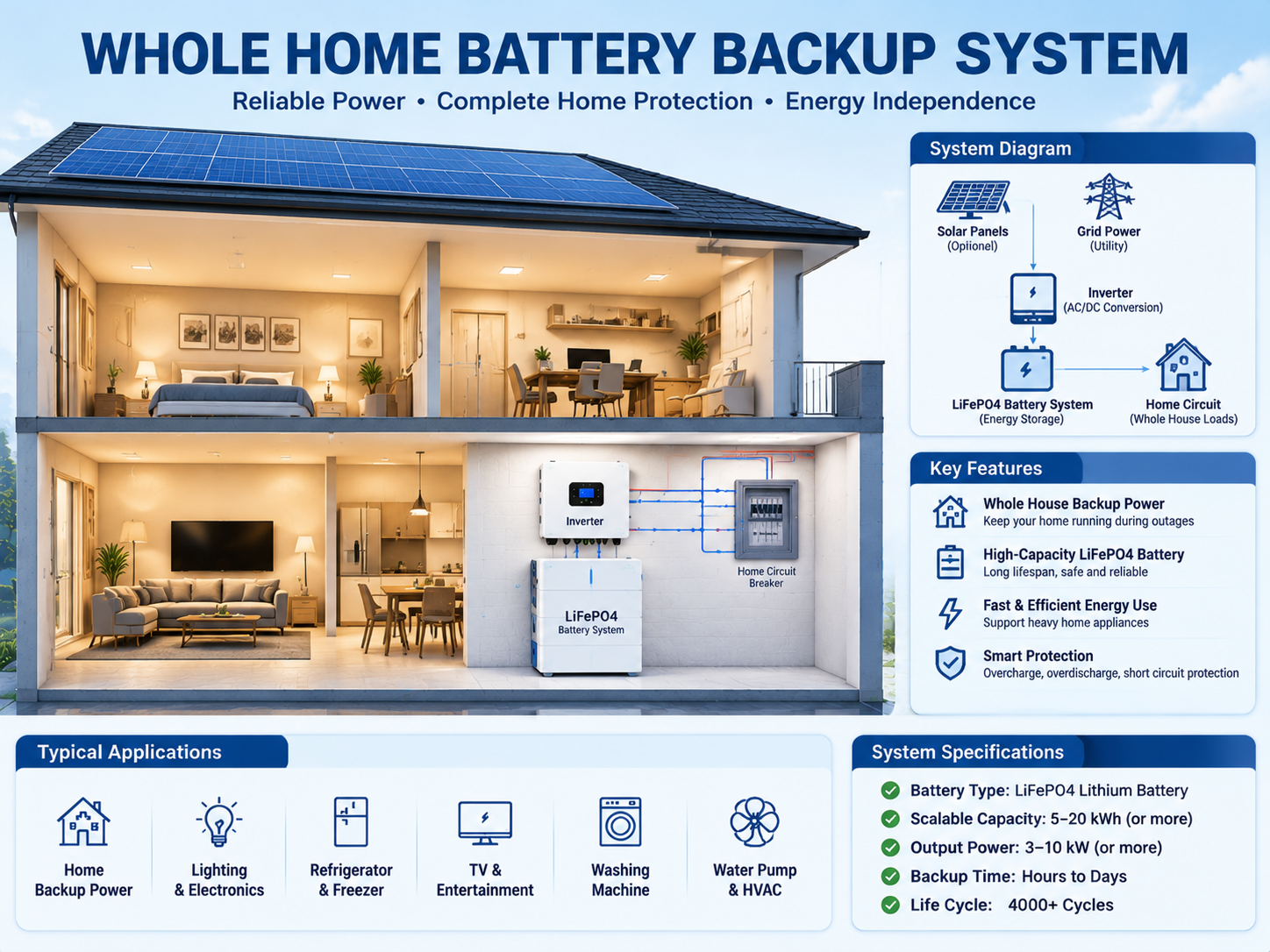
The energy fiow in a residential battery system is typically:
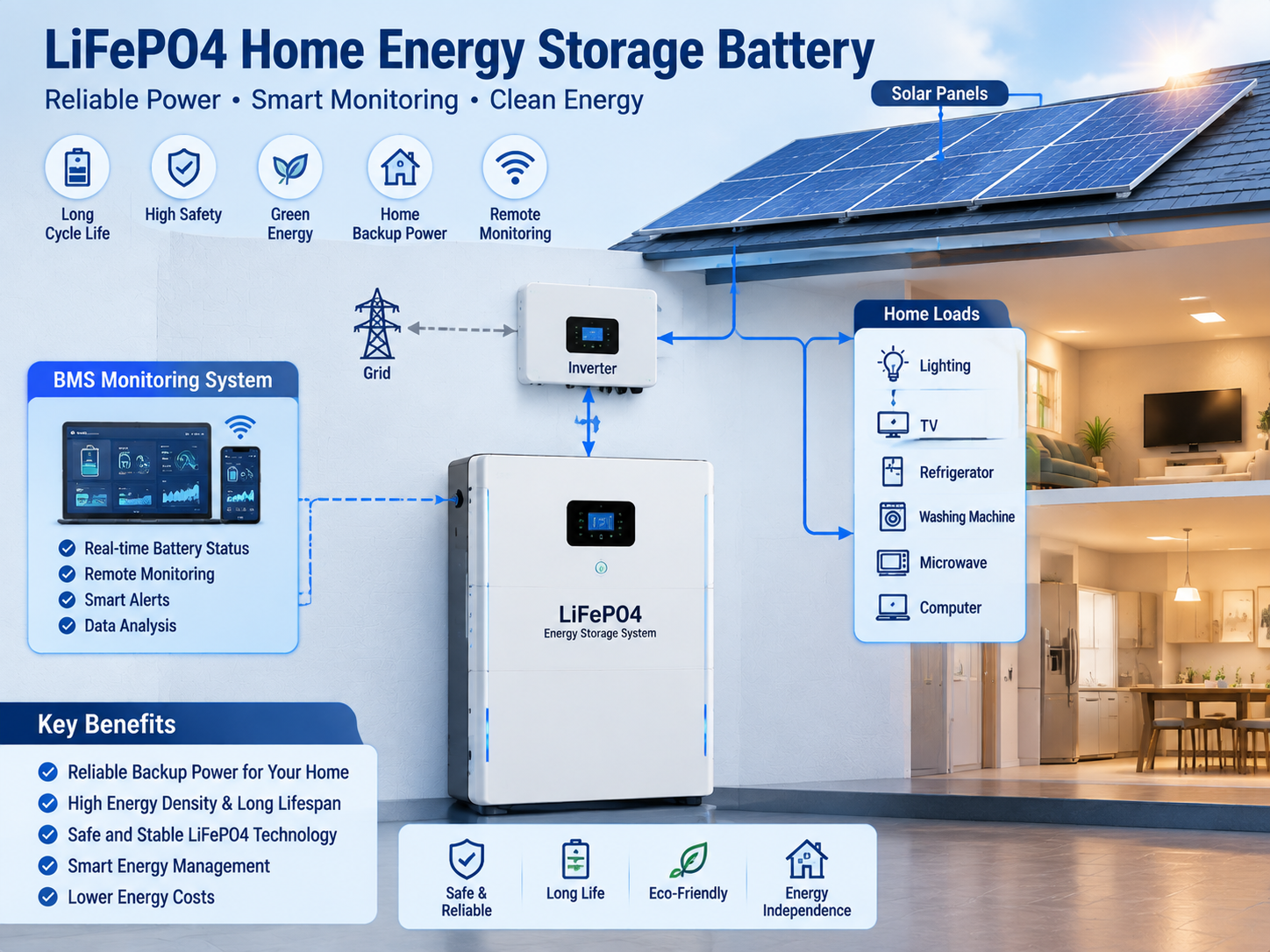
Solar Panels / Grid ↓ Battery Charger or Hybrid Inverter ↓ Lithium Battery ↓ Inverter ↓ Home Appliances
The battery stores DC energy. The inverter converts this energy into AC electricity for household circuits. In a solar-connected system, a hybrid inverter may manage PV energy, battery charging, grid interaction, and backup circuits in one platform. In a retrofit system, the solar inverter and battery inverter may be separate devices connected through an AC-coupled arrangement.
The Battery Management System (BMS) is the battery’ s protection and operating-control layer. It monitors voltage, current, state of charge, temperature, and fault conditions. When a limit is reached, the BMS can restrict or stop charging and discharging. For installers, BMS communication with the inverter is valuable because it allows coordinated charge current, voltage limits, alarm reporting, and battery state management.
An energy-management system or inverter control strategy determines how stored energy is used. A homeowner may reserve most capacity for outage protection, use the battery for evening solar self-consumption, or follow an electricity tariff schedule. The correct strategy depends on the home’ s objectives and must not confiict with the backup reserve requirement.
Component |
Role in Home Backup |
Solar panels or grid |
Supply energy for battery charging |
Charger / hybrid inverter |
Regulates charge and manages energy fiow |
Lithium battery |
Stores energy for later use |
BMS |
Protects cells and communicates operating limits |
Inverter |
Supplies AC power to backup circuits |
Critical-load panel |
Separates supported circuits from nonessential loads |
Monitoring |
Displays SOC, alarms, consumption, and performance trends |
A battery system should be commissioned as a complete operating sequence: normal grid operation, battery charging, transfer to backup, critical-load behavior, solar charging during outage, and recovery after the grid returns. This is more meaningful than checking whether the battery turns on.
For a technical foundation on battery technology, see [What Is a Lithium Battery?] .
__________________________________________________________________________________________________
How Much Lithium Battery Capacity Does a House Need?
Capacity selection starts with the energy that the battery must supply during the backup period. It does not start with the fioor area of the home or a generic “whole-home” label.
Daily electricity consumption. Use utility records, smart-meter data, appliance measurements, or a load survey to understand household energy use. Then isolate the loads expected to remain on during an outage. A home may use substantial energy over a full day, while its critical-load requirement can be much lower.
Critical loads. The backup plan should identify what must remain powered and what can be managed manually. Refrigeration, lighting, internet, security, medical equipment, and selected pumps are common priorities. Air conditioning, electric resistance heating, ovens, dryers, EV charging, spa equipment, and workshop tools can transform a critical-load system into a much larger whole-home project.
Backup duration. Defi ne whether the target is a few hours, an overnight outage, one day, or a multi-day event. Longer runtime requires more usable kWh. Solar can replenish the battery in daylight, but the design must account for weather, season, PV size, load timing, and the battery reserve that must remain available.
Battery effciency and depth of discharge. A battery’ s nominal kWh is not the same as load-side energy. Usable DoD, reserve state of charge, inverter efficiency, wiring losses, and temperature all reduce the amount of energy available to household circuits.
A practical planning expression is:
Nominal Battery Capacity = Battery-Supported Energy Need ÷ (Usable DoD × Estimated System Effciency)
This estimate must then be checked against inverter output, battery continuous current, surge current, and expected recharging.
Home Profile |
Backup Scope |
Capacity-Selection Focus |
Small apartment |
Refrigerator, lights, router, devices, medical load |
Overnight energy and compact inverter output |
Average home |
Refrigeration, security, lighting, internet, selected circuits |
Usable kWh plus pump/compressor surge |
Large home backup |
Managed critical-load panel or broad |
Modular kWh, high inverter power, load priorities, |
circuit coverage |
solar/generator plan |
For a detailed capacity calculation framework, see [How Much Battery Capacity Do You Need for Solar Storage?] .
__________________________________________________________________________________________________
What Can a Lithium Battery Run During a Power Outage?
A lithium battery can run many household loads during an outage, but only within the energy and power limits of the installed system. Buyers should evaluate each load by both its daily energy use and its starting or continuous power demand.
Refrigeration and lighting. These are common backup loads because they are important, relatively predictable, and manageable in a critical-load panel. Refrigeration still requires attention to compressor starting surge.
Internet and communications. Routers, modems, network equipment, phones, and selected computer loads generally use modest power. They can provide high practical value during an outage, especially where communication, remote work, or emergency information is important.
Security and medical equipment. Security systems, access controls, some medical devices, and emergency lighting may be treated as priority circuits. Their reliability requirements should infi uence reserve SOC settings and battery monitoring.
Small appliances and selected outlets. Kettles, microwaves, induction appliances, and other heating loads can draw significant power even if they operate briefiy. The system must be assessed for inverter output and battery current, not only battery capacity.
HVAC and large loads. Air conditioning, electric heating, well pumps, pool equipment, EV charging, electric ovens, and clothes dryers can exceed the practical scope of a modest home battery. Some whole-home systems can support selected HVAC or high-demand loads, but this requires deliberate load management, inverter sizing, battery current capability, and a larger energy reserve. It should not be assumed from battery kWh alone.
Load Type |
Main Design Constraint |
Refrigerator/freezer |
Compressor surge and overnight energy |
Lighting/router/security |
Long runtime, relatively low power |
Water or sump pump |
Motor starting current and duty cycle |
Medical equipment |
Reliability, reserve SOC, monitoring |
Microwave/induction appliance |
Inverter continuous power and battery current |
HVAC |
High power, start-up surge, and large energy demand |
The most effective home systems establish a priority order before an outage. This can be a dedicated critical-load panel, automated load shedding, or a documented operating rule. The goal is not to claim every load can run indefi nite ly; it is to deliver the backup outcome the homeowner actually values.
__________________________________________________________________________________________________
Why Lithium Batteries Are Used for Home Backup Power
Lithium batteries are used in home backup systems because they can combine useful energy storage, compact installation, monitored operation, and low routine maintenance. Their value is clearest when these attributes solve a residential project constraint.
Long cycle life. Homes with solar may use the battery daily to shift energy into the evening. Homes without solar may cycle less often and use the battery mainly during outages. Lithium batteries can support these duty cycles when the system stays within approved current, temperature, and DoD limits. Buyers should compare capacity-retention and throughput warranty terms against the expected usage pattern.
Higher usable capacity. Many lithium systems provide a high usable portion of nominal capacity. This can reduce the physical battery bank required to support a defi ned critical-load target. It also affects mounting area, shipping weight, installation labor, and expansion planning.
Low maintenance. Lithium systems do not require the watering or equalization associated with fiooded lead-acid batteries. Their maintenance model relies more on BMS alarms, inverter status, temperature, state-of-charge trends, connections, enclosure condition, and correct charging configuration.
Compact design. Residential installations often have limited space. A battery may need to fit in a garage, equipment room, utility space, or exterior enclosure while retaining safe clearances and service access. Energy density and modular mounting options can infi uence the installation decision.
Better effciency. When solar energy is part of the system, higher storage efficiency can help preserve more PV production for later use. This matters where roof area is limited, winter sunlight is short, or the homeowner wants to protect a backup reserve while serving evening loads.
For readers comparing residential battery solutions for purchase, see [Best Lithium Battery for Home Backup Power] .
__________________________________________________________________________________________________
LiFePO4 Batteries for Whole Home Backup Systems
LiFePO4 is widely considered for residential energy storage because it can fit the operating conditions of home backup systems: repeated cycling, variable solar charging, limited installation space, and a need for predictable monitoring and protection.
Safety characteristics. LiFePO4 has thermal and chemical characteristics that make it a common stationary-storage choice. The chemistry is not a substitute for an engineered safety system. Cell quality, BMS protection, inverter settings, cables, breakers, disconnects, enclosure design, mounting, installation procedures, and service access all affect the fi nal system.
Cycle performance. A whole-home or high-usage backup system may accumulate more cycles than a system reserved for occasional outages. LiFePO4 can be a strong fit where frequent cycling is expected, but buyers should request cycle data under stated temperature, current, DoD, and end-of-life capacity conditions.
Thermal stability and site conditions. A battery in a garage, basement, exterior cabinet, or hot climate must be selected for the real installation environment. Low-temperature charging limits, ventilation, humidity protection, physical clearances, and access for maintenance all matter. The right battery cabinet is one that fits the site and service model, not merely the one with the highest nominal kWh.
Long-term reliability. Reliability comes from system coordination. A battery should communicate its limits to the inverter, the inverter should manage charge and discharge correctly, and monitoring should fiag unusual temperature, low SOC, or fault events before they become an outage-time problem.
__________________________________________________________________________________________________
Factors to Consider Before Installing a Home Battery System
Battery capacity. Defi ne backup loads and duration fi rst. Review usable kWh after reserve and DoD settings, not nominal capacity alone.
Inverter compatibility. Confi rm the battery voltage, BMS communication, fi rmware, continuous current, peak current, and approved inverter profile. A mismatch can limit function even when the battery and inverter appear compatible on paper.
Installation environment. Check temperature range, low-temperature charging protection, ventilation, moisture, dust, mounting surface, clearance, fi re and electrical code requirements, and service access. Site conditions should be reviewed before equipment is ordered.
Expansion capability. Home energy demand can grow as households add appliances, solar panels, pumps, air conditioning, EV charging, or new occupancy. Confi rm whether battery modules can be added, whether they must match model, age, or fi rmware, and whether inverter and PV capacity can grow with them.
Budget and lifecycle cost. Evaluate initial system cost alongside usable energy, expected cycles, service coverage, maintenance, replacement risk, electricity or solar charging costs, and the cost of downtime. A lower initial price may not produce the lower cost over the operating period.
Future energy needs. A backup system should include an operating rule for long outages. This may involve solar recharge, load shedding, generator support, or a combination. Capacity without a recovery plan is not a complete resilience strategy.
Selection Area |
Questions for Buyer and Installer |
Load scope |
Which circuits must stay active? |
Energy |
How many usable kWh are needed for the planned outage duration? |
Power |
What continuous and surge demand must the system support? |
Integration |
Is the inverter officially compatible with the battery BMS? |
Environment |
Does the location meet operating and installation conditions? |
Growth |
Can the system expand physically and electrically? |
__________________________________________________________________________________________________
Common Mistakes When Choosing a Home Backup Battery
Choosing insuffcient capacity. A battery bank may be sized for average consumption rather than the actual critical-load schedule. This can cause the system to reach its reserve limit earlier than expected.
Ignoring peak power demand. Pumps, compressors, HVAC equipment, garage doors, and kitchen appliances can create short high-power events. Capacity in kWh does not guarantee that the system can supply those events; inverter and BMS power limits must be checked.
Focusing only on initial price. Product price does not capture usable energy, integration work, monitoring, warranty support, installation requirements, service visits, or the cost of replacing a system that cannot meet the intended backup scope.
Not planning future expansion. Buyers should check module-matching rules, fi rmware, inverter capacity, available installation space, PV expansion, and electrical protection before assuming a later upgrade will be simple.
Selecting incompatible equipment. Battery voltage, communication protocol, charge profile, BMS limits, inverter fi rmware, and protection devices must operate as one system. Incompatibility can cause commissioning problems, reduced backup function, or warranty disputes.
Common Project Error |
Better Practice |
Whole-home expectation without load plan |
Defi ne critical and discretionary circuits before sizing |
kWh selected without kW review |
Check inverter output, surge capability, and BMS current |
Battery installed in unsuitable location |
Validate temperature, clearance, ventilation, and service access |
Solar assumed to solve all long outages |
Model seasonal PV recovery and load priorities |
Warranty reviewed after installation |
Confi rm support, capacity retention, and operating conditions before purchase |
__________________________________________________________________________________________________
Frequently Asked Questions
Practical Checklist Before Choosing a Home Lithium Battery System
Before approving a home battery solution, confi rm these points:
 Hot News
2026-08-20
2026-08-16
2026-08-12
2026-08-03
2026-07-30
2026-07-26

Pittar Power is a professional manufacturer specializing inenergy storage solutions.
Room 302, Building 1, No. 10, Huangjin First Road, Nancheng District, Dongguan City, Guangdong Province, China
Copyright © Shenzhen Pittar Power Co., Ltd. All Rights Reserved Privacy Policy
 EN
EN