Introduction.
A home energy storage battery stores electricity for later use. It can hold solar energy produced during the day, preserve power for critical circuits during an outage, or follow a defi ned charging and discharge schedule where local electricity tariffs make that useful. The battery is not a standalone appliance. It works with an inverter, a Battery Management System, protection equipment, monitoring, and a plan for the household loads it is expected to support.
For homeowners, the attraction is usually energy reliability: refrigeration, lighting, internet, security, medical devices, pumps, and selected outlets remain available when the grid fails. For installers and energy solution providers, the real work is translating that expectation into a technically coherent system. Battery capacity, inverter power, charge source, operating
temperature, installation location, service access, and future expansion all affect whether the system meets its intended role.
This Home Energy Storage Battery Guide sets out the buyer decisions that matter. It is written for homeowners with serious purchase intent, solar installers, renewable-energy firms, distributors, system integrators, and procurement professionals who need to evaluate residential storage as an operating system rather than a battery specification.
__________________________________________________________________________________________________
What Is a Home Energy Storage Battery?
A home energy storage battery is a rechargeable battery system installed to retain electrical energy and deliver it later through a residential energy system. It may be charged from solar panels, the grid, or another approved source. During an outage or planned discharge period, the inverter converts the battery’ s DC energy into AC electricity for the home’ s selected circuits.
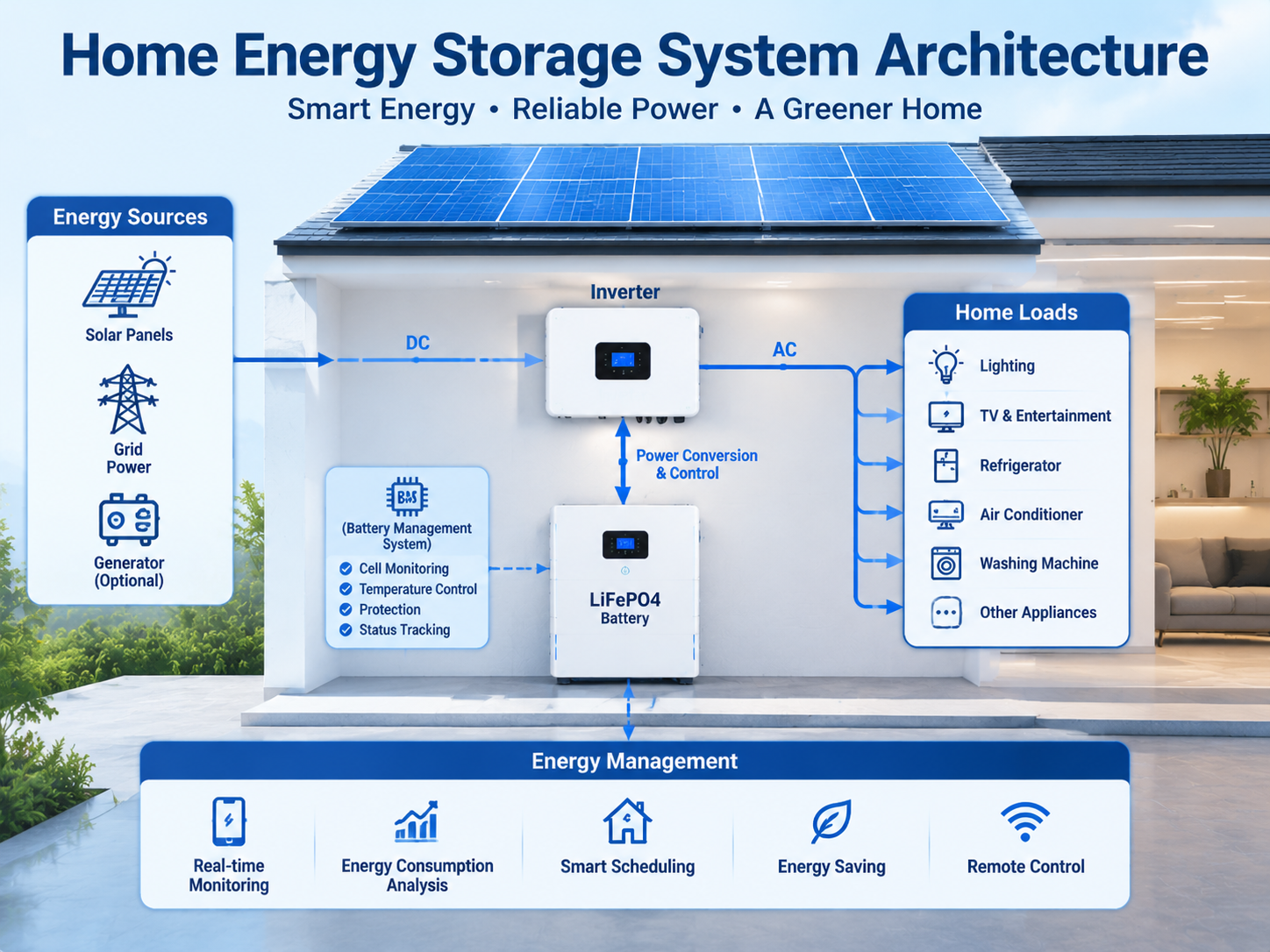
A complete residential system includes more than the battery modules. Its core elements are: Battery + BMS + Inverter + Energy Management System
Battery: stores electrical energy in kWh.
Battery Management System (BMS): monitors cell voltage, current, temperature, state of charge, balancing, and protection limits.
Inverter or hybrid inverter: converts DC battery power into AC power for household circuits and manages charging from solar or grid sources.
Energy management system (EMS): applies the operating strategy__solar self-consumption, backup reserve, scheduled charging, load control, or tariff response.
System Element |
Buyer-Relevant Function |
Battery capacity, kWh |
Determines how long supported loads can operate |
Battery power and BMS current |
Determines whether loads can be served at the required rate |
Inverter, kW |
Determines continuous output and motor-start capability |
Critical-load panel |
Separates backed-up circuits from nonessential circuits |
EMS and monitoring |
Shows SOC, alarms, energy fiow, consumption, and reserve status |
Solar or grid charging |
Restores energy after discharge |
The practical distinction is between energy and power. A battery may store enough energy for an overnight backup but still fail to start a pump if its inverter or BMS cannot meet the surge requirement. Conversely, a large inverter does not create more backup time if battery capacity is inadequate. A complete design examines both values independently.
__________________________________________________________________________________________________
Why Do Homes Need Energy Storage Batteries?
Residential storage serves different purposes depending on the home, grid reliability, solar production, electricity tariffs, and household priorities. A system designed only for emergency backup will look different from one that cycles every day to use more solar energy or reduce time-of-use electricity costs.
Power outage protection. A battery can keep defi ned circuits operating when grid power fails. The correct design starts with a critical-load list, not a broad promise that the system will power every appliance. Refrigeration, lighting, communications, security, medical equipment, and water management often rank first. HVAC, electric heating, large cooking loads, EV charging, and workshop equipment need separate evaluation because they can change both energy and power requirements sharply.
Solar energy self-consumption. Solar panels generate electricity when sunlight is available, while household demand often peaks in the evening. A battery can shift part of the daytime production into later consumption. This reduces the mismatch between PV generation and load timing, provided the inverter control strategy preserves enough energy for the homeowner’ s backup objective.
Electricity cost management. In markets with time-based pricing, a battery may charge during lower-cost periods or from surplus solar and discharge when grid electricity is more expensive. The fi nancial outcome depends on tariff structure, round- trip efficiency, battery cycling plan, and warranty conditions. It should be modeled, not assumed.
Energy independence and resilience. A battery does not make a home completely independent by itself. It can reduce grid dependence and improve resilience when paired with solar generation, managed loads, and__where necessary__a generator plan for extended low-solar conditions. The level of autonomy should be defi ned before capacity is selected.
Home Objective |
System Design Question |
Short outage protection |
Which essential loads need power for several hours? |
Overnight backup |
How many usable kWh are required after sunset? |
Solar self-consumption |
Can PV generation recharge the battery during the available solar window? |
Whole-home strategy |
What high-power loads require control, shedding, or larger inverter capacity? |
Multi-day resilience |
What is the plan for low-sun periods: more PV, load management, generator support, or all three? |
For residential buyers focused specifically on backup-system selection, see [Best Lithium Battery for Home Backup Power] .
__________________________________________________________________________________________________
How Does a Home Battery Storage System Work?
The energy fiow in a typical home storage system can be described simply:
Solar Panels / Grid ↓ Inverter ↓ Battery Storage ↓ Home Appliances
The real operation involves several modes. When solar production exceeds immediate demand, a hybrid inverter or charge controller directs available energy into the battery, subject to BMS and system limits. When the household requires more power than solar panels are producing, the battery can discharge through the inverter to support loads. When the grid fails, the inverter isolates or transfers the supported circuits according to the backup design and local electrical requirements.
Charging mode. The system may charge from PV, the grid, or both, depending on settings and regulations. A lithium battery needs a compatible charging profile; voltage, current, temperature, and communication limits should follow manufacturer documentation. Charging behavior becomes especially important in cold conditions, where some battery types require protection against charging outside their approved range.
Discharging mode. The inverter converts stored DC energy into AC power for the supported circuits. The battery BMS monitors current, temperature, state of charge, and cell-level limits. If the system reaches a protection threshold, the BMS may reduce or stop discharge, which is why reserve settings and load priority matter during a long outage.
Backup mode. A backup system is only as useful as the transfer sequence, inverter capacity, battery reserve, and circuit plan allow. Commissioning should verify normal operation, battery charging, grid loss, transfer to backup, load behavior, solar charging during an outage where applicable, and recovery when the grid returns.
Monitoring mode. Good monitoring gives homeowners and service teams visibility into state of charge, battery temperature, solar generation, load consumption, alarms, and system events. For a distributor or installer, remote diagnostics can reduce unnecessary site visits and provide useful evidence during warranty assessment.
Backup strategy must be configured, not assumed. Residential systems commonly use one of three control approaches:
preserve a fixed reserve for outages, use available battery energy daily to increase solar self-consumption, or schedule charging and discharging against a tariff. These approaches produce different battery states at the moment an outage begins. A home that discharges deeply each evening to reduce grid purchases may have less backup reserve than a home that maintains a high minimum state of charge. The owner, installer, and system designer should agree on which outcome has priority before commissioning.
Critical-load design controls the customer experience. A critical-load panel or managed circuit strategy is often more valuable than simply increasing battery capacity. It makes the backup scope visible: essential circuits remain active, discretionary loads can be isolated, and high-demand appliances can be managed according to available energy. Without this defi nition, homeowners may assume that a battery intended for refrigeration, lighting, communications, and security will also operate electric heating, central air conditioning, cooking equipment, or EV charging without limitation.
Commissioning should test operating scenarios, not only device status. A practical handover should verify grid charging, solar charging where installed, BMS-to-inverter communication, transition into backup mode, critical-load behavior, recovery after the grid returns, and alarm visibility in the monitoring platform. The installer should also document reserve settings, supported circuits, high-load limitations, and escalation contacts. This record reduces expectation gaps and provides a baseline if the system later requires service.
__________________________________________________________________________________________________
Lithium Battery vs Traditional Home Storage Batteries
Lead-acid, AGM, gel, and lithium technologies can all be used in residential storage. The appropriate choice depends on cycling frequency, available maintenance, installation space, environmental conditions, expected life, service model, and budget. The comparison should be made from an operating perspective, not from a chemistry label alone.
Flooded lead-acid can have a lower initial purchase cost and is familiar to many installers. It may suit low-cycle, budget-led, or existing systems where maintenance access is available. Its limitations include weight, lower usable depth of discharge when long life is required, ventilation needs, potential watering requirements, and slower charging behavior near full capacity.
AGM is a sealed lead-acid format that avoids electrolyte watering. It is used in selected backup, RV, and marine applications. It still requires correct charging settings and can be less attractive for repeated deep solar cycling where usable capacity, weight, and lifecycle cost are important.
Gel batteries are also sealed and can fit some applications when their charging profile is carefully managed. Their charge acceptance and sensitivity to improper settings must be considered during inverter or controller selection.
Lithium and LiFePO4 systems generally offer a higher usable portion of nominal energy, efficient charging, lower routine maintenance, and compact installation for projects that cycle regularly. They also require careful BMS, inverter, communication, installation, and warranty review.
Decision Factor |
Flooded Lead- Acid |
AGM |
Gel |
LiFePO4 |
Cycle performance in daily use |
Sensitive to deep discharge |
Moderate, profile- dependent |
Moderate, profile- dependent |
Often strong when correctly configured |
Usable energy at comparable nominal capacity |
Usually lower for long life |
Moderate |
Moderate |
Often higher |
Efficiency |
Usually lower |
Moderate |
Moderate |
Often higher within approved limits |
Maintenance |
Watering and ventilation may be needed |
Lower routine maintenance |
Lower routine maintenance |
Monitoring and connection checks |
Weight and installation footprint |
High |
High |
High |
Lower for comparable usable energy |
Service model |
Regular physical maintenance |
Charging profile and replacement planning |
Charging profile and replacement planning |
BMS, inverter integration, diagnostics, warranty support |
Long-term ownership cost |
Can rise with replacements and labor |
Project-dependent |
Project-dependent |
Often favorable in higher cycle applications |
No technology is automatically correct for every home. A lightly used backup system with established lead-acid infrastructure may still use AGM or gel. A solar-connected home that cycles regularly, has limited installation space, or needs low maintenance often evaluates LiFePO4 more closely. The project’ s usage pattern should determine the technology decision.
__________________________________________________________________________________________________
Why LiFePO4 Batteries Are Popular for Home Energy Storage
LiFePO4 is frequently specified for residential storage because it fits several common home energy use cases: daily solar cycling, compact installation, monitored backup operation, and lower routine maintenance. The practical advantage is not one feature; it is how several operating characteristics work together.
Safety and thermal behavior. LiFePO4 is widely selected for stationary storage because of its thermal and chemical characteristics. Safe operation still depends on the complete system: cell quality, BMS logic, correctly configured inverter, rated cables and breakers, enclosure placement, mounting, clearances, and installation workmanship. Chemistry reduces some risks; it does not remove the need for engineered protection.
Cycle performance. A home with solar can discharge the battery in the evening and recharge it during the next solar window. This regular duty cycle requires a battery solution designed for repeated operation. Buyers should compare cycle data only when DoD, temperature, current, and end-of-life capacity defi nitions are stated. A large cycle number without conditions is not a meaningful basis for procurement.
Thermal stability in real homes. Residential batteries can be installed in garages, basements, utility rooms, exterior cabinets, or warm climates. Low-temperature charging protection, ventilation, moisture exposure, service clearance, and physical protection should be reviewed before selecting the enclosure. The highest nominal capacity is not necessarily the best installation choice if it cannot operate reliably at the site.
Daily charging and discharging capability. LiFePO4 systems often provide a high usable share of nominal capacity and good charge acceptance within approved limits. This can help a solar-linked home store daytime production for later use while retaining a defi ned reserve for backup. The system should be configured around the homeowner’ s priority: backup resilience, solar self-consumption, electricity cost management, or a combination.
__________________________________________________________________________________________________
How to Choose the Right Home Energy Storage Battery
Selecting a home storage solution involves a structured review. Buyers should ask how the system will operate, not only what it costs or how many kWh it contains.
Battery capacity. Capacity in kWh determines duration. The relevant number is usable energy after reserve state of charge, depth of discharge, temperature, and system losses. Defi ne critical loads and desired backup time before selecting capacity.
Power output. Inverter output and BMS current determine which loads can operate simultaneously. Motor-starting surges from pumps, compressors, garage doors, and HVAC equipment can be more important than average daily energy use. A system needs enough kWh for duration and enough kW for the expected load event.
Battery chemistry. LiFePO4 is a common residential choice, but buyers should compare chemistry alongside duty cycle, installation environment, service support, and total ownership cost. A product should be selected for the project conditions rather than as a generic “ best battery.”
Inverter compatibility. Verify battery voltage, communications protocol, BMS behavior, approved inverter list, fi rmware compatibility, charge profile, continuous current, and surge limits. A battery and inverter can each be technically capable but still create problems if their communication and control settings are not aligned.
Installation environment. Review temperature, humidity, dust, ventilation, mounting surface, exterior exposure, physical clearances, service access, and local rules. Installation conditions can affect capacity availability, charging limits, warranty compliance, and long-term maintenance.
Expansion capability. Households can add air conditioning, pumps, appliances, EV charging, solar panels, or new occupancy. Confi rm whether additional battery modules can be added, whether they must match model, age, or firmware, and whether the inverter, PV array, electrical protection, and physical space can grow with them. Warranty and support. Review calendar coverage, capacity retention, energy throughput limits, service process, installation requirements, diagnostic access, local support, and spare-module availability. A warranty is useful only when the buyer understands the operating conditions it assumes.
Supplier documentation and acceptance criteria. Before equipment is ordered, installers and procurement teams should request the battery data sheet, BMS specifications, approved inverter list, communication protocol notes, charge and discharge limits, operating-temperature range, installation manual, warranty document, and commissioning procedure. These documents convert a battery proposal into an auditable system specification. They also make it easier to identify responsibility if a later issue is caused by battery settings, inverter fi rmware, unsupported communication, installation conditions, or the homeowner’ s operating pattern.
For distributed residential projects, acceptance criteria should be agreed before installation. Typical checks include serial-number recording, physical inspection, fi rmware confi rmation, battery-to-inverter communication, charge and discharge behavior, backup transfer, alarm reporting, supported-circuit verification, and monitoring-platform visibility. A clear acceptance record protects the homeowner, installer, distributor, and manufacturer because it establishes the baseline system condition at handover.
Homeowner training is part of system delivery. The handover should explain which circuits are backed up, how reserve settings affect runtime, which high-demand appliances should be avoided during an outage, how to read the monitoring application, and when an alarm requires service attention. This short operating briefi ng prevents avoidable battery depletion and helps the owner use the system as it was designed rather than as an unrestricted whole-house power source.
Evaluation Area |
Buyer Question |
Usable kWh |
How much energy reaches loads after reserve and system losses? |
Inverter and BMS |
Can the system support continuous and peak household demand? |
Charging source |
Can solar or grid charging restore energy under expected conditions? |
Environment |
Does the installation location meet operating requirements? |
Expansion |
Can storage and PV grow without replacing the original system? |
Support |
Who handles commissioning, monitoring, faults, and warranty claims? |
__________________________________________________________________________________________________
How Much Battery Capacity Does a Home Need?
Residential battery sizing should be based on the backup scope. The fi rst decision is whether the system supports selected critical circuits or a broader whole-home strategy.
Daily electricity consumption. Start with measured consumption from utility bills, smart meters, or appliance monitoring. Then identify the part of that energy use that will be battery-supported during an outage or planned discharge period.
Critical loads. Common priority loads include refrigerator and freezer circuits, lighting, routers, security equipment, selected outlets, medical devices, water pumps, and garage doors. High-demand loads such as electric heating, electric ovens, large HVAC systems, EV charging, dryers, pool equipment, and workshop tools need explicit decisions: support them, manage them, or exclude them from backup.
Backup duration. Defi ne whether the system needs to bridge a few hours, one evening, one overnight period, or multiple days. Solar can extend duration by recharging the battery during daylight, but the design must allow for weather, seasonal production, PV size, load timing, and backup reserve requirements.
DoD and system effciency. Nominal capacity does not equal load-side capacity. The usable share depends on DoD settings and reserve SOC. Inverter losses, wiring, standby consumption, and temperature affect delivered energy.
A planning formula is:
Nominal Battery Capacity = Battery-Supported Energy Need ÷ (Usable DoD × Estimated System Effciency)
Backup Scope |
Example Selection Logic |
Apartment essential loads |
Prioritize refrigeration, lighting, internet, and medical needs; verify compact inverter output |
Average household |
Size usable kWh for selected circuits; check pump and compressor surge |
Large home |
Use managed critical-load circuits or a deliberate whole-home strategy; validate inverter power, modular capacity, and backup rules |
Solar-linked home |
Match battery capacity to daily PV surplus, evening load, and required reserve |
For detailed capacity calculation methods, see [How Much Battery Capacity Do You Need for Solar Storage?] .
Energy, power, and recharge must be reviewed together. A capacity calculation can produce the correct kWh target while still missing the project requirement. The inverter must carry the continuous load, the battery and BMS must support the required current, and the system must recover energy after discharge. A home with a well pump or multiple compressor loads may need more surge capability than its daily energy use suggests. A home with limited roof area or weak winter irradiation may need a different backup strategy from a home with abundant daytime PV production.
A practical capacity margin should have a reason. Adding capacity without reviewing the PV array or grid charging plan can result in a bank that remains partly charged after several low-production days. The better approach is to document what the margin is intended to cover: battery aging, unusual load, reserve SOC, a longer outage, or a lower-sun season. This makes the design easier to audit and gives the owner a clear explanation of why a larger battery bank was specified.
__________________________________________________________________________________________________
Common Mistakes When Buying a Home Energy Storage Battery
Choosing only based on price. A lower module price can conceal lower usable energy, reduced support, incompatible equipment, additional installation labor, higher maintenance, or more frequent replacement. Compare the full system cost and operating profile.
Ignoring usable capacity. Nominal kWh does not show the amount of energy delivered to household circuits. Buyers should ask for usable energy at the intended DoD, reserve SOC, and system efficiency assumptions.
Incorrect sizing. Some systems are sized from total monthly consumption without separating critical loads, daily timing, backup duration, and peak power. Others have adequate kWh but insufficient inverter or BMS capability for motors and appliances.
Ignoring future expansion. Battery modules, inverter capacity, PV generation, racks, enclosures, breakers, and communications may all need to grow together. A system that cannot expand under supplier rules can become a costly dead end.
Selecting incompatible systems. Battery voltage, BMS protocol, inverter fi rmware, charge profile, current limit, protection equipment, and monitoring must be reviewed as one operating system. Compatibility should be confi rmed before purchase, not discovered during commissioning.
Overlooking installation conditions. A battery room or enclosure may look suitable yet fail on temperature, ventilation, clearance, moisture, mounting, or service access. These details affect reliability and warranty compliance.
Common Error |
Better Buyer Action |
Capacity quoted in Ah alone |
Compare usable kWh at system voltage and intended settings |
No load priority list |
Define essential, discretionary, and high-demand circuits |
Inverter selected separately |
Verify approved battery compatibility and current limits |
Expansion assumed |
Confirm module, firmware, PV, and space requirements before ordering |
Long outage plan missing |
Define solar recharge, generator support, or load-shedding rules |
__________________________________________________________________________________________________
Frequently Asked Questions
How long does a home energy storage battery last? Service life depends on chemistry, cycle frequency, depth of discharge, temperature, charging behavior, BMS protection, system configuration, and maintenance. Review capacity-retention, throughput, and calendar warranty terms rather than relying on a single life estimate.
Can a battery power an entire house? A battery can be designed to support broad home coverage, but that requires a system sized for the home’ s energy consumption, continuous power, motor-start surge, high-demand appliances, inverter capability, and backup duration. Many projects use critical-load circuits because they deliver more predictable runtime at lower system cost.
What size battery is needed for home backup? The correct size depends on critical-load energy, target backup period, usable DoD, system efficiency, inverter power, surge demand, solar recharge, and future expansion. It should be calculated from the home’ s actual load schedule.
Are LiFePO4 batteries good for home storage? LiFePO4 batteries are widely used in residential storage because they can provide strong cycle performance, usable capacity, stable chemistry, and low routine maintenance. Final suitability depends on the complete battery-inverter system, installation environment, load plan, and service support.
 Hot News
2026-08-20
2026-08-16
2026-08-12
2026-08-03
2026-07-30
2026-07-26

Pittar Power is a professional manufacturer specializing inenergy storage solutions.
Room 302, Building 1, No. 10, Huangjin First Road, Nancheng District, Dongguan City, Guangdong Province, China
Copyright © Shenzhen Pittar Power Co., Ltd. All Rights Reserved Privacy Policy
 EN
EN