Understanding the Difference Between Lithium-Ion and LiFePO4 is essential for anyone choosing batteries for solar storage, home backup, RV power, portable power stations, or commercial energy storage systems. Both technologies belong to the broader lithium battery family, but they are not identical in chemistry, safety profile, cycle life, energy density, cost structure, and best-fit applications.
For B2B battery buyers, distributors, solar installers, and product developers, the question is not simply “which battery is better?” A better question is: which battery chemistry is better for the specific application, operating environment, warranty expectation, and total lifecycle cost?
This article provides an objective LiFePO4 vs Lithium Ion comparison and supports the broader pillar guide [What Is a Lithium Battery?]. If you need a beginner-friendly explanation of battery operation, see [How Does a Lithium Battery Work?].
__________________________________________________________________
What Is a Lithium-Ion Battery?
A lithium-ion battery is a rechargeable battery that stores and releases energy through the movement of lithium ions between the anode and cathode. In common market language, “lithium-ion battery” often refers to chemistries such as NMC, NCA, LCO, or related high-energy lithium chemistries.
These batteries are widely used in electric vehicles, laptops, smartphones, power tools, compact electronics, and some portable energy products. Their main strength is energy density: they can store a large amount of energy in a relatively small and lightweight package.
However, “lithium-ion” is a broad category. LiFePO4 is also technically a lithium-ion chemistry, but in commercial comparisons, buyers often separate LiFePO4 from other lithium-ion chemistries because its performance profile is different.
For a broader chemistry overview, see [Types of Lithium Batteries Explained].
Key Lithium Ion Battery Advantages include:
High energy density.
Compact and lightweight design.
Strong discharge power in many formats.
Wide use in consumer electronics and EV applications.
Mature global manufacturing ecosystem.
__________________________________________________________________
What Is a LiFePO4 Battery?
A LiFePO4 battery, also called a lithium iron phosphate battery or LFP battery, uses lithium iron phosphate as the cathode material. It is known for strong thermal stability, long cycle life, reliable deep-cycle performance, and good safety characteristics.
LiFePO4 batteries are widely used in solar energy storage, home backup batteries, RV systems, marine power, telecom backup, industrial energy storage, and portable power stations. For a full educational explanation, link to [What Is LiFePO4 Battery?].
Common LiFePO4 Advantages include:
Long cycle life for repeated charging and discharging.
Strong safety and thermal stability.
Good deep-cycle performance.
Lower maintenance than lead acid batteries.
Practical fit for stationary and mobile energy storage.
Because of these advantages, LiFePO4 for Energy Storage has become a common choice for applications where reliability, daily cycling, and long-term value matter more than achieving the highest possible energy density.
__________________________________________________________________
Key Difference Between Lithium-Ion and LiFePO4
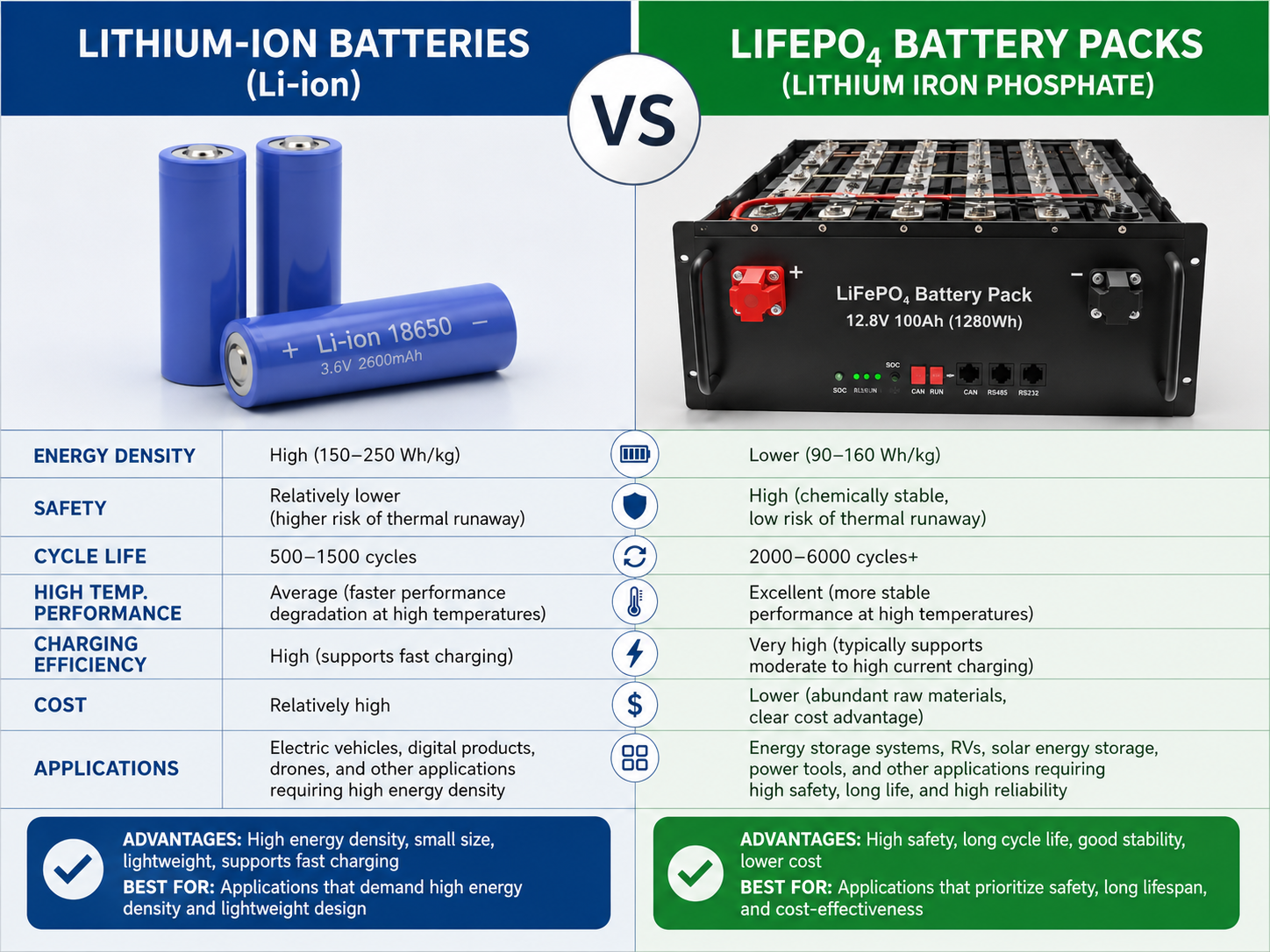
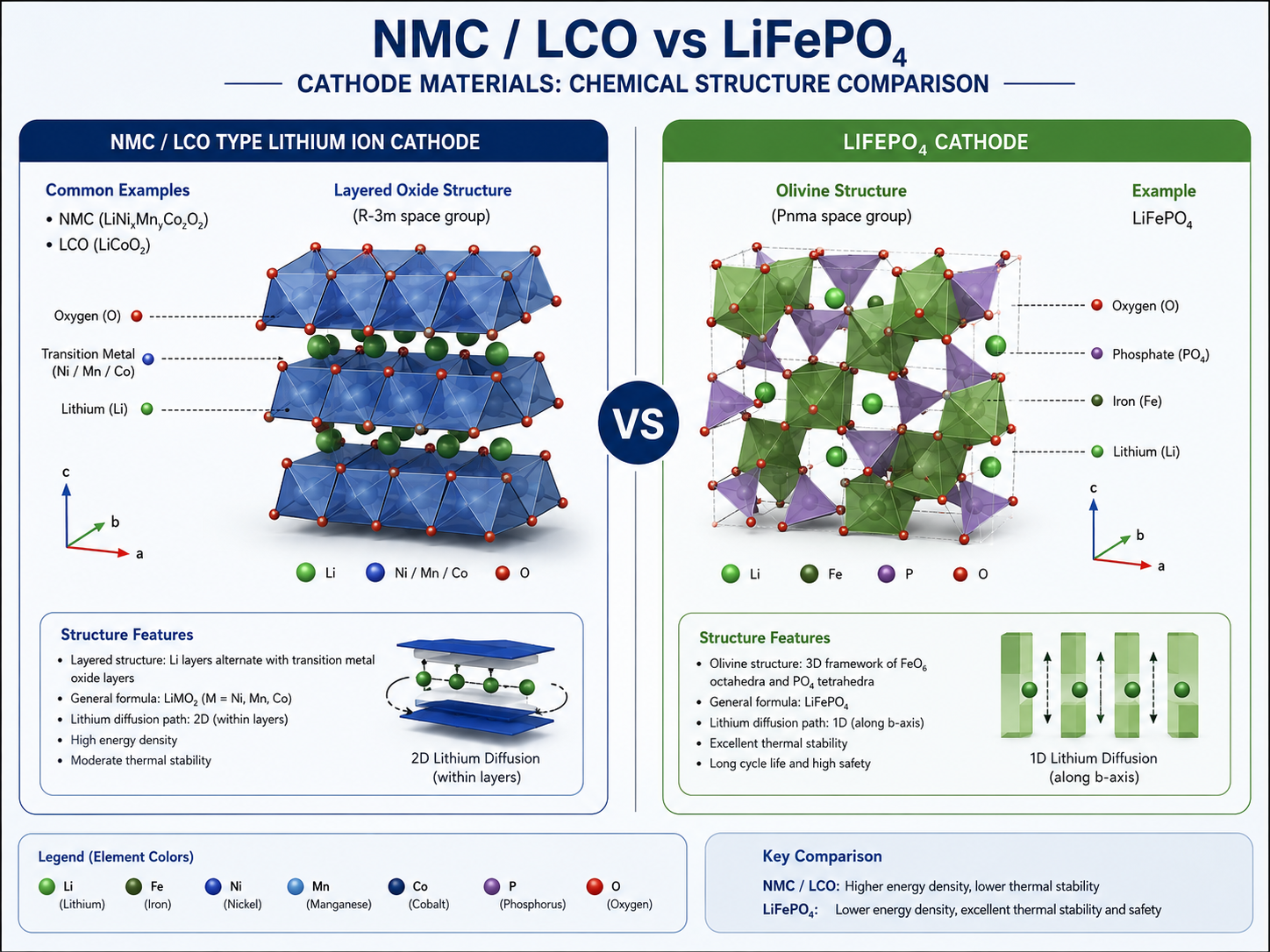
The key Difference Between Lithium-Ion and LiFePO4 is chemistry. LiFePO4 uses lithium iron phosphate as the cathode material, while many other lithium-ion batteries use nickel, manganese, cobalt, aluminum, or cobalt oxide based cathode systems.
That chemistry difference affects how each battery performs in real use.
Factor |
Conventional Lithium-Ion |
LiFePO4 Battery |
Common chemistries |
NMC, NCA, LCO and others |
Lithium iron phosphate |
Energy density |
Usually higher |
Moderate |
Cycle life |
Varies by chemistry and design |
Often longer in deep-cycle use |
Safety profile |
Requires strong thermal and BMS control |
Strong thermal stability |
Weight |
Often lighter for the same nominal energy |
Usually heavier than high-energy Li-ion |
Best-fit use |
EVs, electronics, compact devices |
Solar storage, RV, home backup, portable power |
Lifecycle value |
Strong where compact size matters |
Strong where long life and safety matter |
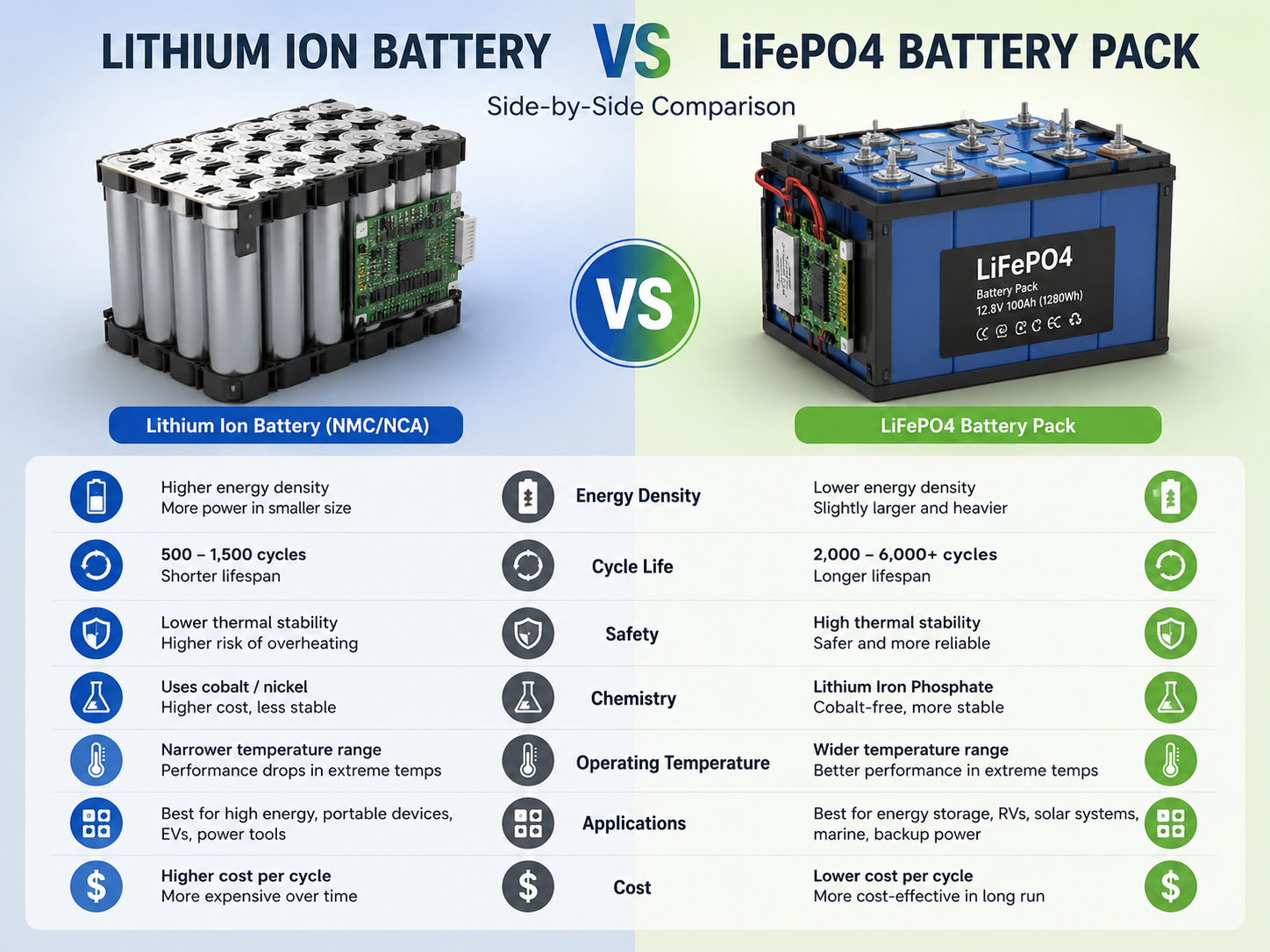
A good LiFePO4 Battery Comparison should not frame one chemistry as universally superior. Instead, it should match the battery to the use case.
__________________________________________________________________
Energy Density Comparison: Difference Between Lithium-Ion and LiFePO4
Energy density describes how much energy a battery can store relative to its weight or volume. In general, many conventional lithium-ion chemistries such as NMC or NCA offer higher energy density than LiFePO4.
This is why NMC and related chemistries are popular in electric vehicles and compact electronics, where size and weight are critical. A smaller battery pack can deliver more range, runtime, or product design flexibility.
LiFePO4 has a lower energy density, but that does not make it a poor choice. For stationary solar storage, home backup systems, and many portable power stations, a slightly larger or heavier battery is often acceptable if it offers longer cycle life, stronger safety, and better deep-cycle durability.
In short:
Choose high-energy lithium-ion when compact size and weight are top priorities.
Choose LiFePO4 when cycle life, safety, and long-term storage value are more important.
__________________________________________________________________
Safety Comparison: Difference Between Lithium-Ion and LiFePO4
Safety is one of the strongest reasons buyers compare Lithium Ion Battery vs LiFePO4. All lithium batteries must be designed, manufactured, charged, transported, and used correctly. However, LiFePO4 chemistry is generally known for better thermal stability than many high-energy lithium-ion chemistries.
Conventional lithium-ion batteries can be very safe when built with quality cells, proper mechanical design, thermal management, and a reliable BMS. They are used successfully in millions of products. But higher energy density chemistries
may require stricter thermal control, especially in high-power or tightly packed applications.LiFePO4 batteries are often preferred for energy storage systems because they are less prone to thermal instability under comparable abuse conditions. Still, safety depends on the complete pack design, not chemistry alone.
Important safety factors include:
Cell quality and consistency.
Battery management system design.
Temperature monitoring.
Short-circuit and overcurrent protection.
Enclosure and insulation design.
Installation environment.
Proper charger or inverter compatibility.
For a dedicated safety article, link to [Are Lithium Batteries Safe?].
__________________________________________________________________
Cycle Life Comparison
Cycle life is one of the most important differences for energy storage buyers. A cycle means one charge and discharge process, although actual cycle counting depends on depth of discharge and test conditions.
LiFePO4 batteries are widely recognized for long cycle life, especially in deep-cycle applications. This makes them attractive for solar storage, RV batteries, home backup systems, and commercial storage projects that charge and discharge frequently.
Conventional lithium-ion batteries can also deliver strong cycle life when properly designed, but many high-energy chemistries are optimized for energy density rather than maximum deep-cycle durability.
When comparing cycle life claims, always check:
Depth of discharge used in testing.
Temperature conditions.
Charge and discharge rate.
End-of-life capacity threshold.
Cell grade and pack design.
Warranty terms and throughput limits.
For long-life applications, buyers should compare lifecycle cost rather than only purchase price. A battery with a higher upfront cost may offer better value if it lasts longer and provides more usable energy.
__________________________________________________________________
Charging Performance Comparison
Both lithium-ion and LiFePO4 batteries can charge efficiently when paired with the correct charger, inverter, or solar charge controller. However, charging performance depends on chemistry, cell design, BMS settings, temperature, and system configuration.
Conventional lithium-ion batteries often support strong charging performance in compact products and electric mobility applications. LiFePO4 batteries also support efficient charging and are commonly used in solar storage because they can handle repeated daily charging well.
For solar installers and energy storage distributors, the most important charging questions are:
Does the battery match the inverter voltage range?
Does the BMS communicate with the inverter?
What is the maximum charge current?
How does the battery behave at low or high temperatures?
What charging profile is recommended by the manufacturer?
Incorrect charging settings can reduce battery life or trigger protection modes. This is why technical documentation and supplier support matter in B2B procurement.
__________________________________________________________________
Cost Comparison
Cost comparison should include more than initial purchase price. Conventional lithium-ion batteries may offer strong value in applications where smaller size, lighter weight, or high energy density reduce system cost. LiFePO4 batteries may offer better long-term value in applications that require frequent cycling and long service life.
For example, a solar storage system that cycles daily may benefit from a LiFePO4 battery because the longer cycle life can reduce replacement frequency. A compact consumer device may benefit more from a higher-density lithium-ion chemistry because physical space is limited.
A practical cost comparison should include:
Purchase price.
Usable capacity.
Expected cycle life.
Efficiency.
Installation cost.
Maintenance requirements.
Warranty coverage.
Replacement schedule.
Safety and compliance requirements.
For buyers considering older technologies as well, a related comparison page such as [LiFePO4 vs Lead Acid Battery] can help evaluate lifecycle value beyond lithium chemistries.
__________________________________________________________________
Temperature Performance Comparison
Temperature affects every battery chemistry. High temperatures can accelerate aging, while low temperatures can reduce power output and charging capability.
LiFePO4 batteries are often valued for thermal stability, but they still need proper operating limits. Charging below the manufacturer’s recommended low-temperature limit can damage cells unless the pack includes low-temperature protection or heating support.
Conventional lithium-ion batteries can perform well across many applications, especially when supported by strong thermal management. In electric vehicles and compact high-power products, thermal design is a major part of system engineering.
For B2B buyers, always confirm:
Operating temperature range.
Charging temperature range.
Low-temperature charging protection.
Storage temperature guidance.
Thermal management design.
Warranty exclusions related to temperature abuse.
Battery chemistry matters, but pack engineering and system integration determine real-world reliability.
__________________________________________________________________
Environmental Impact Comparison
Environmental impact depends on materials, manufacturing processes, energy source, service life, recycling pathway, and end-of-life handling.
LiFePO4 batteries do not rely on cobalt in the cathode material, which can be an advantage for buyers concerned about cobalt supply chain issues. Their long cycle life can also reduce replacement frequency in energy storage applications.
Conventional lithium-ion chemistries such as NMC may use nickel, manganese, cobalt, or aluminum depending on the formulation. These chemistries can provide high energy density, which may reduce material use for applications where compactness is critical.
Both battery types should be recycled through qualified battery recycling channels. Neither should be treated as ordinary waste. Responsible battery selection should consider not only performance but also supplier traceability, certification, recycling support, and product lifespan.
__________________________________________________________________
Lithium-Ion vs LiFePO4 for Solar Energy Storage
For solar energy storage, LiFePO4 is often the preferred choice because solar batteries usually need deep cycling, long service life, stable performance, and strong safety. Many solar systems charge during the day and discharge at night, which makes cycle life and usable capacity very important.
Conventional lithium-ion batteries can also be used in energy storage, especially where space and weight constraints are important. However, for residential and commercial solar storage, LiFePO4 often provides a strong balance of safety, durability, and lifecycle value.
Solar Storage Requirement |
Better Fit in Many Cases |
Reason |
Daily charge/discharge |
LiFePO4 |
Strong deep-cycle performance |
Long service life |
LiFePO4 |
Often longer cycle life |
Compact installation |
Lithium-ion |
Higher energy density may reduce size |
Safety-focused home storage |
LiFePO4 |
Strong thermal stability |
Cost over lifetime |
Depends on use case |
Must compare cycles, warranty, and usable energy |
For buyers evaluating the Best Battery for Solar Storage, link to [Best Lithium Battery for Solar Storage].
Soft CTA: Explore LiFePO4 battery products
If you are sourcing batteries for solar storage, RV systems, or commercial energy storage, explore our LiFePO4 battery products to compare voltage platforms, capacity options, BMS communication, and deep-cycle performance.
__________________________________________________________________
Lithium-Ion vs LiFePO4 for Portable Power Stations
Portable power stations need compact design, reliable output, safe operation, and good cycle life. Both conventional lithium-ion and LiFePO4 can be used, but the best choice depends on product positioning.
High-energy lithium-ion chemistries may be useful when the product must be as light and compact as possible. LiFePO4 is often preferred when the product emphasizes long lifespan, stable performance, and user confidence for frequent use.
For example:
A compact travel unit may prioritize lighter weight.
A larger outdoor backup unit may prioritize lifespan and safety.
A professional field power product may prioritize durability and cycle life.
For product category support, link this section to [Portable Power Station].
Soft CTA: Explore portable power station battery solutions
For brands developing portable power stations, our battery solutions can support product planning across capacity, output power, solar input, safety protection, and battery chemistry selection.
__________________________________________________________________
Lithium-Ion vs LiFePO4 for Home Backup Systems
Home backup systems must be reliable, safe, and ready when the grid fails. They may sit idle for long periods, cycle during peak tariff windows, or operate daily with solar self-consumption.
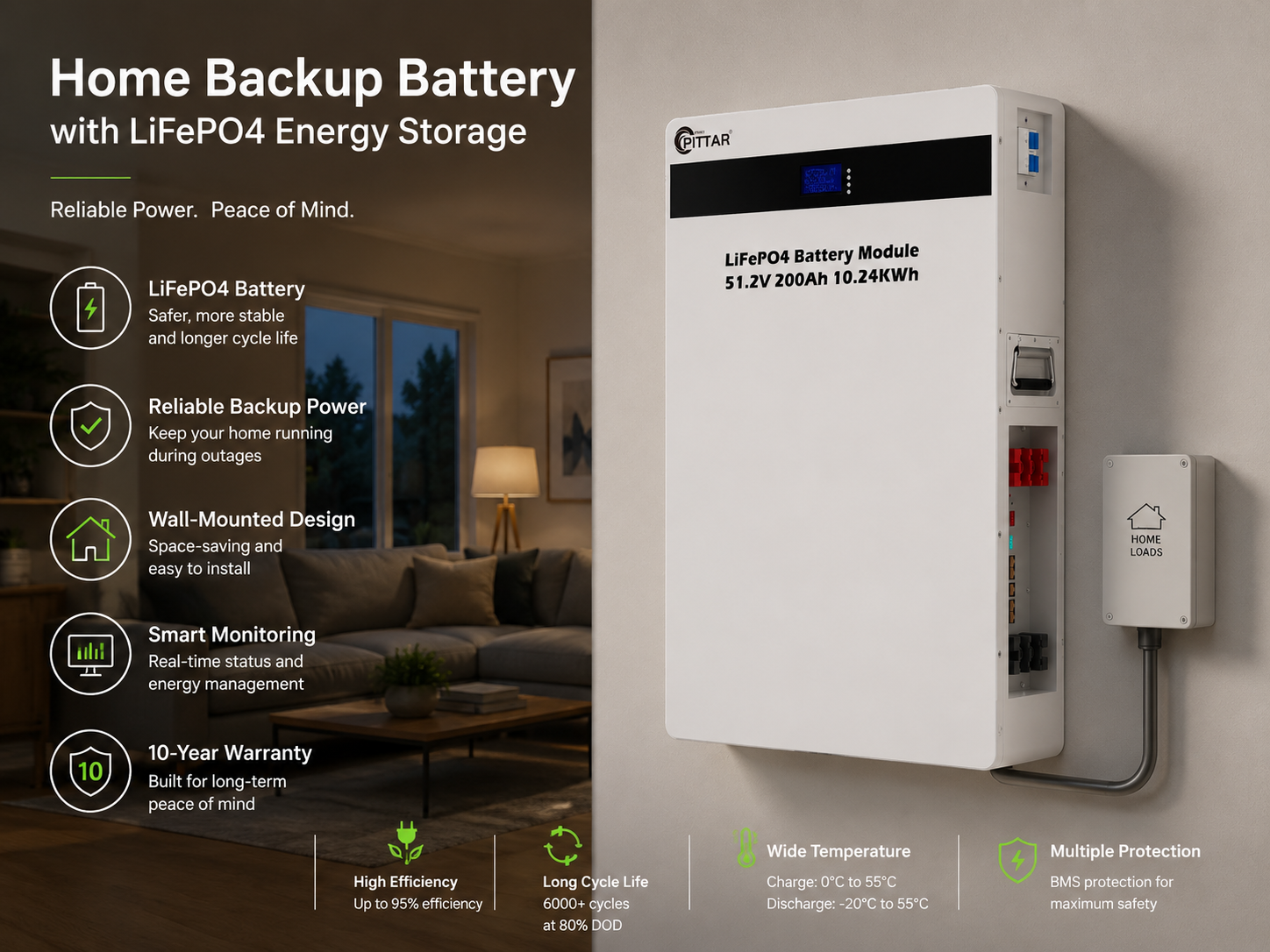
LiFePO4 is widely used in home energy storage because it offers strong safety characteristics, long cycle life, and stable deep-cycle performance. Conventional lithium-ion may still be suitable where compact design and high energy density are key priorities.
For homeowners and installers, selection should consider:
Required backup duration.
Essential load size.
Solar integration.
Inverter compatibility.
Indoor or outdoor installation.
Certification and code requirements.
Warranty and service support.
For deeper system guidance, link to [Home Energy Storage Battery Guide].
Soft CTA: Explore home energy storage batteries
If you are planning residential backup or solar self-consumption projects, explore our home energy storage battery solutions designed for scalable capacity, inverter compatibility, and long-term energy resilience.
__________________________________________________________________
Which Battery Type Is Better?
The honest answer is: it depends on the application.
Choose conventional lithium-ion when:
Maximum energy density is critical.
The product must be compact and lightweight.
The system has strong thermal management.
The application is electronics, EV-related, or space-constrained.
Choose LiFePO4 when:
Long cycle life is important.
Safety and thermal stability are priorities.
The battery will be used for daily cycling.
The application is solar storage, home backup, RV, marine, or portable power.
Total lifecycle value matters more than the lowest upfront cost.
In many energy storage applications, LiFePO4 is the practical choice. In compact mobility and electronics applications, conventional lithium-ion chemistries may still be the better fit.
__________________________________________________________________
Frequently Asked Questions
What is the main Difference Between Lithium-Ion and LiFePO4?
The main difference is cathode chemistry. LiFePO4 uses lithium iron phosphate, while many conventional lithium-ion batteries use nickel, manganese, cobalt, aluminum, or cobalt oxide based cathode materials. This affects energy density, safety, cycle life, and best-fit applications.
Is LiFePO4 better than lithium-ion?
LiFePO4 is better for many deep-cycle energy storage applications because it offers long cycle life and strong thermal stability. Conventional lithium-ion may be better when maximum energy density and compact size are more important.
Is LiFePO4 the same as lithium-ion?
LiFePO4 is technically a type of lithium-ion battery. In commercial comparisons, however, “lithium-ion” often refers to other chemistries such as NMC, NCA, or LCO.
What is LiFePO4 vs NMC?
LiFePO4 vs NMC compares lithium iron phosphate with lithium nickel manganese cobalt oxide. NMC usually has higher energy density, while LiFePO4 is often preferred for safety, cycle life, and stationary energy storage.
Which battery is better for solar storage?
LiFePO4 is often better for solar storage because it supports daily cycling, long service life, stable performance, and strong safety. However, the final choice depends on capacity, inverter compatibility, installation space, and budget.
Which battery is better for portable power stations?
For lightweight compact units, conventional lithium-ion may be attractive. For longer lifespan and frequent cycling, LiFePO4 is often preferred in portable power stations.
Do LiFePO4 batteries last longer?
In many deep-cycle applications, LiFePO4 batteries offer longer cycle life than many conventional lithium-ion chemistries. Actual lifespan depends on cell quality, BMS design, depth of discharge, temperature, and charging conditions.
__________________________________________________________________
Conclusion
The Difference Between Lithium-Ion and LiFePO4 comes down to chemistry, performance priorities, and application fit. Conventional lithium-ion batteries often provide higher energy density, making them suitable for compact electronics, EV-related products, and lightweight applications. LiFePO4 batteries generally offer stronger thermal stability, long cycle life, and excellent deep-cycle performance, making them a strong choice for solar storage, home backup, RV systems, and portable power stations.
For B2B buyers and energy storage professionals, the right decision should be based on more than a simple LiFePO4 vs Lithium Ion label. Evaluate usable capacity, cycle life, safety requirements, charging profile, inverter compatibility, warranty terms, supplier support, and total lifecycle cost. The best battery is the one that matches the technical and commercial reality of the project.
 Hot News
2026-08-20
2026-08-16
2026-08-12
2026-08-03
2026-07-30
2026-07-26

Pittar Power is a professional manufacturer specializing inenergy storage solutions.
Room 302, Building 1, No. 10, Huangjin First Road, Nancheng District, Dongguan City, Guangdong Province, China
Copyright © Shenzhen Pittar Power Co., Ltd. All Rights Reserved Privacy Policy
 EN
EN