Introduction
Understanding the Types of Lithium Batteries is essential for anyone sourcing, designing, installing, or specifying modern energy storage products. Although many packs are marketed simply as “lithium batteries,” the internal chemistry can significantly affect safety, energy density, cycle life, cost, power output, temperature behavior, and long-term value.
For B2B battery buyers, energy storage distributors, solar installers, portable power station manufacturers, engineers, and home energy storage users, chemistry selection is not only a technical decision. It influences product positioning, warranty risk, system integration, logistics, and total lifecycle cost.
This guide explains the major lithium battery chemistries: LiFePO4 Battery, NMC Battery, LCO Battery, LMO Battery, LTO Battery, and NCA Battery. It also provides a practical Lithium Battery Comparison to help you evaluate the best fit for solar storage, home backup, portable power stations, electric mobility, consumer electronics, and industrial applications.
For a broader foundation, this article supports the pillar guide [What Is a Lithium Battery?].
_______________________________________________________________
A lithium battery is a battery that uses lithium-based electrochemistry to store and release electrical energy. In most rechargeable applications, the term refers to lithium-ion batteries, where lithium ions move between the positive electrode and negative electrode during charging and discharging.
A finished lithium battery product may include cells, modules, a battery management system, thermal protection, enclosure, fuses, connectors, and communication ports. The cell chemistry is the foundation, but pack-level engineering determines how safely and reliably the battery performs in real applications.
Lithium batteries are used in smartphones, laptops, electric vehicles, solar batteries, home energy storage systems, RV power, telecom backup, power tools, and portable power stations because they can offer high energy density, strong efficiency, fast charging, and long cycle life.
For basic education, link this section to [What Is a Lithium Battery?]. For the operating principle, connect to [How Does a Lithium Battery Work?].
_______________________________________________________________
Why Are There Different Types of Lithium Batteries?
There are Different Types of Lithium Batteries because no single chemistry is ideal for every use case. Engineers adjust cathode materials, anode materials, electrolyte systems, cell formats, and pack designs to prioritize different performance goals.
The main trade-offs include:
Energy density: How much energy can be stored in a given size or weight.
Cycle life: How many charge-discharge cycles the battery can deliver before major capacity loss.
Thermal stability: How well the chemistry resists overheating and abuse conditions.
Power capability: How quickly the battery can charge or discharge.
Cost structure: How raw materials and manufacturing complexity affect price.
Safety profile: How the cell behaves under electrical, thermal, or mechanical stress.
Application fit: Whether the battery is better for stationary storage, mobility, electronics, or industrial equipment.
A smartphone battery prioritizes compact energy density. A home energy storage battery prioritizes long service life, safety, and stable daily cycling. An electric vehicle battery must balance range, weight, power, and thermal management. This is why lithium battery chemistry matters.
_______________________________________________________________
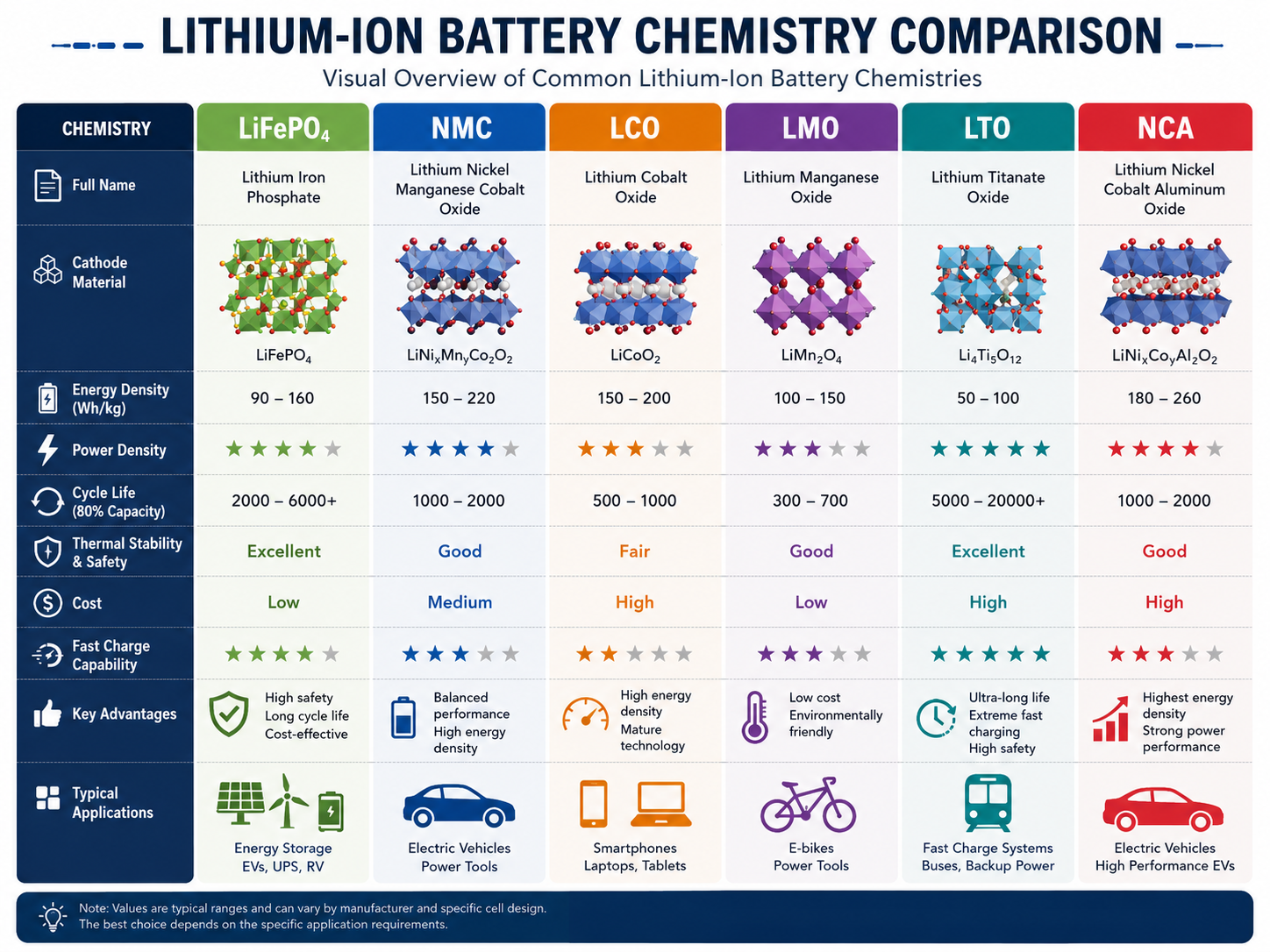
Overview of Lithium Battery Chemistries
The most common lithium battery chemistries are usually named by their cathode material. Each chemistry has a different performance profile.
Battery Type |
Full Name |
Typical Strength |
Common Applications |
LiFePO4 / LFP |
Lithium Iron Phosphate |
Safety, long cycle life, stability |
Solar storage, home backup, RV, marine,portable power stations |
NMC |
Lithium Nickel Manganese Cobalt Oxide |
Balanced energy density and power |
Electric vehicles, e-bikes, power tools, compact storage |
LCO |
Lithium Cobalt Oxide |
High energy density in compact cells |
Smartphones, laptops, tablets, cameras |
LMO |
Lithium Manganese Oxide |
Power output and thermal behavior |
Power tools, medical devices, some EVs |
LTO |
Lithium Titanate |
Fast charging and very long cycle life |
Industrial systems, buses, grid support |
NCA |
Lithium Nickel Cobalt Aluminum Oxide |
High energy density and performance |
Electric vehicles, aerospace, high-performance packs |
These categories describe chemistry families. A finished battery pack can still vary widely depending on cell grade, BMS design, thermal control, assembly quality, testing, and certification.
_______________________________________________________________
LiFePO4 (Lithium Iron Phosphate) Batteries
A LiFePO4 Battery, also called lithium iron phosphate or LFP battery, uses lithium iron phosphate as the cathode material. It has become one of the most important chemistries for energy storage because it offers strong safety characteristics, long cycle life, stable voltage output, and reliable deep-cycle performance.
LiFePO4 is widely used in solar batteries, home energy storage systems, rack-mounted battery modules, wall-mounted batteries, RV batteries, marine power, telecom backup, and portable power stations. For deeper education, link to [What Is LiFePO4 Battery?].
Advantages
Long cycle life for frequent charge-discharge use.
Strong thermal and chemical stability.
Good deep-cycle capability for solar and backup systems.
Lower cobalt dependence compared with some lithium-ion chemistries.
Strong lifecycle value for stationary and mobile storage.
Disadvantages
Lower energy density than many NMC or NCA designs.
Larger or heavier pack size for the same capacity.
Requires proper low-temperature charging protection.
Less suitable for ultra-compact consumer electronics.
Applications
LiFePO4 is commonly used in solar storage systems, home backup batteries, portable power stations, RV and marine batteries, telecom backup, UPS systems, and off-grid power.
Soft CTA: Explore LiFePO4 battery products
If you are sourcing batteries for solar storage, RV power, telecom backup, or portable energy products, explore our LiFePO4 battery solutions to compare voltage platforms, capacity options, BMS functions, communication compatibility, enclosure designs, and OEM/ODM customization support.
_______________________________________________________________
NMC (Nickel Manganese Cobalt) Batteries
An NMC Battery uses lithium nickel manganese cobalt oxide as the cathode material. It is widely used because it provides a strong balance between energy density, power capability, and overall performance. By adjusting the ratio of nickel,
manganese, and cobalt, manufacturers can tune the battery for different priorities.
Advantages
High energy density for lighter and more compact packs.
Good balance of capacity, power, and cycle life.
Strong fit for electric vehicles and mobility products.
Flexible chemistry design for different performance targets.
Disadvantages
Requires more complex thermal and safety management.
Exposed to nickel and cobalt material cost fluctuations.
May have lower cycle life than LiFePO4 in daily deep-cycle storage.
Pack safety depends heavily on BMS and thermal design.
Applications
NMC batteries are common in electric vehicles, e-bikes, scooters, power tools, medical devices, high-energy portable products, and some compact energy storage systems.
For safety-focused buyers, link this section to [Are Lithium Batteries Safe?].
_______________________________________________________________
LCO (Lithium Cobalt Oxide) Batteries
An LCO Battery uses lithium cobalt oxide as the cathode material. It is one of the older and most established lithium-ion chemistries and is known for high energy density in small cells.
Advantages
High energy density for compact devices.
Mature manufacturing history.
Good fit for lightweight consumer electronics.
Disadvantages
Lower thermal stability compared with LiFePO4.
Limited cycle life for heavy-duty cycling.
Higher dependence on cobalt.
Less suitable for high-current industrial or storage applications.
Applications
LCO batteries are widely used in smartphones, laptops, tablets, digital cameras, wearable electronics, and compact consumer devices. For energy storage distributors, LCO is important to understand, but it is rarely the preferred chemistry for solar storage or home backup systems.
_______________________________________________________________
LMO (Lithium Manganese Oxide) Batteries
An LMO Battery uses lithium manganese oxide as the cathode material. It is known for good power capability and better thermal behavior than some cobalt-heavy chemistries. LMO can be used alone or blended with other chemistries, such as NMC, to improve performance balance.
Advantages
Good power output for demanding loads.
Improved thermal behavior compared with some older lithium chemistries.
Lower cobalt reliance.
Useful in hybrid chemistry designs.
Disadvantages
Lower energy density than NMC and NCA.
Shorter cycle life than LiFePO4 in many storage applications.
Capacity fade can be a concern under demanding conditions.
Applications
LMO batteries are used in power tools, medical instruments, e-bikes, and some electric or hybrid vehicles. For long-duration stationary storage, LiFePO4 is usually more attractive because it offers stronger lifecycle value.
_______________________________________________________________
LTO (Lithium Titanate) Batteries
An LTO Battery uses lithium titanate as the anode material instead of the more common graphite anode. This makes LTO different from most lithium-ion batteries, which are usually categorized by cathode chemistry.
Advantages
Very long cycle life.
Fast charging capability.
Strong power performance.
Good low-temperature behavior.
Strong safety profile in demanding conditions.
Disadvantages
Lower energy density than mainstream lithium chemistries.
Higher cost.
Larger and heavier packs for the same energy capacity.
Limited use in mainstream residential products.
Applications
LTO batteries are used in electric buses, rapid-charging transport systems, grid support, industrial equipment, military systems, cold-climate power applications, and high-cycle energy storage projects. LTO may be the best lithium battery type when extreme cycle life and fast charging matter more than energy density or upfront cost.
_______________________________________________________________
NCA (Nickel Cobalt Aluminum) Batteries
An NCA Battery uses lithium nickel cobalt aluminum oxide as the cathode material. It is valued for high energy density, strong specific energy, and good performance in advanced mobility applications.
Advantages
Very high energy density.
Strong performance potential.
Good fit for premium electric vehicle platforms.
Suitable for high-performance battery packs.
Disadvantages
Requires careful thermal management.
Exposed to nickel and cobalt supply-chain considerations.
Less common for residential storage than LiFePO4.
Requires advanced pack engineering and safety control.
Applications
NCA batteries are used in electric vehicles, aerospace, advanced mobility, high-performance battery packs, and some specialty industrial applications. For stationary solar and home backup products, NCA is usually considered only when high energy density is more important than storage-focused safety and cycle life.
_______________________________________________________________
Comparison Table of Lithium Battery Types
A practical Lithium Battery Comparison should evaluate chemistry based on real application needs, not only headlinecapacity.
Chemistry |
Energy Density |
Cycle Life |
Safety Profile |
Power Capability |
Relative Cost |
Best Fit |
LiFePO4 / LFP |
Medium |
High |
Very strong |
Medium to high |
Medium |
Solar storage, home backup, RV, marine, portable power stations |
NMC |
High |
Medium to high |
Requires strong controls |
High |
Medium to high |
EVs, e-bikes, power tools, compact storage |
LCO |
High |
Low to medium |
Requires strict controls |
Medium |
Medium to high |
Smartphones, laptops, tablets |
LMO |
Medium |
Medium |
Good |
High |
Medium |
Power tools, medical devices, some EVs |
LTO |
Low to medium |
Very high |
Very strong |
Very high |
High |
Fast charging, industrial, grid support, transport |
NCA |
Very high |
Medium to high |
Requires advanced controls |
High |
High |
EVs, aerospace, high-performance packs |
Buyer Priority |
Recommended Chemistry to Evaluate First |
Why It Matters |
Long cycle life for solar storage |
LiFePO4 |
Strong lifecycle value and stable daily cycling |
Maximum energy in limited space |
NMC or NCA |
Higher energy density supports compact packs |
Consumer electronics |
LCO |
Mature chemistry for small high-energy cells |
Fast charging and extreme cycling |
LTO |
Excellent power and cycle performance |
High-current tools or devices |
LMO or NMC |
Strong power output capability |
Home backup safety and reliability |
LiFePO4 |
Good balance of safety, lifespan, and cost |
For solar-specific buyers, add an internal link to [Best Lithium Battery for Solar Storage]. For residential projects, connect readers to [Home Energy Storage Battery Guide].
_______________________________________________________________
Which Lithium Battery Type Is Best?
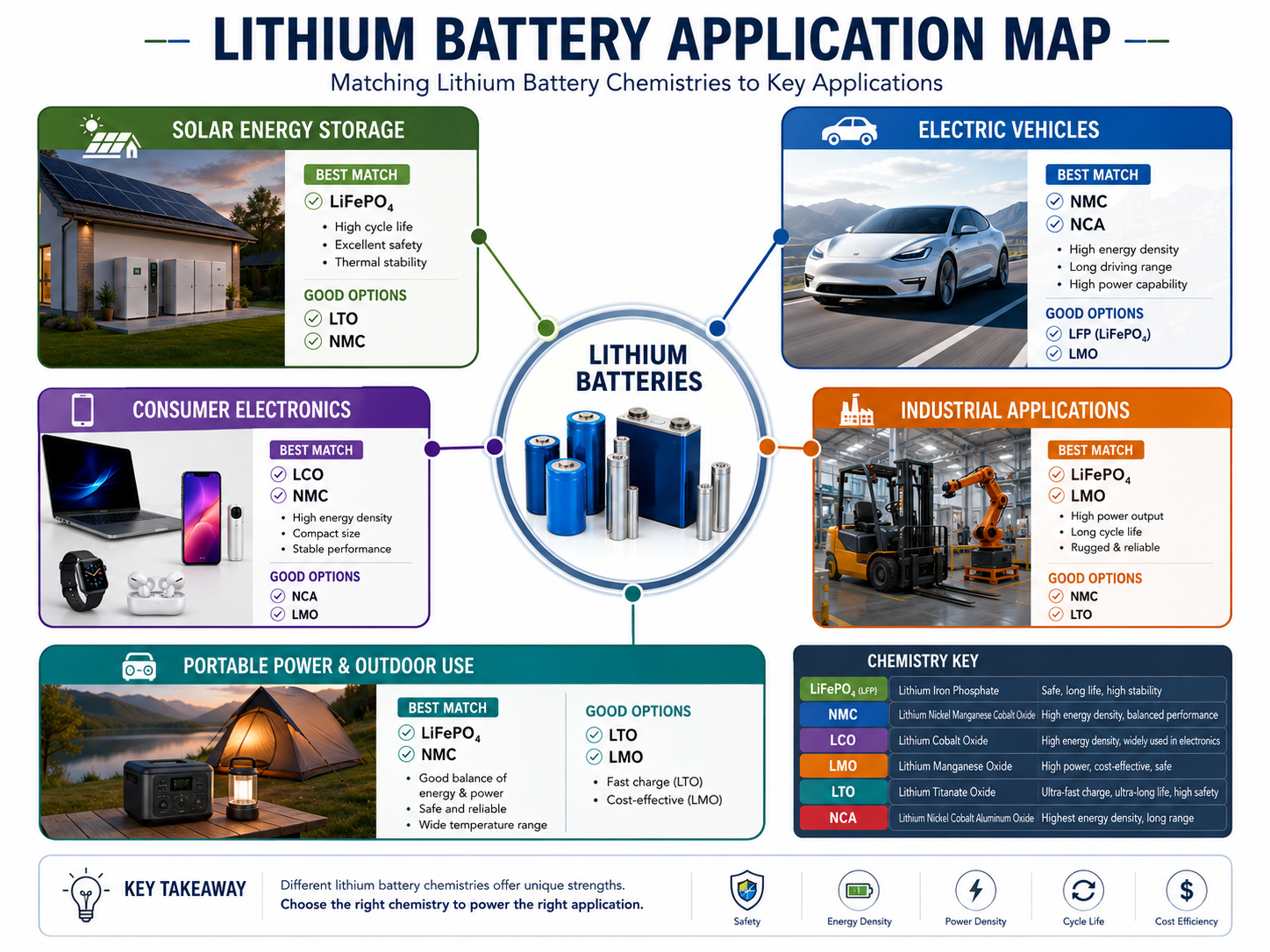
The Best Lithium Battery Type depends on the application. There is no single chemistry that wins every category.
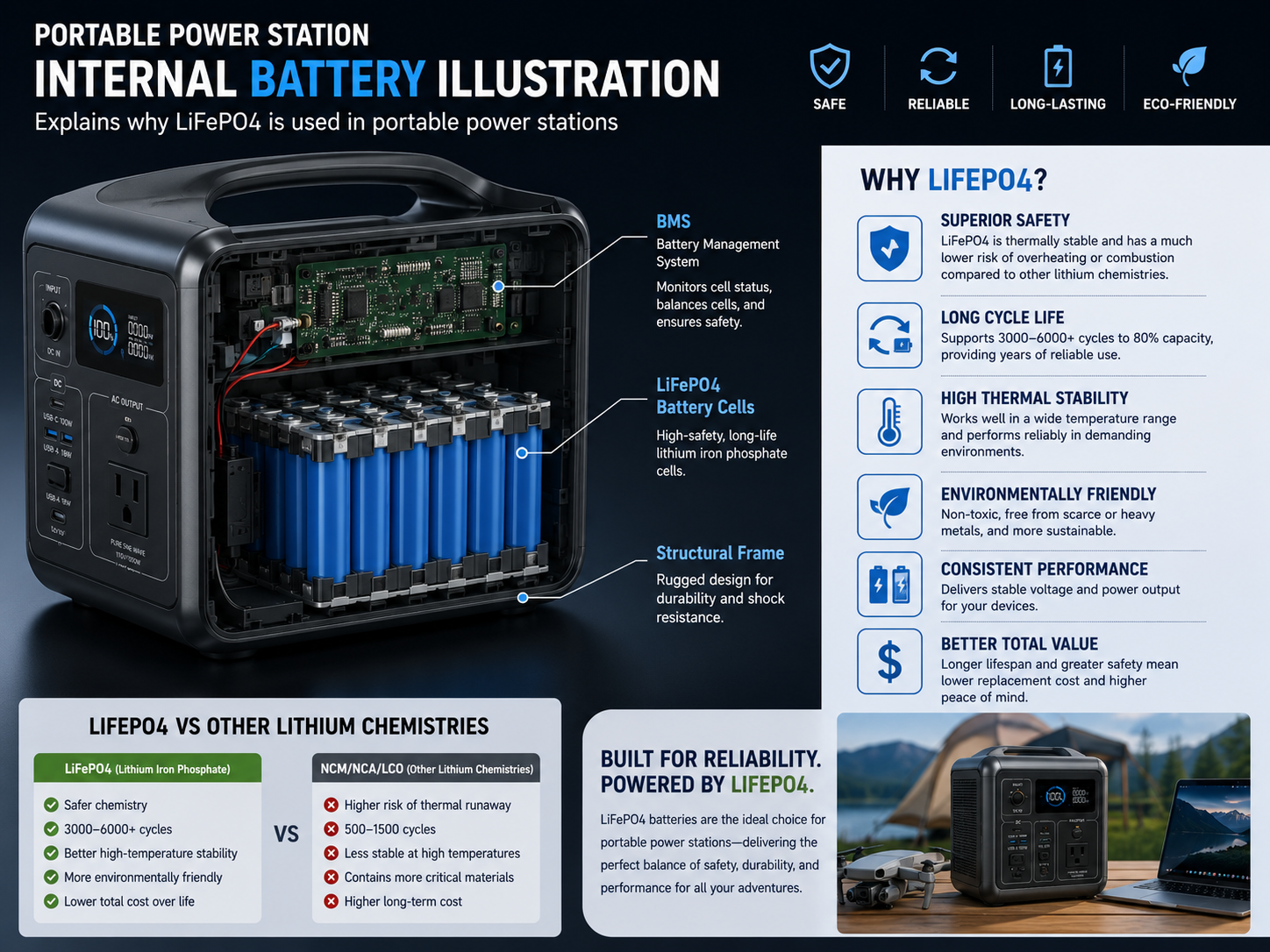
For solar storage and home energy storage, LiFePO4 is often preferred because it offers long cycle life, strong safety characteristics, and stable deep-cycle performance. These qualities are valuable when the battery charges during the day and discharges at night for many years.
For electric vehicles, NMC and NCA are often selected because higher energy density can improve driving range and reduce pack weight. The trade-off is that these chemistries require more advanced thermal management and safety control.
For consumer electronics, LCO remains common because compact energy density is a top priority. For fast-charging industrial systems, LTO may be the best choice because it supports rapid charge-discharge cycles and long operating life.
For portable power stations, LiFePO4 has become increasingly popular because users value long lifespan, safer operation, and reliable output. This section can naturally link to [Portable Power Station].
A good selection process should compare application, load profile, expected cycles, temperature range, space limits, safety requirements, warranty expectations, total lifecycle cost, supplier support, and BMS compatibility.
Soft CTA: Explore home energy storage batteries
If you are planning residential storage projects, our home energy storage battery solutions are designed for solar self-consumption, backup power, scalable capacity, inverter communication, and distributor-friendly installation support.
_______________________________________________________________
Why LiFePO4 Batteries Are Popular for Energy Storage
LiFePO4 batteries are popular for energy storage because the chemistry aligns closely with the real needs of solar, backup, and deep-cycle applications. Energy storage buyers usually care less about the highest possible energy density and more about safety, lifespan, reliability, usable capacity, and long-term operating cost.
Key reasons include:
Daily cycling performance: Solar batteries may cycle frequently, so cycle life is critical.
Stable safety profile: Strong thermal stability helps reduce risk in residential and commercial installations.
Long-term value: Longer service life can reduce replacement frequency.
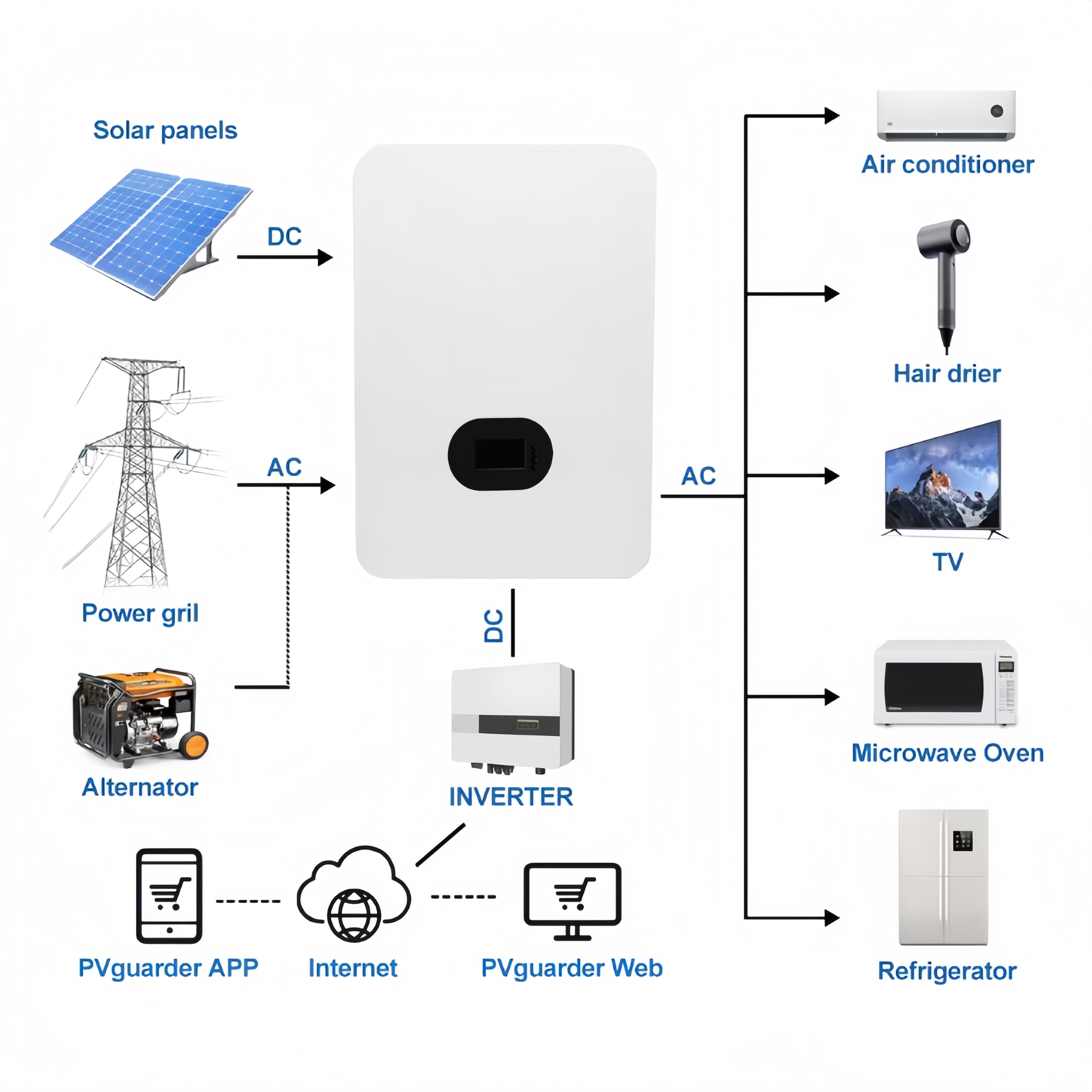
Modular system fit: LiFePO4 cells are widely used in rack batteries, wall-mounted batteries, and cabinet systems.
Practical voltage platforms: LFP packs can support 12V, 24V, 48V, high-voltage home storage, and commercial systems.
BMS compatibility: Professional systems can support CAN, RS485, and inverter communication.
LiFePO4 is also a strong replacement option for many lead acid applications. For buyers comparing legacy battery banks with modern lithium storage, link to [LiFePO4 vs Lead Acid Battery].
Soft CTA: Explore portable power station battery solutions
For portable power station brands and OEM manufacturers, our LiFePO4-based battery solutions can support longer product life, stable output, safer user experience, and flexible capacity design for outdoor, emergency, and professional power applications.
_______________________________________________________________
Frequently Asked Questions
What are the main Types of Lithium Batteries?
The main types of lithium batteries include LiFePO4, NMC, LCO, LMO, LTO, and NCA. These chemistries differ in energy density, safety profile, cycle life, cost, and best-use applications.
Which lithium battery chemistry is best for solar storage?
LiFePO4 is often preferred for solar storage because it offers long cycle life, strong thermal stability, and reliable deep-cycle performance. For more guidance, link to [Best Lithium Battery for Solar Storage].
Is LiFePO4 better than NMC?
LiFePO4 is often better for energy storage, home backup, RV systems, and applications that prioritize safety and cycle life. NMC is often better when higher energy density and lighter weight are critical.
What is the safest lithium battery type?
LiFePO4 is widely recognized for strong thermal and chemical stability, making it one of the preferred chemistries for safety-focused energy storage. Real safety also depends on cell quality, BMS design, certification, installation, and charging conditions. Link this answer to [Are Lithium Batteries Safe?].
What lithium battery type is used in portable power stations?
Many modern portable power stations use LiFePO4 because it supports long cycle life, stable performance, and a strong safety profile. Some compact models may use NMC when lower weight and smaller size are priorities.
Are LTO batteries worth the higher cost?
LTO batteries may be worth the cost in applications requiring very fast charging, extreme cycle life, high power output, or cold-temperature performance. They are less common in mainstream residential storage because of lower energy density and higher upfront cost.
_______________________________________________________________
Conclusion
The Types of Lithium Batteries differ significantly in chemistry, performance, safety profile, cost, and application fit. LiFePO4, NMC, LCO, LMO, LTO, and NCA all belong to the broader lithium battery family, but they are designed for different priorities.
For B2B battery buyers, solar installers, energy storage distributors, portable power station manufacturers, and engineers, the best decision starts with application requirements. If the goal is long cycle life, safety, and dependable energy storage, LiFePO4 is often the leading choice. If the goal is maximum energy density for mobility or compact electronics, NMC, NCA, or LCO may be more suitable. If the goal is rapid charging and extreme cycle performance, LTO deserves consideration.
A professional lithium battery selection process should compare chemistry, cell quality, BMS design, safety certification, system compatibility, warranty terms, and supplier engineering capability. When these factors are evaluated together, buyers can choose the lithium battery type that delivers the best lifecycle value instead of simply chasing the lowest upfront price.
For broader education, connect this article back to the pillar page [What Is a Lithium Battery?] and supporting guides such as [What Is LiFePO4 Battery?], [How Does a Lithium Battery Work?] , and [Home Energy Storage Battery Guide].
 Hot News
2026-08-20
2026-08-16
2026-08-12
2026-08-03
2026-07-30
2026-07-26

Pittar Power is a professional manufacturer specializing inenergy storage solutions.
Room 302, Building 1, No. 10, Huangjin First Road, Nancheng District, Dongguan City, Guangdong Province, China
Copyright © Shenzhen Pittar Power Co., Ltd. All Rights Reserved Privacy Policy
 EN
EN