Introduction
How Many Cycles Can a LiFePO4 Battery Provide? In many energy storage applications, a well-designed LiFePO4 battery can provide thousands of charge-discharge cycles, often far more than traditional lead-acid batteries and many consumer lithium chemistries. The exact number depends on depth of discharge, temperature, charging current, BMS protection, cell quality, and how the battery is used.
For B2B battery buyers, solar energy storage users, home backup customers, RV and marine owners, portable power station buyers, and energy storage distributors, cycle life is more than a technical specification. It directly affects replacement frequency, total cost of ownership, warranty planning, and customer satisfaction.
This article explains LiFePO4 Battery Cycle Life in practical terms and supports the pillar guide [What Is a Lithium Battery?]. For basic chemistry background, see [What Is LiFePO4 Battery?].
__________________________________________________________________
What Does Battery Cycle Life Mean?
Battery cycle life means how many charge-discharge cycles a battery can complete before its usable capacity falls to a defined level, usually stated by the manufacturer. Many datasheets define end-of-life at around 70% or 80% remaining capacity, but the exact definition varies.
A battery does not become useless immediately after reaching its rated cycle life. It may still work, but runtime becomes shorter and voltage behavior may change. For commercial energy storage, this matters because customers buy usable energy over time, not just nominal capacity on day one.
Term |
Meaning |
Cycle life |
Number of charge-discharge cycles before defined capacity fade |
State of Health (SOH) |
Remaining battery health compared with original condition |
Depth of Discharge (DoD) |
Percentage of capacity used before recharge |
End of life |
Point where capacity no longer meets defined performance target |
To compare cycle life with calendar lifespan, see [How Long Does a Lithium Battery Last?].
__________________________________________________________________
How Is a Charge Cycle Calculated?
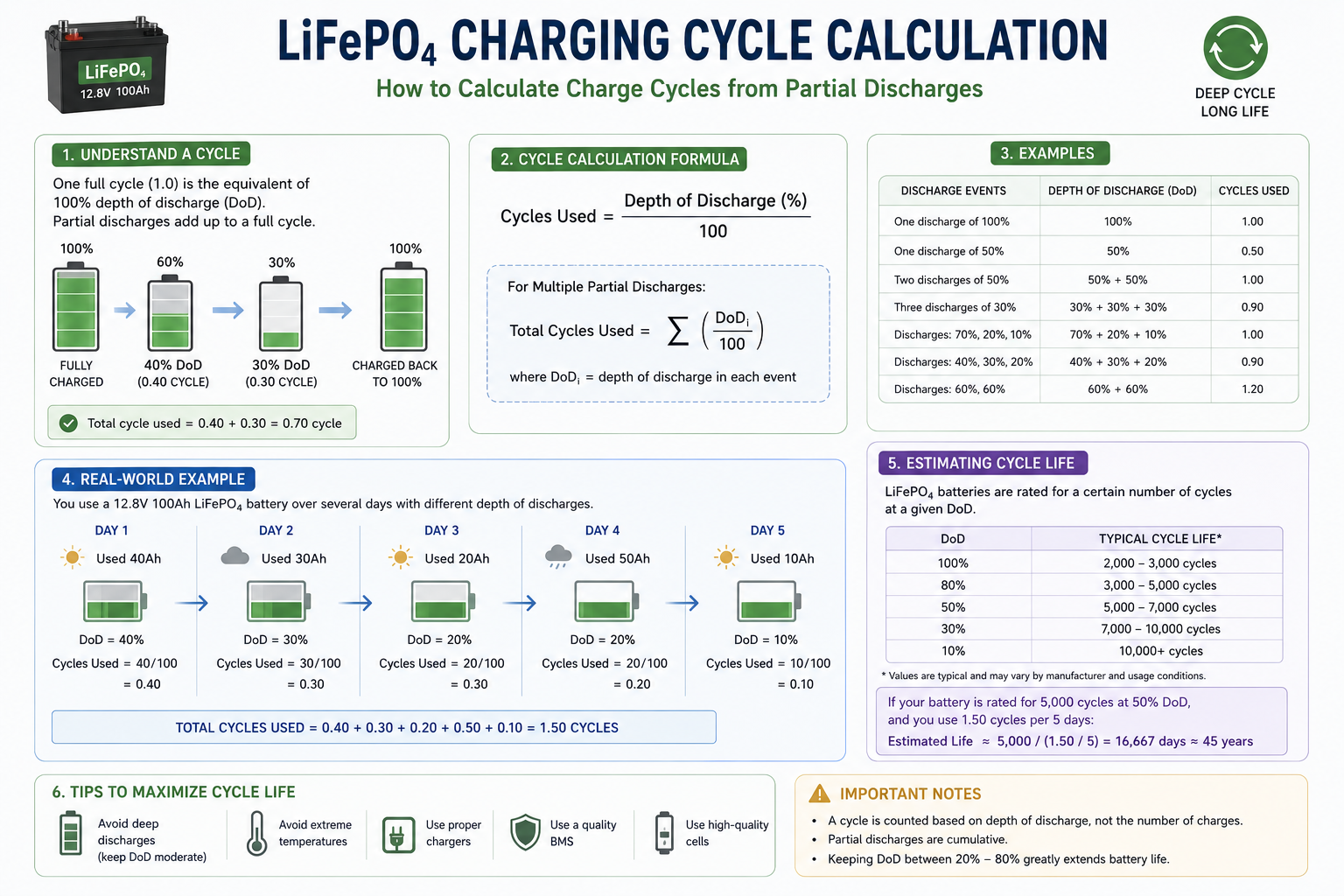
A charge cycle is not always one full discharge from 100% to 0% and one recharge back to 100%. In practical battery management, partial cycles add up.
Example:
Usage Pattern |
Approximate Cycle Count |
Use 100% once |
1 full cycle |
Use 50% twice |
About 1 full cycle |
Use 25% four times |
About 1 full cycle |
Use 10% ten times |
About 1 full cycle |
This is important because many real systems do not fully discharge every day. A solar battery might cycle 40%-70% depending on weather and load. A home backup battery may sit mostly full until an outage. A portable power station may experience irregular partial cycles.
Cycle counting methods can vary by BMS and monitoring software, so always check how the manufacturer defines LiFePO4 charge cycles.
__________________________________________________________________
Typical Cycle Life of LiFePO4 Batteries
How Many Cycles Can a LiFePO4 Battery Provide in real use? Many quality LiFePO4 batteries are rated for thousands of cycles under specified test conditions. Some products are designed for around 2,000-6,000+ cycles, while advanced systems may claim higher cycle ratings depending on DoD, temperature, current, and end-of-life definition.
These numbers should be read carefully. A cycle-life rating is only meaningful when you know:
Depth of discharge used in the test.
Charge and discharge current.
Operating temperature.
End-of-life capacity definition.
Whether the rating applies to cells or the complete battery pack.
Whether the BMS, enclosure, and thermal design support real-world conditions.
Cycle-Life Claim |
What to Check |
2,000 cycles |
At what DoD and temperature? |
4,000 cycles |
What remaining capacity defines end-of-life? |
6,000+ cycles |
Is this cell-level or pack-level data? |
Long warranty |
What usage conditions are excluded? |
The safest buying approach is to compare datasheets under similar test conditions, not just the largest advertised number.
__________________________________________________________________
LiFePO4 vs Other Battery Chemistries: Cycle Life Comparison
LiFePO4 is widely selected for energy storage because it balances long cycle life, safety, and stable performance. Other chemistries may be better for specific needs. For example, NMC can offer higher energy density, while lead-acid may have lower upfront cost.
Battery Type |
Cycle Life Trend |
Strength |
Limitation |
LiFePO4 |
Usually very strong |
Long cycle life, stability, low maintenance |
Higher upfront cost |
NMC lithium |
Moderate to strong depending on design |
Higher energy density |
More sensitive to thermal design |
Lead-acid deep cycle |
Lower under deep cycling |
Low upfront cost, familiar |
Heavy, lower usable DoD |
AGM/Gel lead-acid |
Better sealed lead-acid options |
Maintenance-light |
Still limited vs LiFePO4 in frequent cycling |
For more chemistry comparisons, see [Types of Lithium Batteries Explained], [Difference Between Lithium-Ion and LiFePO4], [LiFePO4 vs Lead Acid Battery], and [LiFePO4 vs NMC Battery].
[Soft CTA 1] Evaluating long-cycle storage options? Explore LiFePO4 battery products designed for solar storage, RV power, marine systems, home backup, and commercial energy storage projects.
__________________________________________________________________
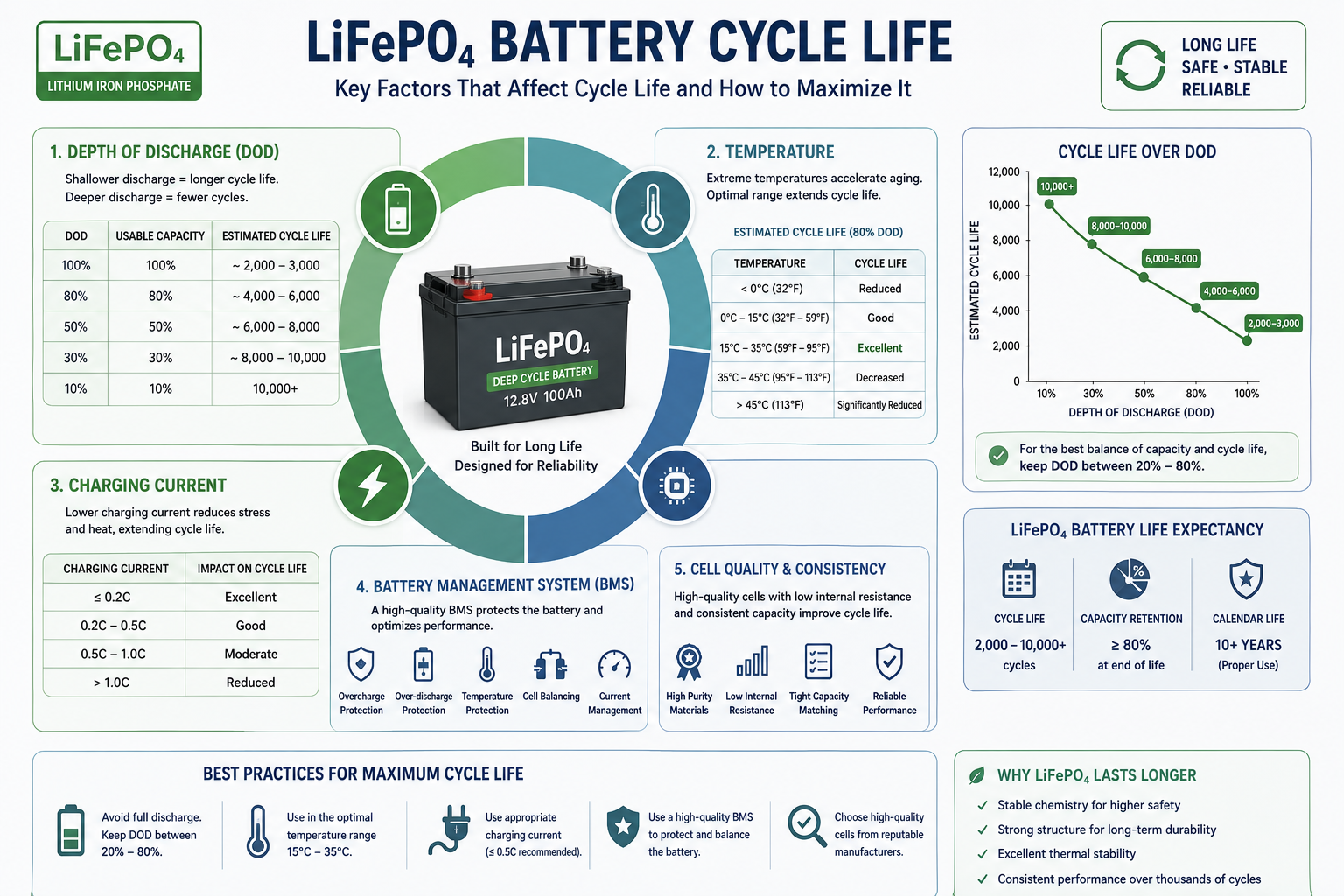
Factors That Affect LiFePO4 Battery Cycle Life
LiFePO4 batteries are durable, but they are not immune to aging. The following factors have the largest impact on LiFePO4 Battery Cycles.
Depth of Discharge (DoD)
Depth of discharge means how much capacity is used before recharging. Lower average DoD usually extends cycle life. A battery cycled between 30% and 80% state of charge may last longer than one repeatedly discharged close to its lower limit.
Charging habits
Use chargers and inverters with LiFePO4-compatible voltage settings. Incorrect charging voltage, poor-quality chargers, or frequent operation outside recommended limits can shorten battery life.
Operating temperature
Heat accelerates chemical aging. Cold temperatures reduce available capacity and may restrict charging. Many LiFePO4 batteries include low-temperature charging protection, but users should still follow manufacturer temperature limits.
Charging current
Charging too fast can increase stress and heat. LiFePO4 batteries often support faster charging than lead-acid, but cycle life is best when current stays within rated limits.
Battery Management System (BMS)
The BMS protects cells from overcharge, over-discharge, overcurrent, short circuit, and unsafe temperature. It also supports balancing in many packs. For a beginner-friendly explanation of lithium battery operation, see [How Does a Lithium Battery Work?].
Cell quality
Cell consistency, manufacturing quality, internal resistance, and pack matching strongly affect long-term durability. Two batteries with the same capacity label may perform very differently over thousands of cycles.
__________________________________________________________________
How to Maximize LiFePO4 Battery Cycle Life
The best way to maximize LiFePO4 cycle life is to reduce unnecessary stress while keeping the system within manufacturer limits.
Practical recommendations:
For safety-related maintenance, see [Are Lithium Batteries Safe?].
[Soft CTA 2] Designing a long-life solar or home backup system? Explore solar energy storage batteries and home energy storage systems built around stable LiFePO4 chemistry and intelligent BMS protection.
__________________________________________________________________
Common Misconceptions About Battery Cycles
Misunderstanding battery cycles can lead to poor buying decisions. Here are common misconceptions:
Misconception |
Reality |
One cycle means one day |
A cycle depends on energy used, not calendar days |
More advertised cycles always means better battery |
Test conditions and EOL definition matter |
LiFePO4 can be abused without aging |
It is durable, but still affected by heat, current, and DoD |
Partial charging damages LiFePO4 |
Partial cycling is usually acceptable and often beneficial |
All LiFePO4 batteries are the same |
Cell grade, BMS, pack design, and quality control differ |
A good buyer should ask for datasheets, warranty terms, cycle-life test conditions, BMS features, and application recommendations.
__________________________________________________________________
LiFePO4 Cycle Life in Different Applications
LiFePO4 cycle performance depends heavily on application duty cycle.
Solar energy storage
Solar batteries may cycle daily. LiFePO4 is a strong fit because it offers high usable capacity, long cycle life, and good efficiency. For system selection, see [Best Lithium Battery for Solar Storage].
Home backup systems
A home backup system may cycle rarely if used only during outages, or frequently if used for solar self-consumption and time-of-use optimization. Correct sizing reduces unnecessary deep cycling. See [Home Energy Storage Battery Guide].
Portable power stations
Portable power stations often experience irregular partial cycles. Their cycle life depends on chemistry, heat exposure, charging method, and storage habits. For product-category education, see [Portable Power Station].
RV and marine systems
RV and marine systems often combine solar, alternator, shore power, and inverter loads. LiFePO4 durability is valuable, but charger compatibility and secure installation are essential.
Application |
Cycle-Life Priority |
Best Practice |
Solar storage |
Daily cycling durability |
Use correct DoD and thermal design |
Home backup |
Long calendar life and reliability |
Size for essential loads |
Portable power |
Heat and storage management |
Avoid hot vehicle storage |
RV/marine |
Mixed charging sources |
Use compatible chargers and secure mounting |
[Soft CTA 3] Need application-specific battery guidance? Compare LiFePO4 battery products, solar energy storage batteries, home energy storage systems, and portable power station battery solutions for your project.
__________________________________________________________________
Frequently Asked Questions
How many cycles can a LiFePO4 battery provide?
A quality LiFePO4 battery can often provide thousands of cycles. Many products are rated around 2,000-6,000+ cycles depending on DoD, temperature, charge/discharge current, BMS design, and end-of-life definition.
How long does a LiFePO4 battery last?
A LiFePO4 battery can often last many years in energy storage use. Service life depends on cycle frequency, calendar aging, temperature, charging habits, and battery quality.
What counts as one LiFePO4 charge cycle?
One full charge cycle roughly equals using 100% of the battery capacity, even if that happens through multiple partial discharges. For example, two 50% discharges can equal about one full cycle.
Does deeper discharge reduce LiFePO4 cycle life?
Repeated deeper discharge usually increases stress and may reduce cycle life. LiFePO4 handles deep cycling better than lead-acid, but moderate DoD is still better for long-term durability.
Can I extend LiFePO4 battery life?
Yes. Use a compatible charger, avoid excessive heat, stay within current limits, avoid unnecessary full discharge, store at partial charge, and monitor BMS data when available.
__________________________________________________________________
Conclusion
So, How Many Cycles Can a LiFePO4 Battery Provide? The practical answer is: usually thousands of cycles, but the exact number depends on DoD, temperature, charging current, BMS design, cell quality, and test conditions. A well-designed LiFePO4 battery can deliver excellent cycle life for solar energy storage, home backup systems, portable power stations, RVs, marine systems, and commercial energy storage.
For buyers, the most important step is to compare cycle-life ratings under similar conditions. Do not judge only by the largest number on a brochure. Look at usable capacity, warranty terms, BMS protection, temperature range, and application fit. With correct system design and maintenance, LiFePO4 can provide durable, efficient, and low-maintenance energy storage over many years.
 Hot News
2026-08-20
2026-08-16
2026-08-12
2026-08-03
2026-07-30
2026-07-26

Pittar Power is a professional manufacturer specializing inenergy storage solutions.
Room 302, Building 1, No. 10, Huangjin First Road, Nancheng District, Dongguan City, Guangdong Province, China
Copyright © Shenzhen Pittar Power Co., Ltd. All Rights Reserved Privacy Policy
 EN
EN