Introduction
How to Store Lithium Batteries Properly is an important question for anyone using solar batteries, home backup systems, portable power stations, RV batteries, marine batteries, or commercial energy storage products. Lithium batteries can offer long service life, but poor storage conditions can reduce battery health even when the battery is not being used.
Proper lithium battery storage means controlling state of charge, temperature, humidity, physical protection, and inspection intervals. It also means following the manufacturer’s storage instructions, because exact requirements vary by chemistry, pack design, BMS settings, and application.
This guide explains practical battery storage best practices for homeowners, solar energy system owners, RV and marine users, portable power station users, B2B battery buyers, and energy storage distributors. For basic battery education, see [What Is a Lithium Battery?].
__________________________________________________________________
Why Proper Lithium Battery Storage Matters
Lithium batteries age through both cycling and calendar aging. Cycling happens when the battery charges and discharges. Calendar aging happens over time, even when the battery is stored. Storage conditions affect this calendar aging.
Poor storage can lead to:
Capacity loss.
BMS low-voltage protection.
Cell imbalance.
Reduced runtime.
Warranty issues.
Safety risks if the battery is damaged or exposed to heat.
Unreliable performance when the battery is needed again.
For solar energy storage users and home backup customers, a stored battery may be expected to work during an outage. For RV and marine users, a battery may sit unused during winter or off-season periods. For distributors, poor warehouse storage can affect customer satisfaction and after-sales cost.
__________________________________________________________________
Recommended State of Charge for Storage
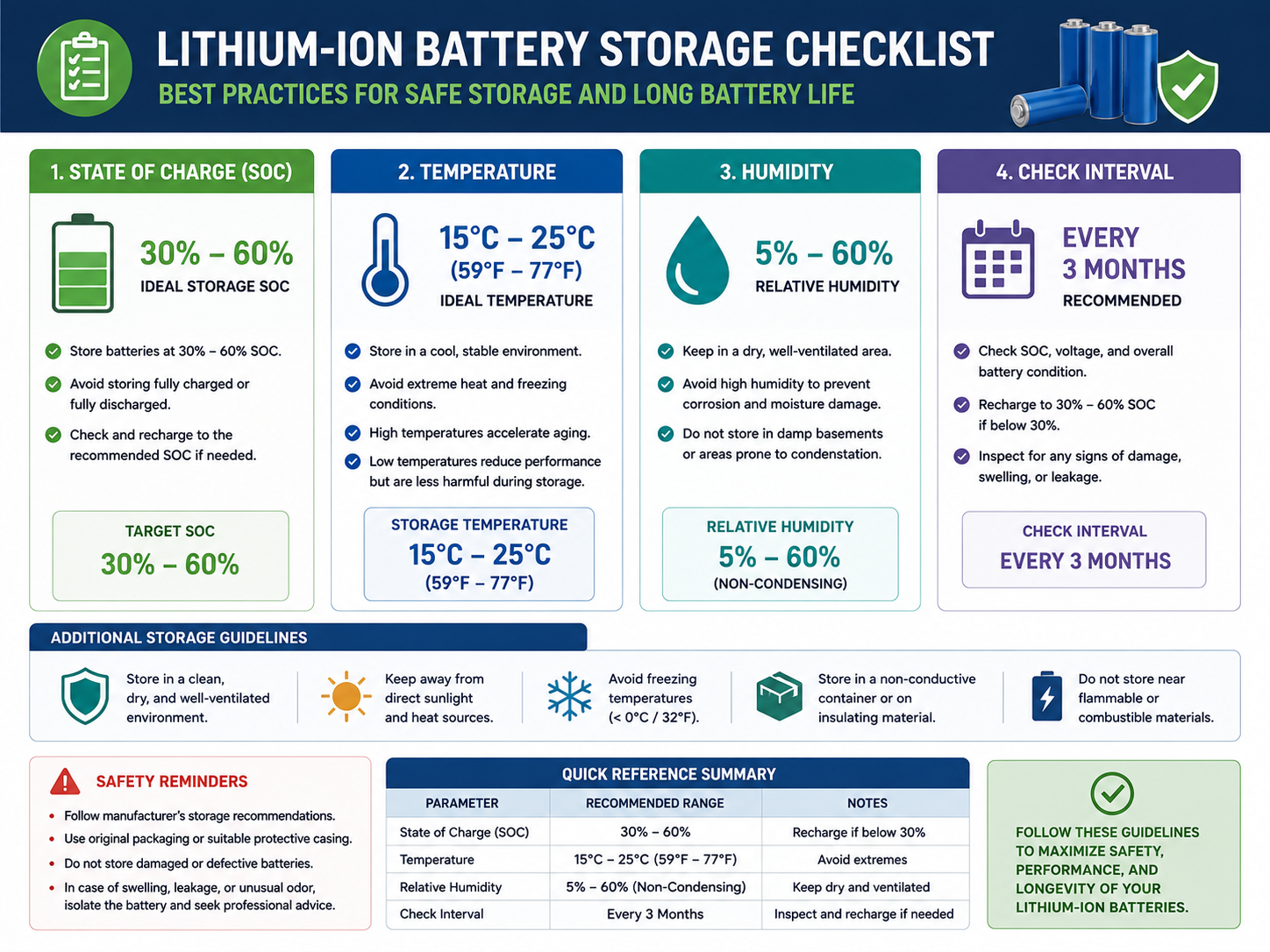
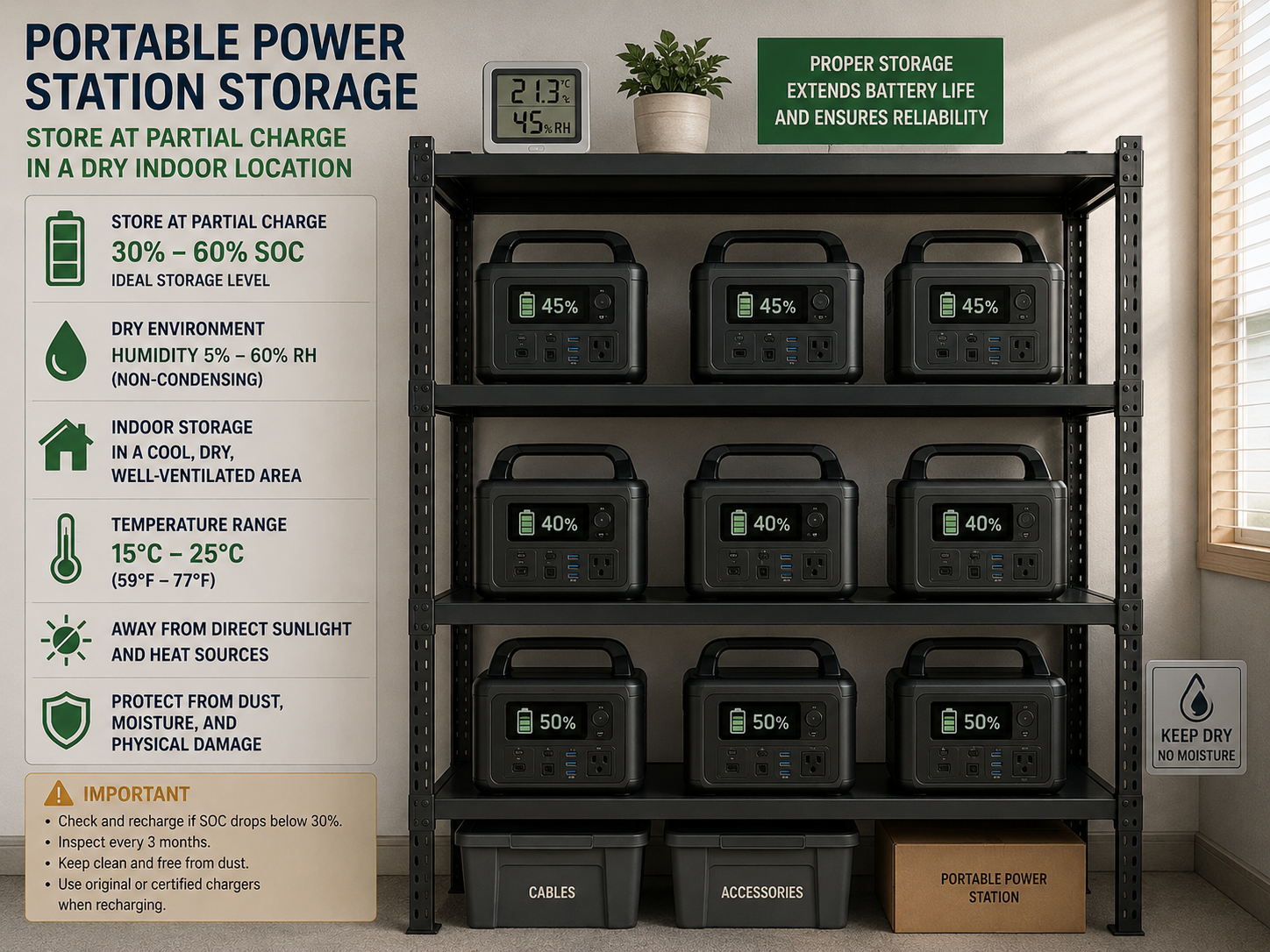
State of charge, or SOC, means how full the battery is. For long-term lithium battery storage, many manufacturers recommend storing batteries at a partial state of charge rather than fully charged or fully depleted. A common general range is around 40%-60% SOC, but the correct value depends on the battery model and manual.
Why partial SOC helps:
Storage SOC |
Potential Issue |
0% or deeply discharged |
Risk of low-voltage protection or recovery difficulty |
Very high SOC for long periods |
More chemical stress in some lithium batteries |
Moderate partial SOC |
Often better for long-term storage stability |
Do not store a lithium battery fully depleted. If the battery self-discharges below the BMS protection threshold, it may require special recovery steps or manufacturer service. For lifespan context, see [How Long Does a Lithium Battery Last?].
__________________________________________________________________
Ideal Storage Temperature and Humidity
Temperature is one of the most important storage factors. High heat accelerates chemical aging. Extreme cold can reduce available capacity and may affect charging after storage. For most lithium batteries, a cool, dry, stable environment is preferred.
General storage guidance:
Factor |
Practical Recommendation |
Temperature |
Store in a cool, stable environment; avoid heat and freezing extremes |
Humidity |
Keep dry; avoid condensation and water exposure |
Sunlight |
Avoid direct sunlight and enclosed hot spaces |
Ventilation |
Use a clean, ventilated area without trapped heat |
Physical protection |
Protect from impact, crushing, and sharp objects |
Some technical references suggest cool storage ranges such as 10-20°C or 15-25°C for many lithium-ion batteries. However, the exact storage temperature range should always come from the battery manual. For field use, the most important rule is simple: avoid long-term storage in hot vehicles, direct sun, damp rooms, or freezing outdoor locations without proper enclosure.
__________________________________________________________________
Where Should You Store Lithium Batteries?
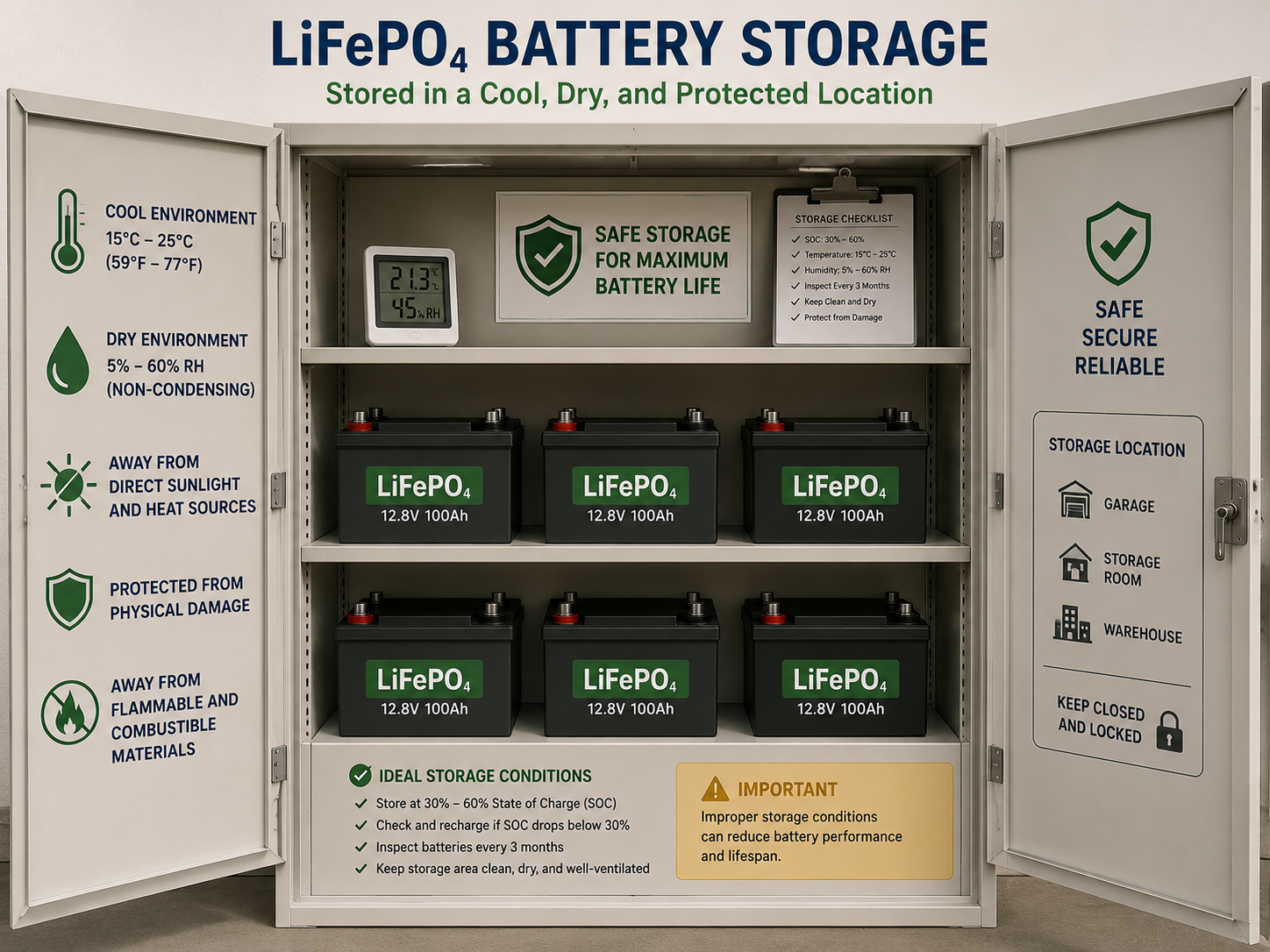
Store lithium batteries in a clean, dry, stable, and protected location. The storage area should reduce exposure to heat, moisture, vibration, physical damage, and unauthorized handling.
Good storage locations may include:
A dry indoor utility room.
A temperature-stable storage cabinet.
A ventilated equipment room.
A manufacturer-approved battery enclosure.
A warehouse area with controlled humidity and inventory rotation.
Avoid storing lithium batteries:
Near heaters, boilers, or direct sunlight.
Inside hot vehicles for long periods.
In damp basements without humidity control.
On metal surfaces where terminals could short.
Near flammable clutter or corrosive materials.
Where children or untrained users can access terminals.
For safety principles, see [Are Lithium Batteries Safe?].
__________________________________________________________________
How to Store LiFePO4 Batteries for Long-Term Storage
LiFePO4 batteries are widely used in solar storage, home backup, RV, marine, telecom, and portable power systems because they offer stable chemistry and strong cycle life. However, LiFePO4 Battery Storage still requires correct SOC, temperature, and inspection habits.Long-term LiFePO4 storage tips:
Charge or discharge to the manufacturer-recommended storage SOC.
Turn off the battery switch if the manual recommends it.
Disconnect unnecessary loads that may cause parasitic drain.
Store in a cool, dry place.
Keep terminals protected from accidental short circuit.
Check voltage or SOC periodically.
Recharge if SOC drops below the recommended storage range.
Inspect for swelling, odor, corrosion, damaged case, or loose terminals.
For chemistry background, see [What Is LiFePO4 Battery?] and [Types of Lithium Batteries Explained].
Long-term storage also affects future cycle performance. A LiFePO4 battery may be rated for thousands of cycles, but storage abuse can reduce the usable capacity available when those cycles begin. For example, a battery stored for months at very low SOC may enter protection mode, while a battery stored in a hot enclosure may lose capacity faster even before it is used heavily. If you are buying batteries for solar, RV, marine, or backup projects, storage quality before installation is part of product quality.
For distributors and installers, warehouse storage should be managed like inventory control, not simply shelf storage. Recommended practices include labeling arrival dates, checking SOC on a schedule, rotating stock, separating damaged units, and recording inspection results. This is especially important for seasonal markets where batteries may sit through hot summers or cold winters before being installed.
For deeper lifecycle context, see [How Many Cycles Can a LiFePO4 Battery Provide?].
[Soft CTA 1] Looking for stable long-term storage performance? Explore LiFePO4 battery products designed for solar storage, home backup, RV, marine, and commercial energy storage applications.
__________________________________________________________________
How Often Should You Check Stored Batteries?
Inspection intervals depend on battery type, storage temperature, BMS power consumption, and whether any loads remain connected. As a practical rule, check stored lithium batteries every few months, and more often if the environment is hot, humid, or mission-critical.
Storage Situation |
Suggested Check Interval |
Portable power station at home |
Every 3-6 months |
RV or marine battery in off-season |
Every 1-3 months |
Solar/home backup battery in standby |
Review monitoring monthly if available |
Distributor warehouse inventory |
Scheduled inventory and SOC checks |
Hot or uncontrolled storage |
Check more frequently |
During inspection, check SOC, battery voltage if accessible, physical condition, terminals, cable tightness, BMS alarms, and signs of moisture or heat exposure.
For B2B storage rooms, distributors, and installers, every inspection should leave a simple record. Note the battery model, serial number, storage date, SOC or voltage, room temperature, visual condition, and the name of the person who checked it. This creates traceability if a battery is later sold, installed, or returned for warranty review. For homeowners, a simple phone reminder every few months is often enough, especially for portable power stations, RV batteries, and seasonal backup batteries.
__________________________________________________________________
Common Mistakes to Avoid During Battery Storage
Many lithium battery storage problems come from simple mistakes.
Mistake |
Why It Is a Problem |
Storing at 0% SOC |
May trigger deep low-voltage protection |
Storing fully charged for too long |
Can increase stress in some lithium chemistries |
Leaving loads connected |
Causes slow parasitic drain |
Storing in high heat |
Accelerates aging |
Storing in damp areas |
Increases corrosion and electrical risk |
Ignoring BMS alarms |
Small problems can become failures |
Mixing old and new batteries in storage |
Creates inventory and performance confusion |
No inspection schedule |
Problems are discovered too late |
To understand how lithium batteries operate and why BMS protection matters, see [How Does a Lithium Battery Work?].
__________________________________________________________________
Signs That a Stored Battery May Be Damaged
A stored battery should be inspected before it is returned to service. Do not use a battery that shows clear physical or electrical warning signs.
Warning signs include:
Swelling or case deformation.
Abnormal odor.
Leakage or residue.
Melted, cracked, or damaged case.
Corroded, loose, or overheated terminals.
Battery will not wake up or charge normally.
BMS error codes or repeated protection trips.
Voltage far outside the expected range.
Unusual heat during charging or discharge.
If any serious warning sign appears, isolate the battery in a safe location and contact the manufacturer or a qualified technician. Do not attempt to bypass the BMS or force charge a damaged battery.
Before returning a stored battery to service, also check the equipment around it. A battery may appear normal, but a damaged charger, corroded connector, loose terminal, blocked ventilation path, or incorrect inverter setting can create new stress as soon as the system restarts. For solar, RV, marine, and home backup systems, a short pre-use inspection is often safer than assuming the battery alone determines system readiness.
__________________________________________________________________
Storage Recommendations for Different Applications
Different applications require different storage habits because battery size, usage frequency, and installation conditions vary.
Solar energy storage systems
Solar energy storage batteries may remain installed even when not cycling heavily. Keep monitoring active if available, review BMS or inverter alerts, and check whether the system maintains an appropriate SOC during seasonal low-use periods. For system planning, see [Best Lithium Battery for Solar Storage].
Home backup batteries
Home backup batteries should be ready for outages. Review backup settings, inspect ventilation, check system alerts, and test critical-load operation according to the manufacturer’s maintenance schedule. See [Home Energy Storage Battery Guide].
Portable power stations
Portable power stations should not be stored empty or left in hot cars, damp garages, or direct sunlight. Store them at partial charge, check SOC every few months, and recharge if needed. See [Portable Power Station].
RV and marine batteries
RV and marine batteries often sit unused during off-season storage. Disconnect parasitic loads, check SOC regularly, protect terminals, avoid freezing or hot enclosed spaces, and ensure chargers are compatible before returning to service.
Application |
Storage Priority |
Best Practice |
Solar storage |
Monitoring and seasonal SOC |
Review inverter/BMS data |
Home backup |
Readiness for outages |
Test backup function periodically |
Portable power |
Heat and SOC control |
Store cool and partially charged |
RV/marine |
Parasitic loads and off-season storage |
Disconnect loads and inspect periodically |
[Soft CTA 2] Need batteries that store safely between uses? Explore home energy storage battery systems and solar energy storage batteries designed for monitored, long-term energy storage applications.
__________________________________________________________________
Frequently Asked Questions
What is the best state of charge for storing lithium batteries?
Many lithium batteries are best stored at a partial state of charge, commonly around 40%-60%, but the correct storage SOC depends on the manufacturer’s instructions and battery design.
Can lithium batteries be stored fully charged?
Short-term full-charge storage may be acceptable for some applications, but long-term storage at very high SOC can increase stress in some lithium batteries. Follow the product manual.
Can lithium batteries be stored in a garage?
Yes, if the garage is dry, temperature-stable, and protected from direct heat, freezing extremes, moisture, and physical damage. Avoid hot or damp garages.
How often should I check a stored lithium battery?
For many users, checking every 3-6 months is reasonable. RV, marine, warehouse, or hot-environment storage may require more frequent checks.
How do I store LiFePO4 batteries in winter?
Store LiFePO4 batteries at the recommended SOC, disconnect unnecessary loads, protect them from moisture, avoid charging below the specified low-temperature limit, and check SOC periodically.
__________________________________________________________________
Conclusion
How to Store Lithium Batteries Properly comes down to four priorities: store at an appropriate state of charge, keep the battery cool and dry, inspect it periodically, and follow the manufacturer’s manual. Lithium batteries are low-maintenance, but storage conditions still affect battery health, safety, and long-term reliability.
For solar energy storage, home backup, portable power stations, RV, marine, and B2B inventory, proper storage reduces the risk of deep discharge, heat damage, corrosion, BMS faults, and unexpected runtime loss. If you want better long-term performance, treat storage as part of lithium battery maintenance, not an afterthought.
[Soft CTA 3] Planning a battery system for seasonal or standby use? Compare LiFePO4 battery products, home energy storage battery systems, solar energy storage batteries, and portable power station battery solutions for your application.
 Hot News
2026-08-20
2026-08-16
2026-08-12
2026-08-03
2026-07-30
2026-07-26

Pittar Power is a professional manufacturer specializing inenergy storage solutions.
Room 302, Building 1, No. 10, Huangjin First Road, Nancheng District, Dongguan City, Guangdong Province, China
Copyright © Shenzhen Pittar Power Co., Ltd. All Rights Reserved Privacy Policy
 EN
EN